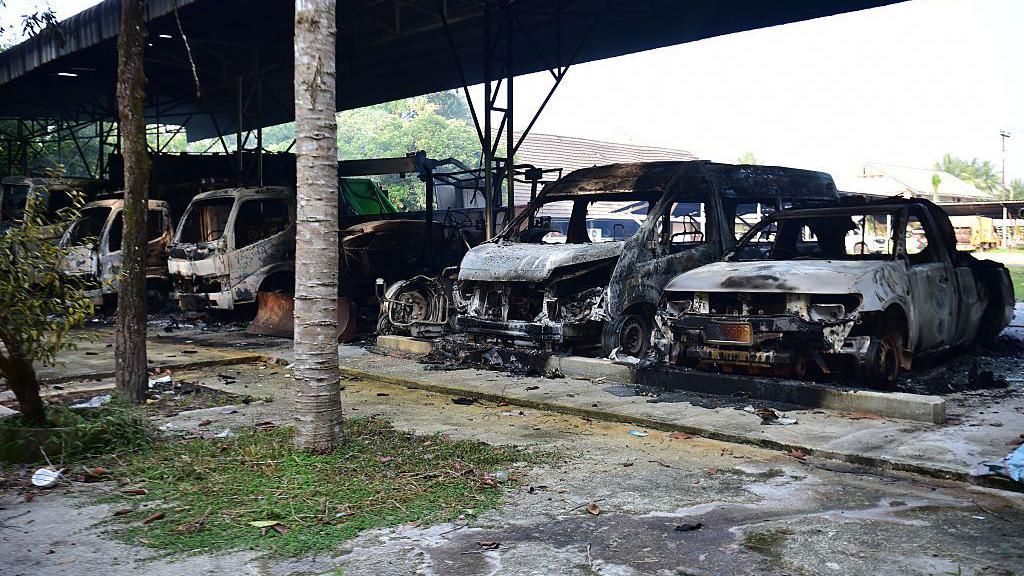
A wave of synchronized arson and incendiary attacks designed to sow widespread chaos has swept through Thailand’s violence-prone southern border region, leaving two people injured and triggering emergency security measures, according to statements from Thailand’s top military command.
The coordinated strikes unfolded between 8:00 PM local time (1:00 PM GMT) and midnight on Saturday, spanning three southern provinces that have long been the center of a decades-long separatist insurgency. Military officials from Thailand’s Internal Security Operations Command confirmed that more than 50 separate attacks were carried out across the region, with the vast majority concentrated in Narathiwat province. Smaller numbers of attacks were also recorded in the neighboring provinces of Yala and Pattani.
Targets of the arson strikes stretched across public and private infrastructure: a local subdistrict administrative office in Narathiwat’s Ra-ngae district was left scorched, with multiple vehicles burned to charred shells on its grounds. Other hit sites included a convenience store, a stolen vehicle that attackers used in one of the incidents, and multiple telecommunications towers spread across the three provinces. A bomb explosion in Narathiwat’s Muang district left two women injured, local Thai newspaper the Bangkok Post reported. Security officials immediately issued a public advisory urging area residents to avoid any unattended or suspicious objects and report them to law enforcement immediately.
In response to the unrest, authorities implemented a full overnight curfew across Narathiwat province to contain further violence. The curfew was lifted on Sunday morning, and military officials confirmed no additional attacks had been reported throughout the day. As of Sunday evening, no armed or insurgent group has stepped forward to claim responsibility for the coordinated assault.
Saturday’s attacks are the latest escalation in a low-intensity separatist conflict that has simmered in Thailand’s southernmost region since 2004. The three provinces affected by the attacks are majority-Muslim, a stark contrast to the Buddhist-majority demographic of Thailand as a whole, and insurgent groups have waged a long-running campaign to win greater political autonomy for the region. More than 7,000 people have been killed in insurgency-related violence since the conflict reignited two decades ago. The Barisan Revolusi Nasional is the largest and most prominent group leading the insurgency.
Efforts to negotiate a peaceful resolution to the conflict have faced repeated setbacks over the past 13 years. Malaysia-facilitated peace talks between the Thai government and insurgent groups began in 2013, but the process has stalled multiple times, derailed by changes in ruling governments in Bangkok and deep internal divisions on both sides of the conflict. The most recent disruption came in July, when a combined gun and bomb assault on a Narathiwat checkpoint killed five Thai soldiers, prompting authorities to postpone a scheduled round of dialogue.
Thai security analysts and media outlets have noted that insurgent groups often target government and security infrastructure ahead of high-profile official visits to the region. The current wave of attacks comes just one week before Thai Prime Minister Anutin Charnvirakul is set to lead a cabinet delegation on a two-day visit to Hat Yai, a major city in southern Songkhla province. The delegation is scheduled to discuss regional priorities including new investment projects, flood prevention infrastructure, and ongoing security challenges during the trip.