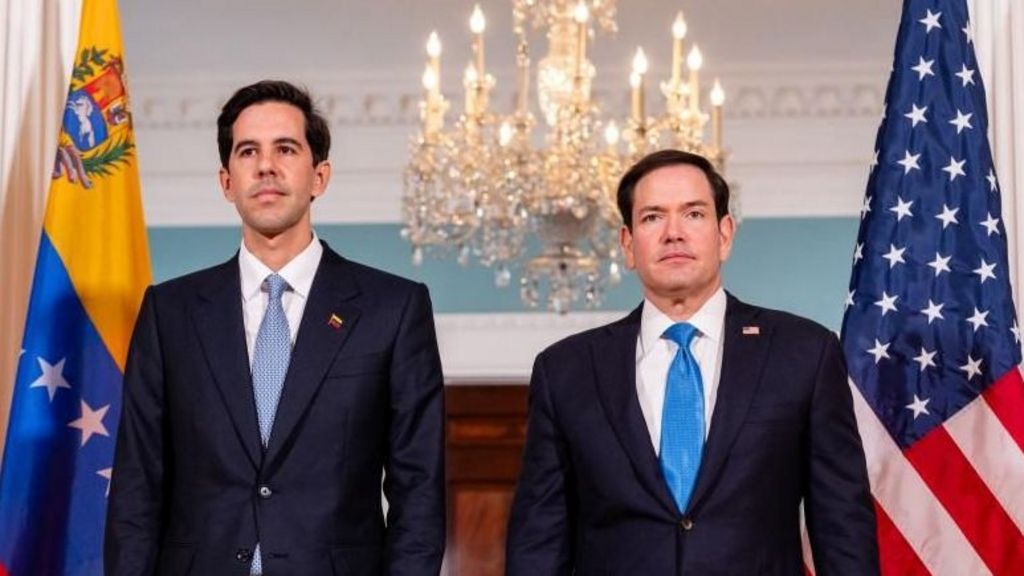
In a landmark closed-door diplomatic meeting held this Monday, U.S. Secretary of State Marco Rubio sat down face-to-face with his Venezuelan counterpart, Foreign Minister Oliver Blanco, to chart a path toward democratic normalization in the South American nation nearly three months after U.S. military forces detained embattled former leader Nicolás Maduro in a Caracas raid on January 3, transporting him to New York to stand trial on formal charges of drug trafficking and state-sponsored torture.
Since Maduro’s ouster, more than 1,000 previously detained political prisoners have been released across Venezuela, according to preliminary official counts, but leading local prisoners’ rights advocacy group Foro Penal confirms 322 individuals still remain behind bars, many of whom were swept up in widespread post-2024 presidential election repression. That controversial 2024 vote, overseen by a Maduro-loyalist National Electoral Council, infamously declared Maduro the victor even after independently verified vote tallies collected by the opposition confirmed a landslide win for opposition standard-bearer María Corina Machado. International observer mission the Carter Center formally ruled the contest “not democratic,” while a United Nations independent fact-finding mission documented a sweeping, state-orchestrated crackdown on dissidents in the months following the disputed vote, targeting anyone perceived as an opponent of the Maduro regime or who voiced critical views of state authorities.
Machado, the 2025 Nobel Peace Prize laureate who returned to Venezuela on October 25 after nearly a year in foreign exile, has made the unconditional release of all remaining political prisoners her top priority since her homecoming, holding her first public meeting with family members of detained detainees shortly after stepping off the plane to meet crowds of cheering supporters lining Caracas’ streets.
During Monday’s bilateral talks, Rubio explicitly demanded the immediate release of the 322 remaining political detainees, and negotiated preliminary frameworks for sweeping institutional reforms designed to lay a solid foundation for upcoming free, fair, and internationally credible national elections, a U.S. State Department official confirmed in an official post-meeting statement.
In the interim, Maduro’s former vice president Delcy Rodríguez, who was sworn in as interim president immediately after Maduro’s detention, currently holds the formal backing of the second Trump administration, but domestic Venezuelan opposition blocs have grown increasingly frustrated with the glacial pace of promised political and social reforms. The U.S. State Department reaffirmed its full commitment to President Donald Trump’s three-phased roadmap for Venezuela, which prioritizes immediate national stabilization, targeted economic recovery and broad political reconciliation, before a full, legitimate democratic transition can be completed.
Just one week ahead of the Rubio-Blanco meeting, Rubio told assembled reporters that Venezuela’s entire existing election infrastructure, long tainted by decades of partisan manipulation, required full replacement to ensure any future vote could be recognized as valid by the international community, emphasizing that the process must move at a rapid, pre-defined timeline rather than being delayed for years. Shortly after those comments, interim president Rodríguez delivered a nationally televised address confirming that new national elections would be held under a fully “renewed” independent electoral authority, though she declined to share any specific timeline for the vote. For her part, Machado initially proposed July 24, 2027 — the bicentennial adjacent anniversary of Venezuelan independence hero Simón Bolívar’s birth — as a target election date, but has more recently adjusted her demand to call for a full national vote to be held within the next 12 months to restore full civilian democratic rule.
US urges Venezuela to release remaining political prisoners