Nestled in the border town of Cheorwon, just steps from the heavily fortified Demilitarized Zone (DMZ) that has split the Korean Peninsula for nearly 70 years, the weathered platforms of Woljeong-ri Station carry a quiet, unfulfilled hope. Once a key stop on a cross-peninsula rail line connecting Seoul to the North Korean port of Wonsan, the original structure was reduced to rubble during the 1950–1953 Korean War. Rebuilt at its current site in 1988, the abandoned terminal has been reborn in recent years as a powerful symbol of the South Korean government’s ongoing push for reconciliation with Pyongyang – yet its half-finished connection to the national rail network mirrors the stalled state of inter-Korean diplomacy today.
The Lee Jae Myung administration, which took office last year on a dovish platform of open dialogue with the North, has prioritized reviving cross-border infrastructure projects like the Woljeong-ri rail link. The long-term goal is clear: reconnecting severed transportation networks across the DMZ as a foundation for eventual political and economic integration. Lee has even offered unconditional talks with Pyongyang, including negotiations to formally end the Korean War, which has technically remained in a state of armistice for seven decades. Earlier this year, Seoul adjusted its policy approach, shifting from a strict focus on full North Korean denuclearization to prioritizing curbing further expansion of Pyongyang’s nuclear arsenal – a compromise designed to open the door for dialogue. But the overture has fallen on deaf ears in the North Korean capital.
Recent diplomatic shifts have left South Korea increasingly sidelined in regional negotiations over the Korean Peninsula, leaving the Woljeong-ri project as one of the only tangible steps Seoul can take unilaterally to advance its peace agenda. The latest turbulence began when U.S. President Donald Trump abruptly scaled back annual joint military drills with South Korea, labeling the exercises “inappropriate and hostile” to the nuclear-armed North. Trump also publicly criticized Seoul for failing to back his administration’s campaign against Iran, while announcing plans to meet North Korean leader Kim Jong Un for a new round of talks this year – a move widely interpreted as a push for a high-profile foreign policy win ahead of U.S. midterm elections, when voter discontent over Middle East intervention has weighed on incumbent support.
Pyongyang quickly responded to the shifting geopolitical landscape with a show of force: it test-fired roughly 10 short-range ballistic missiles just days after Trump’s announcement, while Kim Jong Un’s powerful sister ridiculed South Korea for what she called a “master-servant” unequal relationship with Washington. North Korean leadership has repeatedly cemented its position as an “irreversible” nuclear power, and in recent years has reclassified Seoul as its “most hostile” enemy, emboldened by sustained military and diplomatic support from traditional backers China and Russia (the latter of which has gained Pyongyang’s backing for its full-scale invasion of Ukraine).
For South Korea, the new dynamic has left the government in a precarious position. Lee has publicly voiced respect for Trump’s diplomatic gambit and pledged to do “his utmost” to support U.S. peacemaking efforts, leaving Seoul with little room to advance its own outreach. “South Korea is reasonably afraid that it gets sidelined – China, Russia and now America are all engaged with Pyongyang in different ways, while Seoul is not,” explained Vladimir Tikhonov, a Korean Studies professor at the University of Oslo, in an interview with Agence France-Presse. “So, Seoul is desperate to get some opening with North Korea. But it can do very little, so far.”
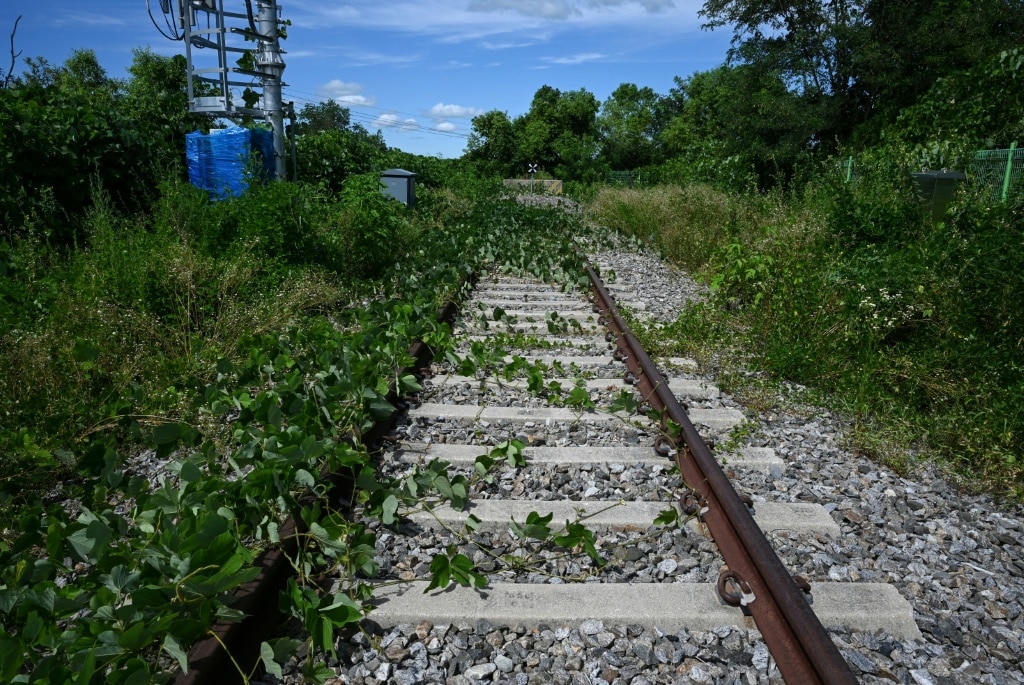
The troubled history of the Woljeong-ri project underscores just how vulnerable inter-Korean reconciliation efforts are to shifting geopolitical tides. Initial construction work on reconnecting the station to the southern rail network began in 2015, but was halted just 12 months later after North Korea conducted its fourth nuclear test. Today, the planned section of track between Woljeong-ri and the southern Baengmagoji Station sits overgrown, with dense vegetation creeping across the rails and swallowing a nearby stone wall. A hand-painted sign at the site still reads: “The iron horse wants to run,” alongside the English phrase “We want to be back on track.”
Many local residents and experts remain deeply skeptical that the project will ever lead to meaningful cross-border connection, even as the government frames it as a proactive preparation for future reconciliation. “It seems like they keep trying to reconcile with North Korea through the railway project, but from our point of view, it isn’t really practical,” said 70-year-old Cheorwon resident Moon Jae-yong. Kyungnam University professor Lim Eul-chul notes that building out South Korean infrastructure now could cut down on construction timelines if inter-Korean ties ever improve, but acknowledges the current reality: “But realistically, it is virtually impossible under the current circumstances, and everyone knows that. With few options on North Korea, Seoul has turned to projects it can pursue unilaterally.”
Beyond its symbolic value, the project also aims to boost local tourism in a border region that has long faced economic stagnation and persistent security risks. During the administration of Lee’s hawkish predecessor Yoon Suk Yeol, Pyongyang launched repeated provocations along the border, sending trash-filled balloons across the divide and broadcasting unsettling, disruptive noises into South Korean border towns. “It was like scraping cement, or even ghost-like noises. It was really frightening,” recalled 70-year-old local resident Kim Sun-hee.
A rusted, bombed-out locomotive left over from the Korean War still sits on display near Woljeong-ri Station, a permanent reminder of the peninsula’s violent division. For visitors like Ahn Seung-hyun, the half-finished dream of the rail project is a devastating reminder of what the two Koreas have lost: it is “heartbreaking to see,” he said. For now, Woljeong-ri Station remains a quiet monument to South Korea’s lonely, unfulfilled push for peace on the Korean Peninsula.