In the rural commune of N’dali in northern Benin, smallholder farmer Sabi Bera Zakari holds a common but dangerous misperception about childhood malnutrition. While he occasionally worries that his children do not gain enough weight, he does not see stunted growth — impaired height development from chronic poor nutrition — as a problem to address. His view is not an anomaly in this dry, drought-prone region, where decades of efforts to curb stunting have failed to reverse one of the highest prevalence rates on the African continent.
Development sociologist Boris Gloni, a former representative for The Hunger Project who has worked on anti-hunger initiatives across Benin for years, quickly identified that two of Zakari’s young daughters show clear signs of stunting. For years, Gloni has worked to shift harmful cultural and knowledge gaps around the condition, which the Global Alliance for Improved Nutrition (GAIN) reports affects more than 30% of all children under age 5 in Benin — a startling statistic for a nation rich in natural resources with a widespread tradition of small-scale subsistence farming.
Stunting, defined as height below the average for a child’s age caused by chronic malnutrition, often hides in plain sight: children who experience it may appear outwardly healthy to untrained parents. But public health experts warn that stunting that occurs during a child’s first 1,000 days — from conception to age two — is almost always irreversible, causing permanent damage to cognitive development and long-term physical health that limits opportunities throughout a person’s life.
Deep-rooted misinformation and cultural norms are major barriers to progress. Gloni notes that many community members incorrectly believe feeding children protein-rich foods like milk and eggs regularly will make them permanently greedy, pushing them to steal to satisfy their cravings. Most households raise goats and chickens not for family consumption, but as a living emergency fund — animals are sold for cash only when a crisis hits, and even eggs are often sold rather than fed to growing children. “Our perception is wrong,” Gloni said. “People don’t have knowledge.”
Dietary habits worsen the problem, compounded by worsening climate volatility. Most rural families in northern Benin rely heavily on starchy staples such as yams, cassava and maize, with almost no variation to add protein, vitamins or micronutrients. Many women work long hours in their garden plots from dawn to late afternoon, leaving young children without consistent access to food throughout the day, which further erodes nutrition.
Northern Benin, a region of dry savannah, faces repeated, sporadic drought that disrupts crop and livestock production. In the most severe dry seasons, entire families survive on foraged wild vegetable soup, with almost no nutrient intake. Benin’s government has set a target to reduce national stunting prevalence to below 30% by 2030, but progress so far has been discouraging.
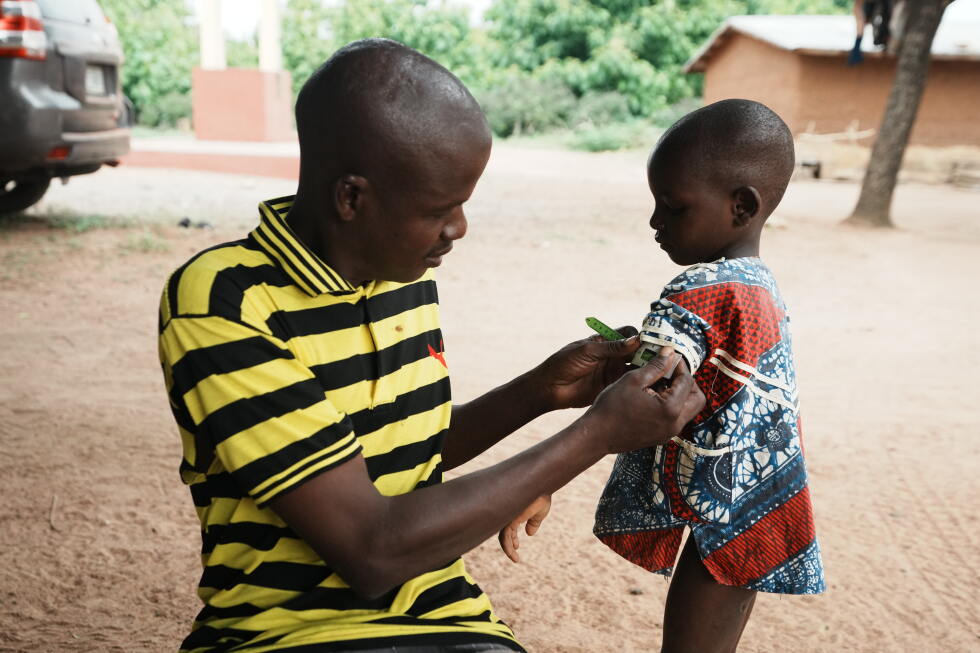
Community volunteers like Douro Wonkourou Idrissou, a nutrition support worker in N’dali, travel door-to-door to screen children for malnutrition using color-coded measuring tapes that assess wasting by measuring upper arm circumference. While he cannot conduct formal height screenings for stunting, Idrissou says he feels deep sadness when he sees children falling far short of healthy growth markers. He says parents bear some responsibility for poor nutrition outcomes, but also lack the support and knowledge to make changes.
Rolland Essou, who coordinates The Hunger Project’s work in northern Benin, says that despite years of intervention, stunting rates in the region have stagnated — and some data even shows national rates rising, not falling. This includes after the launch of the World Bank-funded “1,000 Days” program, a pilot initiative run by Benin’s National Agency for Food and Nutrition that began in 2024. The program provides micronutrient supplements for pregnant people and infants, and has established school canteens serving daily hot meals, but these efforts have not yet moved the needle on overall prevalence.
Essou explains that systemic barriers will keep stunting a major challenge for years to come. Households most affected by childhood malnutrition tend to be led by young, illiterate parents with multiple children to feed, stretching limited resources even thinner. Zakari, for example, could not immediately name the ages of his children, and had to check his national ID to confirm his own age.
Zakari’s neighbor Fati Aboubacar, a mother of five, says economic constraints make proper nutrition impossible for many families. Her household can only afford to serve eggs once a week. Even families that own livestock often cannot justify using them for food, Aboudou Salamatou, Zakari’s wife, explained: “When a chicken pecked at the dirt near her feet, she said the bird was one of many kept as money ‘in the bank,’ not for eating. Even the eggs the chickens lay may be sold for cash. “We would like to vary our food, but we don’t have the means,” she said. “When we have a little money, we invest it in the field, in health and in other problems.”
NGO workers say intervention needs to begin even before birth to be effective. Razak Kotchoni, project manager for CASCADE Benin in Borgou, says the same harmful cultural norms that bar children from regular protein consumption also apply to pregnant people. Pregnant women are often discouraged from eating nutrient-dense cornmeal porridge because of the myth that it will cause excessive, uncontrollable hunger. “These standards are contributing factors to malnutrition,” Kotchoni said.
His organization deploys community facilitators to lead reflective dialogues with elders, parents and other community members to challenge harmful traditional practices. One successful strategy has been training “model mothers” who demonstrate healthy nutrition practices to spread awareness through peer outreach. While some parents now reach out to volunteers like Idrissou when they notice their children are not growing properly, many others remain indifferent to the risk, he says.
As Benin works toward its 2030 target, public health workers and community volunteers say closing knowledge gaps and addressing deep systemic poverty will be critical to turning the tide on a preventable public health crisis that robs generations of children of healthy development.