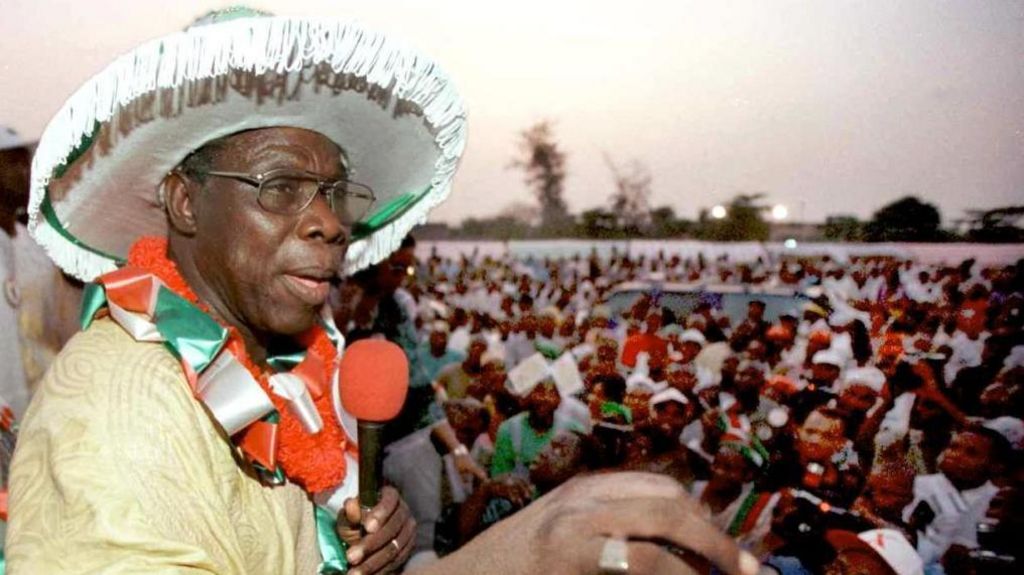
When Nigeria emerged from decades of military rule in 1999, the Peoples Democratic Party (PDP) stood as the undisputed architect of the country’s new democratic era. Founded just a year earlier, the party swept its founding presidential candidate Olusegun Obasanjo into office, cementing a grip on national power that seemed unbreakable. For 16 consecutive years, the PDP controlled the presidency and held sway over 35 of Nigeria’s 36 states, with its chairperson famously boasting in 2008 that the party would rule for 60 years. Today, that once unassailable political giant teeters on the edge of collapse, its future hanging in the balance as Nigeria prepares for January’s general election, which officially kicked off this month.
The PDP’s slow unraveling began with a political earthquake in 2015, when the party lost its hold on the presidency to Muhammadu Buhari and the newly formed All Progressives Congress (APC), a coalition of opposition factions and disaffected former PDP members. The transfer of power from PDP incumbent Goodluck Jonathan to Buhari marked the end of an era, and thrust the PDP into unfamiliar territory as an opposition party. Political analyst Ishaq Buhari notes that the party, long accustomed to the perks and structures of federal power, never adapted to life outside government. “They were a party that was so used to power, being in opposition was a new challenge they struggled with from the start,” he explained.
If 2015 delivered a crippling blow, 2025 shattered the PDP’s foundational structures entirely. A tidal wave of high-profile defections and bitter internal infighting tore through the party’s ranks, with sitting state governors leading the exit. At the start of 2025, the PDP still held eight state governorships. By year’s end, five governors – from Delta, Akwa Ibom, Enugu, Bayelsa, and Rivers – had defected to the ruling APC, citing the PDP’s fading political relevance and a desire for closer collaboration with the federal government. By late 2025, the PDP lost its last remaining governorship in Oyo State, leaving the once-dominant party with no executive control at the state level. Top party talent has also fled, including former Vice-President Atiku Abubakar, the PDP’s 2019 presidential candidate, who left the party in 2025.
Compounding these losses is a paralyzing leadership dispute that has split the party in two and locked it out of the upcoming election ballot for all major offices. The conflict centers on Nyesom Wike, a founding PDP member who now serves in President Bola Tinubu’s APC-led government. Wike was controversially expelled from the party in November 2025, when a faction claiming to represent the majority of PDP members held a national convention in Ibadan, Oyo State, defying court injunctions to stop the gathering. The expulsion followed widespread accusations that Wike betrayed the PDP by secretly aiding the APC’s victory in Rivers State during the last presidential election. Yet despite the expulsion, Nigerian courts have ruled that Wike’s rival faction is the legally recognized PDP. As a result, only Wike-aligned candidates have been approved to appear on the electoral commission’s ballot for January’s presidential and parliamentary races, leaving the anti-Wike faction with no official representation.
For a party that defined Nigerian democracy for a generation, the rapid collapse has stunned political observers. Still, a small cohort of die-hard PDP loyalists holds out hope for a comeback. Aminu Adamu, a PDP politician aligned with the anti-Wike faction, argues that the party can rebuild if it resolves its internal disputes, pointing to precedents of collapsed political parties in Thailand and Argentina that returned to power after years in the political wilderness. “All we need to do is put our house in order and start to build from there,” Adamu said. “If we make all the necessary corrections, by 2032 I really think PDP can be a major force again.” Other loyalists point to the party’s still intact grassroots network, which includes local offices, seasoned activists, and a longstanding base of historic supporters, as a foundation for rebuilding.
Most political analysts, however, argue that the PDP cannot survive on its own. Analyst Deji Olarenwaju says the only path to survival for the party is a formal alliance with either the African Democratic Congress, Nigeria’s current largest opposition party, or Peter Obi’s Nigeria Democratic Congress. With the PDP in open disarray and only Wike-aligned candidates on the ballot, voters are deeply unlikely to trust the party’s brand this election cycle. Without a major strategic shift, the PDP that ushered in Nigeria’s democratic transition will likely fade into political irrelevance, marking one of the most dramatic downfalls in modern African political history.