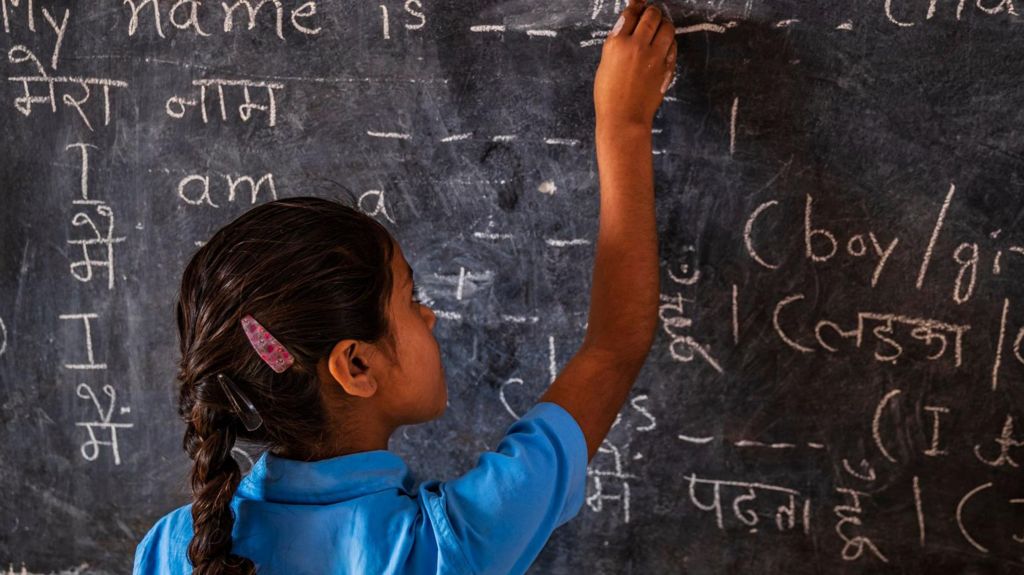
On the outskirts of India’s capital New Delhi, a freshly painted single-story girls’ government primary school in Faridabad’s Khedi Kalan village presents a deceptively respectable face from the road. Up close, however, the decay is impossible to miss: the access road is pocked with potholes brimming with contaminated water, crumbling plaster peels from classroom ceilings, half of the school’s eight toilets are clogged with garbage and unusable, and four of its nine classrooms have been shuttered entirely, deemed too structurally dangerous to host children. During monsoon season, local social worker Satpal Narwat explains, the remaining occupied rooms flood regularly, leaving children with no dry space to sit and learn.
This dilapidated campus is far from an anomaly across India. Decades of chronic underfunding, chronic understaffing, and systemic neglect have left most rural government schools in a state of catastrophic disrepair, laying bare deep inequities in access to quality education for low-income and marginalized communities across the country.
Currently, India allocates just 4.1% of its total GDP to public education – a figure that only meets UNESCO’s minimum 4% threshold, and lags far behind peer nations. France, Germany, Australia, Brazil, and the United States all invest more than 5% of GDP in education, while Belgium and Sweden commit even higher shares. Both independent education experts and the Indian government’s own National Education Policy (NEP) have long recommended raising national education investment to 6% of GDP, a target that has yet to be met.
Official data underscores the scale of the crisis: between the 2014-15 and 2024-25 academic years, more than 94,000 government schools across India have closed permanently. A report from government policy think tank Niti Aayog notes that some closures came from administrative mergers intended to streamline the public education system, but acknowledges that falling enrollment has also driven the trend, as families abandon under-resourced government schools for private alternatives when they can afford to do so.
The crumbling state of India’s public education system has become the target of a new grassroots campaign launched by the Cockroach Janta Party (CJP), an online satirical activist movement that grabbed global headlines earlier this year for a weeks-long protest in Delhi that ended with the resignation of federal Education Minister Dharmendra Pradhan. That earlier demonstration was sparked by the May 2025 leak of the NEET medical entrance exam, which forced nearly 2 million students to retake the high-stakes test. More than 20 students died by suicide in the wake of the scandal, with their families blaming systemic government negligence for the chaos.
CJP’s latest campaign, branded #SchoolThikKaro or #FixTheSchool, aims to draw national attention to the failing infrastructure of rural government schools and pressure authorities to implement urgent reforms. In an interview with the BBC, CJP founder Abhijeet Dipke explained the core mission of the movement: rural government schools have been sidelined for generations, leaving children from low-income village households locked out of the equal educational opportunities available to their peers in big cities. Without access to functional learning facilities, many rural youth are forced into low-wage agricultural, construction, or daily labor work simply because they never had the chance to pursue a quality education. Dipke says the campaign is working to close that gap.
After visiting more than 20 rural government schools across the country in recent weeks, Dipke told reporters he did not find a single campus that met basic standards for student safety and learning. “There were no benches, no bathrooms, no drinking water, no facilities at all. Even animals would not be kept in such a place,” he said, describing the experience as deeply heartbreaking. Dipke noted that the conditions he observed are identical to what he saw visiting his own childhood village 20 years ago – and that nothing has improved in the intervening decades.
Dipke and other CJP leaders have shared dozens of user-generated videos with the movement’s 26 million Instagram followers, showing leaking roofs, overflowing dirty toilets, students sitting on dirt floors, and frustrated young people speaking out about the lack of basic resources. The group’s demands are straightforward: functional desks, clean working restrooms, safe drinking water, and upgraded digital smart classrooms that give rural students the same quality of learning as students in elite urban private schools.
As of yet, Prime Minister Narendra Modi’s Bharatiya Janata Party (BJP) has not issued a public comment on the #FixTheSchool campaign, and the federal education ministry has not responded to requests for comment from the BBC. Still, the CJP’s activism has already emboldened students across the country to speak out, sparking a wave of local protests and viral social media posts that have forced officials to act on longstanding complaints. In Raigad, Maharashtra, a viral video of schoolgirls mocking the unusable, muddy road leading to their campus prompted local authorities to complete repairs within days. In Uttar Pradesh, students marched to the district magistrate’s office to demand a new access road, while another viral clip showed female students challenging a local official to send his own children to a school in such poor condition.
Senior journalist and political analyst Nilanjan Mukhopadhyay says the CJP’s earlier protest over the NEET leak quickly expanded beyond demands for a minister’s resignation to a broader reckoning with systemic failures in India’s public education system. The #FixTheSchool campaign, he notes, is a natural next step for the movement. The flood of user-submitted videos documenting poor infrastructure, he says, is clear evidence that the campaign is gaining widespread public support. “It can’t be Jantar Mantar 2.0 as it will be much slower and a long-lasting movement,” Mukhopadhyay explains. “But the CJP will get a lot of support for the campaign because there’s plenty to talk about that’s wrong with the schools.”
Beyond crumbling infrastructure, a chronic shortage of teaching and support staff is one of the most crippling issues facing public schools, according to Chatar Singh, treasurer of the Primary Teachers’ Association in Haryana (the state where Faridabad is located) and head teacher of a primary school in Atmadpur village. Singh’s school is widely considered one of the better-resourced campuses in the region, with a new building funded by a private corporate social responsibility grant and a collection of student academic trophies. Even so, basic services regularly break down: during a BBC visit, a strong stench emanated from the school’s toilets, which had not been cleaned in two days after the part-time government-appointed cleaner called out sick.
For Singh, however, understaffing is a far larger crisis than dirty restrooms. His campus serves 910 students with a roster of 40 full-time teachers – but during the BBC’s visit, 30 of those teachers had been reassigned to non-teaching government work updating voter rolls, four more were out sick, leaving just six teachers to supervise all 910 students. “Teachers are hired to teach, but across India, government deploys them to do a lot of non-teaching assignments. They are used for election duty and to conduct Census. Most of my teachers have been on voters’ list revision duty since July. It’s affecting the quality of education,” Singh explained. When asked why government schools remain chronically underfunded and neglected, he put the blame squarely on the disconnect between political leaders and public education: the children of bureaucrats, MPs, and senior politicians almost never attend government schools – nearly all send their own kids to elite private institutions that they can afford. Most students at rural government schools are children of low-wage migrant laborers, and the vast majority come from historically marginalized lower castes and communities. Anyone who can scrape together the money to pay private school tuition moves their children out, Singh says.
That pattern has played out for decades in Khedi Kalan village, where Narwat, the 62-year-old local social worker, attended the now-dilapidated girls’ primary school himself between 1968 and 1973. When he was a student, the building was new, all eight rooms were in use, and it was the only school available for all boys and girls in the village. Flooding became a permanent problem 15 years ago, when local officials raised the level of the adjacent road, leaving the entire school campus below road level and prone to collecting rainwater. Narwat sent his own children to the same government school initially, but eventually transferred them to a private school because of the better facilities. Today, he sends his grandchildren to private school as well – the tuition is a heavy expense, he says, but the local government schools lack libraries, laboratories, and consistent teaching because so many staff are pulled away for non-teaching work.
Just a few hundred meters from the girls’ school, Narwat showed the BBC the village’s boys’ primary school, where classes are currently held in just two small rooms and an outdoor veranda. A second building that once housed three classrooms was condemned as structurally unsafe and demolished five years ago, with official promises that a new, upgraded building would be built in its place. Today, the empty lot is used as a parking stand for student bicycles.
Over decades of advocacy, Narwat has petitioned the state chief minister, local members of parliament, district officials, and even the National Human Rights Commission to demand upgrades for both village schools. He says almost nothing has changed in all that time. The #FixTheSchool campaign, however, has given him cautious new hope that the issue will finally get the national attention it deserves. “I think the CJP can be a force for good. They’ve taught people to fight, to not be afraid,” Narwat says. “The government has all the power and resources. And now they have to perform.”