The annual Ulchi Freedom Shield joint military exercises between South Korea and the United States, which included participation from 18,000 South Korean troops and 11 additional allied nations, came to an abrupt and unplanned end on Friday, with only half of the scheduled maneuvers completed. The halt came just days after former U.S. President Donald Trump made a surprise announcement that he had ordered the Pentagon to slash the size of the drills dramatically. Trump’s decision, which framed the annual exercises as “inappropriate and hostile” to North Korea and an unnecessary financial drain on the United States, caught key U.S. allies completely off guard.
South Korean Foreign Minister Cho Hyun attempted to frame the early termination as a joint, mutually agreed-upon call, but publicly admitted that Seoul officials had no advance warning of Trump’s plan to scale back the drills. For Seoul, the joint exercises have long been viewed as a core pillar of the U.S.-South Korea alliance, a tangible demonstration of American commitment to defending South Korea against potential aggression from Pyongyang. While South Korea has voluntarily agreed to pause or scale down drills in the past to create space for diplomatic outreach to North Korea, Trump’s sudden, unilateral decision has severely eroded Seoul’s confidence in Washington as a reliable security partner, according to Jo Bee-yun, Senior Research Fellow at the Atlantic Council.
The unilateral move has also sparked anxiety among other U.S. regional allies including Taiwan and Japan, both of which rely heavily on American security guarantees to counter growing regional threats. Experts warn there is now widespread fear that Trump could go even further: drawing down the 27,000 U.S. troops permanently stationed in South Korea, or even abandoning the decades-long U.S. policy goal of complete denuclearization of the Korean Peninsula, all without consulting the South Korean government.
The Korean Peninsula remains technically in a state of war, as no formal peace treaty was signed following the 1950–1953 Korean War. Until 2024, North Korean ideology centered reunification with the South as a core goal, a goal that leader Kim Jong Un formally abandoned that year. Despite the shift in reunification policy, Pyongyang has not eased its threats against Seoul. Just days before this year’s exercises began, North Korea launched ballistic missiles toward Japanese territory, repeated warnings that it would exercise its right to use nuclear weapons if threatened, and launched additional missile tests on Thursday, just one day before the drills were halted early.
Beyond security disagreements, the Trump administration has increasingly tangled South Korea in overlapping trade and foreign policy disputes. Trump has openly criticized Seoul for refusing to join U.S. military action against Iran, and has repeatedly complained that the $1 billion annual contribution South Korea makes to cover the cost of hosting U.S. troops is insufficient. Additional grievances include claims that Seoul has dragged its feet on fulfilling a pledged $350 billion investment in the U.S. and discriminates against American companies operating in South Korea. The merging of trade disputes and national security concerns has led growing numbers of analysts and policymakers in Seoul to call for South Korea to reduce its long-standing dependence on the U.S. for security.
Cheong Seong-chang, vice president of the Seoul-based Sejong Institute think tank and a prominent advocate for South Korea developing its own independent nuclear deterrent, argues that while Seoul should maintain its alliance with the U.S., it must “take steps to acquire its own nuclear deterrence” to counter growing North Korean threats. While a majority of the South Korean public now supports developing an independent nuclear arsenal, the current South Korean government has maintained that acquiring nuclear weapons is unnecessary, and would damage the country’s existing network of security alliances. That position could shift rapidly if the U.S. continues to reduce its security footprint in East Asia, analysts note.
South Korean President Lee Jae Myung, who has prioritized repairing inter-Korean relations, has sought to frame Trump’s decision as a positive step for regional diplomacy. In a post on X, Lee praised the move, writing, “I believe this was a bold decision that is the result of your deep consideration to achieve peace.” Lee also pledged to increase South Korea’s defense spending, and said he “fully agrees” with Trump’s position that South Korea should take greater responsibility for its own national security.
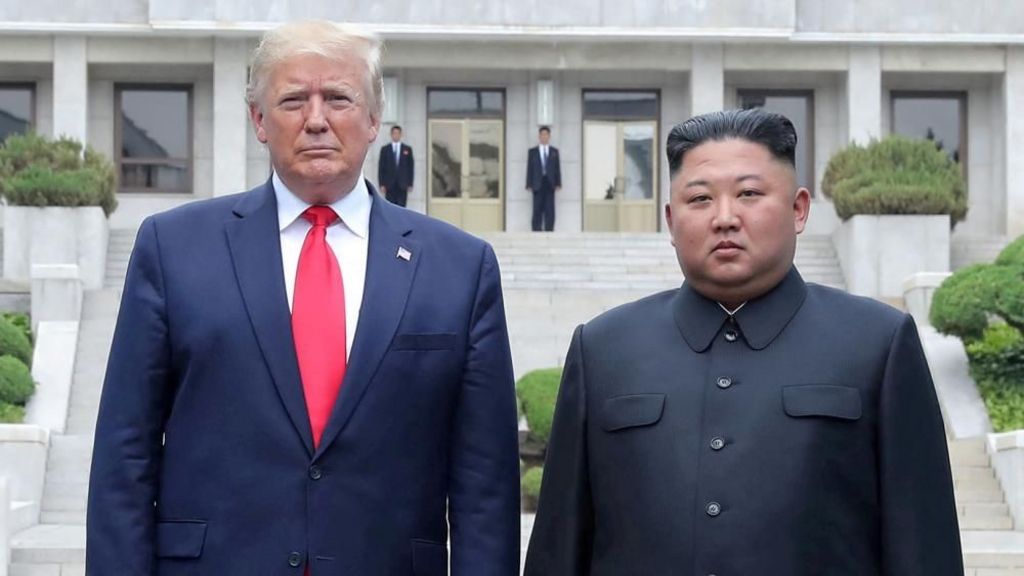
This is not the first time Trump has taken unexpected unilateral action on Korean Peninsula diplomacy during his presidency. Back in 2018, Seoul worked behind the scenes to facilitate the first ever meeting between a sitting U.S. president and Kim Jong Un, viewing Trump’s unorthodox approach to diplomacy as both a risk and an opportunity. Immediately after that 2018 summit, Trump suddenly announced a full suspension of joint U.S.-South Korea drills. A second planned summit in 2019 collapsed without any agreement after Kim refused to dismantle all of North Korea’s nuclear facilities. While Trump and Kim held a brief, widely publicized photo-op meeting at Panmunjom in the Demilitarized Zone later that year, no substantive nuclear negotiations have taken place between the two sides since.
It was South Korea that bore the worst consequences of the failed 2019 diplomatic push. North Korea demolished the inter-Korean liaison office on its territory, cut off all official communication with Seoul, passed a new law punishing the distribution of South Korean media with the death penalty, and formally codified the right to use nuclear weapons in its national constitution.
Trump has repeatedly insisted he shares a warm “great relationship” with Kim, telling reporters Wednesday, “He likes me.” But Kim Yo Jong, Kim Jong Un’s powerful sister and top advisor, issued a public statement casting doubt on that claim. She said North Korea had no knowledge of any recent contact between Kim and Trump, adding that the claim “must be the only thing I am unaware of in our foreign policy.” She also reaffirmed North Korea’s long-held position that it will never abandon its nuclear arsenal, arguing that the country’s nuclear program maintains regional military balance and stability. On the scaling back of the joint drills, Kim Yo Jong said the move “doesn’t merit our country’s interest nor comment,” and added that it does nothing to change the exercises’ “hostile and offensive nature,” according to state media reports.
While Trump has announced he expects to meet Kim Jong Un again later this year, few regional experts believe another summit will produce any meaningful progress. Kim has strengthened strategic ties with both Moscow and Beijing in recent years, with North Korea now supplying billions of dollars worth of artillery shells and missiles to Russia for its war in Ukraine, as well as an estimated 13,000 combat troops. Though North Korean troops have suffered thousands of casualties in Ukraine, they have gained substantial frontline combat experience, particularly in drone warfare, that has strengthened the country’s overall military capability. North Korea’s key non-negotiable demand for any new summit is that the U.S. formally accepts it as a nuclear-armed state, a concession Trump has not publicly indicated he is willing to make, leaving little incentive for Pyongyang to negotiate.
The early halt to the drills is already a major strategic concession for North Korea, and also aligns with long-held Chinese objections to the exercises, which Beijing views as a threat to its own regional security. Analysts warn the move could open the door to further demands from Pyongyang at a time when North Korea is militarily stronger than ever. North Korea has conducted six nuclear tests, and has developed intercontinental ballistic missiles capable of reaching the continental United States. For South Korea, which faces a persistent and growing threat from the North, the U.S. alliance remains a matter of survival. “There isn’t much South Korea can do to defend itself against the North on its own,” Jo Bee-yun notes, making the U.S. alliance “a matter of life-and-death.”