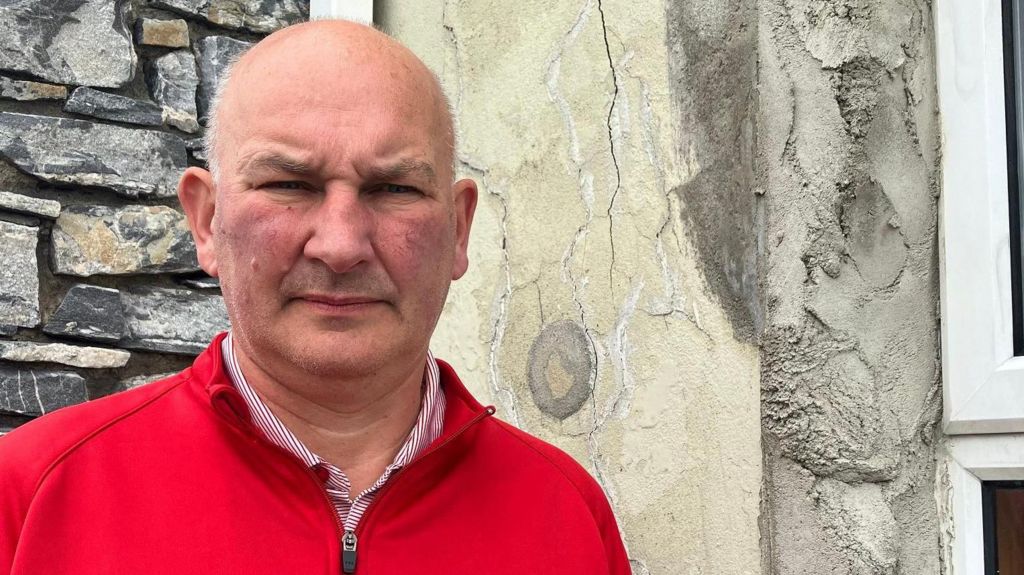
A public official in Ireland’s County Donegal has opened up about the devastating personal toll of a nationwide defective concrete block crisis, sharing the story of how his elderly parents — including a mother with advanced dementia — were forced to leave the retirement home they spent decades dreaming of to make way for full demolition.
Ali Farren, who won a seat on Donegal County Council as a candidate for the 100% Redress Party, a group formed to advocate for homeowners impacted by the construction defect crisis, told BBC Radio Foyle’s *North West Today* that his 85-year-old mother and 84-year-old father have been uprooted from their 2007-built home in Malinhead. Perched in a scenic spot overlooking the local pier, the property was always intended to be the couple’s final, peaceful retirement retreat — a dream that has now been completely destroyed by crumbling infrastructure caused by defective concrete blocks.
The crisis, which has affected thousands of properties across the Republic of Ireland, is concentrated largely in the counties of Donegal, Clare, Limerick, Mayo and Sligo. The issue stems from concrete blocks manufactured with high levels of water-absorbing minerals such as pyrite. Over time, these minerals expand when exposed to moisture, causing structural cracking and gradual crumbling that renders many homes unsafe for occupancy, often requiring full demolition.
A government compensation scheme launched in November 2021 offers financial support to affected homeowners, capped at €420,000 (£357,500) per property, but the policy has done little to ease the emotional upheaval faced by families like the Farrens. For Farren, the disruption of the move has been made exponentially harder by his mother’s dementia, a condition that leaves vulnerable adults extremely sensitive to even small changes to their familiar surroundings.
“It was her birthday this past Tuesday, and for her and my father, who cares for her full-time, this upheaval is incredibly traumatic,” Farren explained. “Even small shifts to routine or environment can be deeply unsettling for someone with dementia, so a full house move is unimaginably stressful. Our whole family felt the anguish — even the grandchildren who turned out to help pack could see how heartbroken my grandparents were to leave the home they built.”
This is not the first time Farren’s family has been affected by the crisis: he confirmed that his own sister was forced to relocate from her defective block home back in December, an experience that was deeply emotional, but nothing compared to moving two elderly, vulnerable parents. Farren says his case is far from unique, with hundreds of families across Donegal facing the same heartbreak of leaving homes they built and loved.
As an elected official, Farren says he has no hesitation in sharing his family’s story to draw attention to the ongoing crisis. “My parents did nothing wrong,” he emphasized. “They purchased construction materials that were unregulated by the state, and they should not have to bear this burden. If we do not implement stronger, mandatory testing requirements for construction materials going forward, we are doomed to repeat this same disaster. Twenty years from now, another generation of homeowners could be forced to tear down their homes because we failed to act now.”
BBC News NI has confirmed it has reached out to the Republic of Ireland’s Department of Housing, Local Government and Heritage to request comment on the ongoing crisis and the experiences shared by Farren.