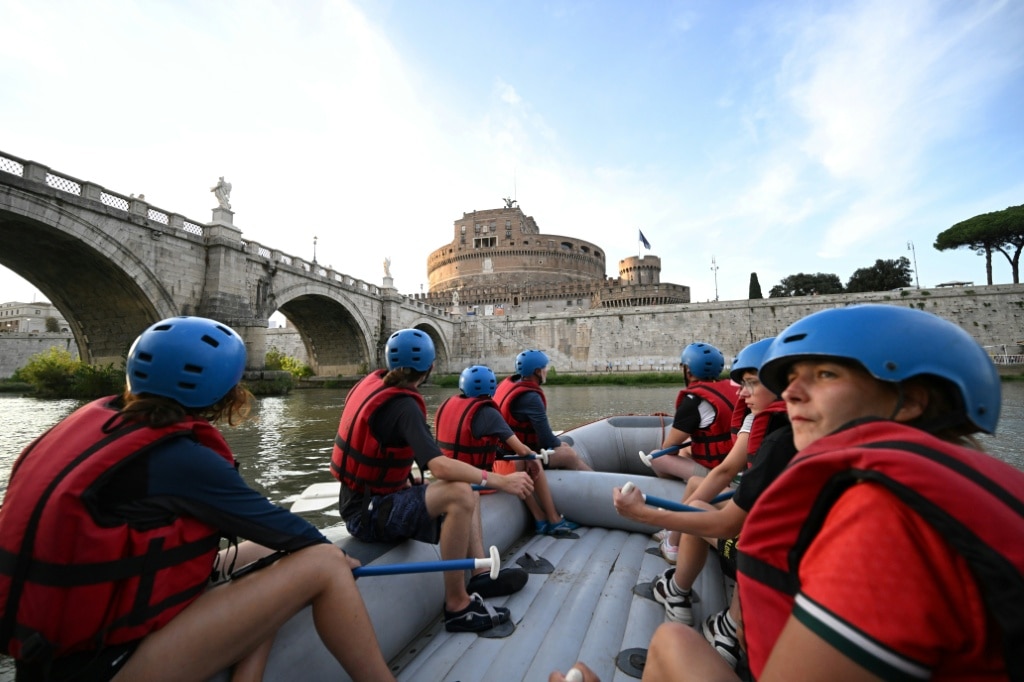
As record-breaking heat waves sweep across Southern Europe each summer, throngs of visitors to Rome have found a creative escape from scorching temperatures: floating down the city’s iconic Tiber River on inflatable rafts. Far from the crowded queues of the Colosseum and overpriced street-side gelato stands, this off-the-beaten-path activity has emerged as a hit for travelers tired of the standard Roman sightseeing circuit.
Organized under operators like Roma Rafting, the two-hour excursion launches from the waterfront near the centuries-old Piazza del Popolo, carrying groups along a water route that has shaped Rome’s history for millennia. As rafts drift gently downstream, passengers glide past some of the capital’s most famous landmarks, all seen from a one-of-a-kind vantage point. The massive stone silhouette of Castel Sant’angelo, built as a burial tomb for Emperor Hadrian, rises on the riverbank, while the iconic dome of St. Peter’s Basilica peeks over the horizon visible from the water.
When the trip nears its end, rafts dock at a historic ancient Roman port in the beloved Trastevere neighborhood, an area whose name translates directly to “across the Tiber” – a nod to the river that has long divided and defined the city’s districts. Along the route, rafters pass through gentle rapids near the charming Tiber Island, where mild currents send refreshing splashes over the edges of rafts, cooling down overheated travelers as they glide under some of Rome’s oldest stone bridges.
For many tourists, the draw of the activity is as much about the new perspective as it is about escaping the heat. “It’s really nice to get a different view of Rome. It’s something special compared with what you can see on foot,” explained 19-year-old German visitor Manuel Frank during a recent excursion.
Fifty-year-old Belgian tourist Sabine Maisano, who joined the trip with her entire family, echoed that sentiment. After spending full days trekking kilometers through Rome’s crowded streets and archaeological sites, the slower pace of rafting offered a much-needed break. “After a day of walking for kilometres, being able to sit down in a boat… even though you have to paddle a little, that allows us to relax, stay cool and discover the city at a more relaxed pace,” she said.
Giuseppe Battaglia, a 37-year-old guide with Roma Rafting, notes that the 40-euro (roughly $46.7 USD) tour follows a path deeply rooted in Roman history. The route mirrors much of the waterway that ancient Romans traveled centuries before they launched their military conquests across the Mediterranean, he explained. For more than two thousand years, the Tiber – Italy’s third-longest river – served as the beating heart of the city, providing fresh water, food, and a critical trade route for generations of inhabitants.
“We’re always used to thinking about roads, cars and motorbikes, but Rome also gives us the chance to take a tour along the river,” Battaglia said. For modern visitors seeking both cooling relief and a fresh take on the ancient Eternal City, that chance has quickly become one of Rome’s most popular summer activities.