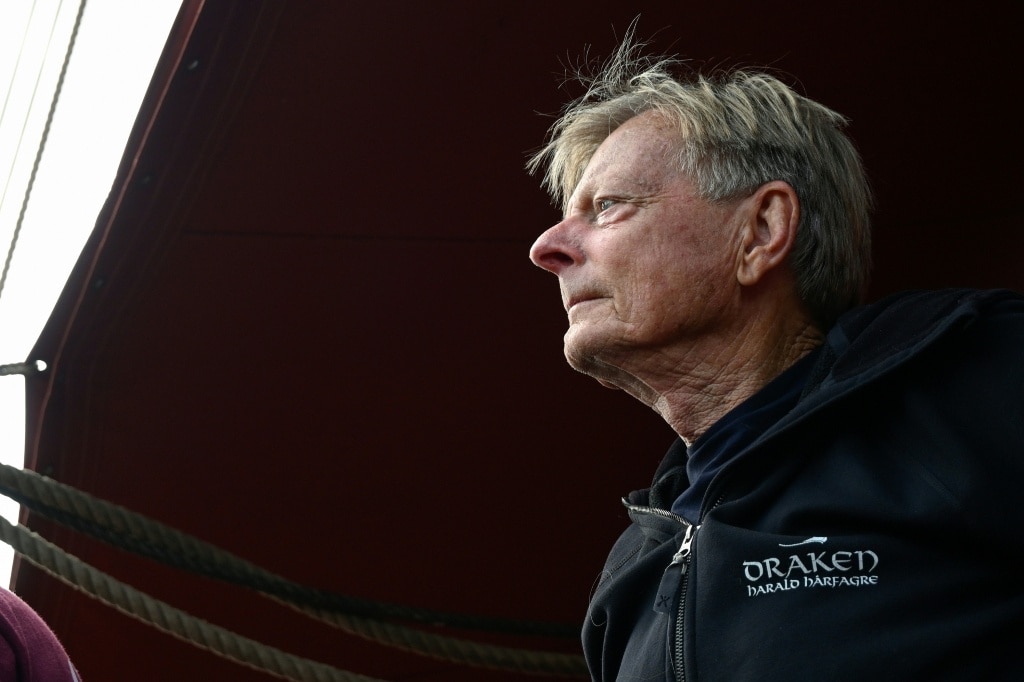
More than two millennia separate the Bronze Age era of Homer’s *The Odyssey* from the Viking age that gave rise to iconic Nordic longships. Yet this striking chronological gap did not stop one world-famous modern Viking ship replica from taking a key spot in Christopher Nolan’s highly anticipated new blockbuster — all thanks to the director’s relentless commitment to practical, real-world filmmaking and the craft of a team of Norwegian shipbuilders and sailors.
The vessel in question is Draken Harald Harfagre, the largest functional replica of a Viking longship built in modern history. Fitted with tar-soaked rigging, a weathered solid oak deck, and 50 hand-carved spruce oars, the ship is normally moored as a cultural landmark in Oslo, Norway’s capital. For Nolan, however, its anachronistic Viking origins were irrelevant: the ship’s overall shape, construction, and open-sea capability perfectly matched his vision of a Bronze Age trading vessel fit for Odysseus’ legendary post-Trojan War journey. To fit the film’s ancient Greek setting, the ship only required one small modification: the removal of its traditional dragon figurehead, a signature feature of actual Viking vessels from the 8th to 11th centuries.
Nolan, long famous for rejecting overreliance on computer-generated imagery (CGI) in favor of practical effects and real locations, explained the choice in a recent US television interview: “We found a Viking ship that had been built exactly according to those ancient specifications. And it was very much the whole shape and the rig that we needed to do a Bronze Age ship.” Unlike digital props that can be perfectly manipulated on a screen, the real vessel demanded that cast and crew learn the practical work of traditional sailing: Nolan’s team integrated the Draken’s own experienced sailors into the film’s production crew, and lead actors — including A-lister Matt Damon, who plays Odysseus — trained alongside them to master sailing skills from raising the sail to rowing in sync.
For months, the Draken sailed through filming locations off the coasts of Greece, Italy, and Scotland, with the ship’s permanent crew rubbing shoulders with Hollywood’s biggest names. Trammell Hudson, one of the Draken’s regular sailors, recalled a chaotic on-set moment that embodied the unscripted authenticity of practical filming: “There was one day where one of the actors who was sitting in front of me got seasick and threw up over the rail. It blew back on me. I thought that would be my big scene, because the IMAX camera was very focused on him and me in the background dodging the debris. But I didn’t see that particular scene in the film.”
Nolan’s adaptation follows Odysseus’ treacherous 10-year voyage back to his home island of Ithaca following the end of the Trojan War, a story rooted in 12th century BCE Greek legend. For the Draken’s expedition director Emanuel Persson, the choice to use a real, functional sailing ship rather than a digital or soundstage replica adds an intangible authenticity that audiences can perceive. “Most of the scenes would be completely different if it wasn’t for us being there, doing the real thing with the real ship and the real crew in the real ocean and real weather,” he said during the ship’s recent return to Oslo. “I think the viewers can actually feel the genuine materials. I don’t know if you can really smell the tar, but you can tell it’s really genuine handicraft instead of being a digital creation.”
Bjorn Ahlander, captain of the Draken, praised the cast for their grit while working in tough open-sea conditions. “Matt Damon was very nice and very good. Never complained. Every one of the actors was out for a long time and it was very cold and sometimes rough,” he said. “No complaints, nothing, never. So that was fantastic to see.” Coordinating up to 100 rowers on the longship was no small feat, Hudson added: with oars measuring several meters long, perfect synchronization is required to avoid tangling, and rough seas brought unexpected jolts. He recalled one incident where a direct collision with an oncoming wave threw him and his rowing partner nearly 1.5 meters into the air.
Not all behind-the-scenes stories from the production are positive, however. Like Penelope, Odysseus’ faithful wife who waited a decade for his return, the owners of a second Viking ship from neighboring Sweden that also featured in the film have endured a long wait of their own: after the vessel sustained damage during filming, they have waited more than a year for the promised compensation, a sour note amid the otherwise triumphant collaboration between history and Hollywood.