Nestled along Yemen’s southwestern Red Sea coast in the Taiz governorate, the centuries-old trading port of Mocha once built its global reputation as the premier exporter of the world-renowned Yemeni coffee. For generations, the quiet coastal community’s daily rhythm was shaped by native fishermen who cast their nets into the Red Sea and spoke the soft coastal dialect of their ancestors. Today, that cultural landscape has been irrevocably reshaped by Yemen’s nearly decade-long civil war, as the city’s dominant language has become the northern dialect of fighters and displaced families fleeing Houthi-controlled territories.
The war between the Houthi movement and Yemen’s internationally recognized government upended Mocha’s fate in 2015, when the strategic port was forced to close amid active fighting. It remained shuttered until 2021, when it underwent rehabilitation and reopened under the control of the Republican Guard, a faction of Yemen’s former elite military units led by Tareq Saleh — a one-time Houthi ally who split from the group after his uncle, former Yemeni president Ali Abdullah Saleh, was killed by Houthi fighters in a 2017 power struggle. After fleeing the Houthi-held capital Sanaa, Saleh established the Republican Guard’s headquarters in Mocha, drawing thousands of displaced Yemenis with the promise of steady salaries paid in Saudi Riyals, far higher than average incomes available in Houthi-held regions.
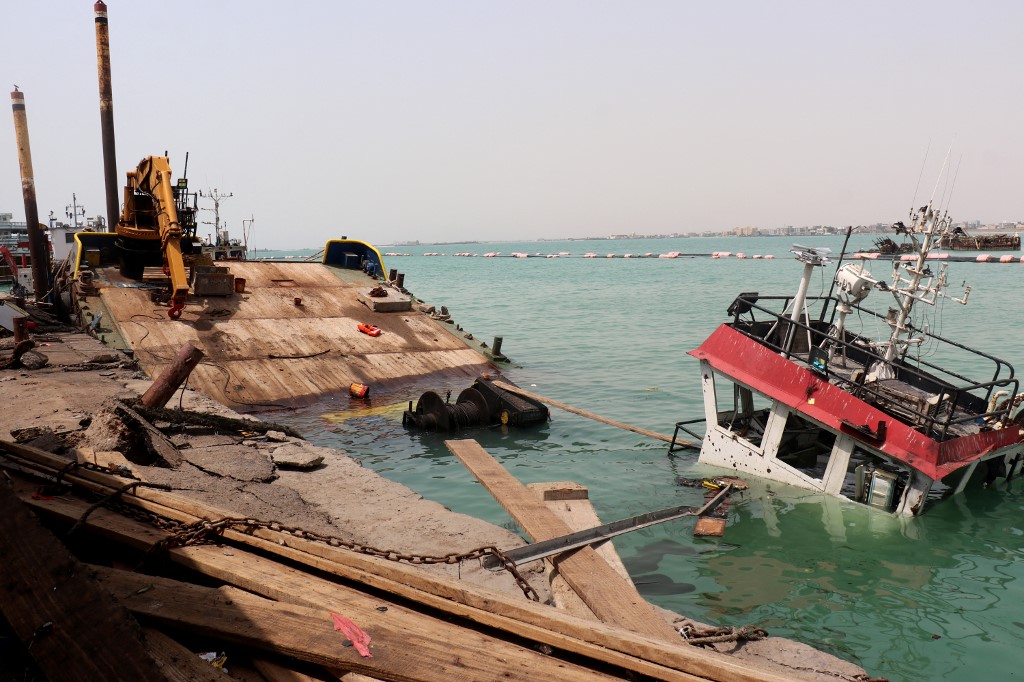
Mocha, which sits just 60 kilometers from the strategically critical Bab al-Mandab Strait, has long held significant geostrategic value for all warring parties in Yemen’s conflict. Over the past two weeks, that strategic importance has made it the target of near-constant Houthi attacks, with more than 25 strikes hitting the port and surrounding areas in the seven-day period ending in mid-this month. While Houthi forces claim they only target military positions and reinforcements, Yemeni government officials confirm that civilian casualties have been severe: 16 civilians were killed and 22 more wounded in a single day of strikes on Friday alone.
The spike in attacks has forced hundreds of Republican Guard fighters to relocate their families to safer rural villages further inland in the Taiz and Lahj governorates, creating a new wave of displacement for families who already fled Houthi control just months or years earlier. For 41-year-old Ibrahim Salem, who arrived in Mocha seven months ago after defecting from the Houthi forces in his native Dhamar governorate, 300 kilometers north of the city, the choice to move his family was an obvious one. “The Houthis don’t differentiate between military targets and civilians, so it is better not to keep our families in Mocha,” Salem explained in an interview with Middle East Eye, standing outside a village grocery store with his three children. The village, located 100 kilometers east of Mocha in Taiz’s al-Maafer district, has welcomed displaced families warmly, Salem said, and he has adapted easily to rural life after growing up in a farming community in Dhamar. “When I walk through Mocha, I sometimes feel like I’m still in Dhamar because I run into so many familiar faces. It makes me forget how far I am from home – though families still need to stay safe, which means staying out of Mocha,” he added.
Other fighters made the choice to keep their families inland from the very start, anticipating the ongoing escalation. Ramez, a 38-year-old Republican Guard fighter with 15 years of military experience, moved his family to a rural village outside Mocha immediately after joining the faction two years ago. He noted that Mocha’s reputation as a major military hub made it an inevitable target for Houthi attacks. “Villages or cities far from Mocha are safe for families, but we prefer villages because the rent is cheaper than in the cities,” Ramez explained. “Nowadays, most of those who have their families in Mocha are scrambling to find homes in villages all at once, as they didn’t anticipate the situation becoming so dangerous earlier on.” The mass influx of displaced fighter families has already put significant upward pressure on local housing rents across rural Taiz, as correspondents observed during on-the-ground visits to affected villages. Ramez argues that pre-positioning soldiers’ families in safe zones should be a core security policy for all military factions operating in active conflict zones. “Not only in Mocha, but anywhere there is a war, soldiers’ families shouldn’t stay in the same city or area as military camps; they should remain far away in safe areas,” he said.
For Mocha’s original native population, the ongoing violence and military occupation has come at a devastating cost to their traditional livelihoods. Local fishermen, who once formed the backbone of Mocha’s economy, are now barred from sailing into the Red Sea due to active combat, leaving thousands without work. Many blame the presence of the Republican Guard headquarters for bringing daily Houthi attacks to their once peaceful community. “Since the beginning of this war in 2015, we have been going from one crisis to another, and fishermen are always the most vulnerable victims,” said Akram, a 40-something fisherman who asked to be identified only by his first name. “The truth is that these fighters have ruined our town, and they are the main reason we lost our jobs. The Houthis know that Mocha is full of fighters, and that is why they are targeting us every day. Before the war, most residents here worked as fishermen and enjoyed a peaceful life. Since those fighters arrived in the city promising us a better life, we haven’t seen anything improve; instead, we just miss the life we used to have.”
Some fishermen have abandoned their trade to join the Republican Guard, drawn by salaries that can reach four times the average income from fishing. But Akram says he rejects that path, clinging to the hope that peace will allow him to return to the sea. “I only believe in peace and civilian jobs. What we need is peace, but there are some who only care about money and don’t think about the future of our area or the next generation,” he said. “The sea used to be our primary source of income, but today it feels more like a battlefield.” Akram’s greatest wish is for the current escalation to end, so local fishermen can resume sailing freely, catch fish to sell in local markets and export to neighboring countries.
Other local residents acknowledge that the arrival of fighters and military activity has brought some modest economic growth to Mocha, with new humanitarian operations and small investments entering the city after the port reopened in 2021. Still, even those who benefit from the new activity say persistent insecurity overshadows any progress. Zaher, a 46-year-old Mocha resident who works as a driver for an international humanitarian organization, asked to withhold his full name for security reasons. “While I am glad to see Mocha growing every day, attracting aid groups and new investments… Anyone would be happy to see new opportunities coming to their city, but our biggest challenge today is that we don’t feel safe,” he said. “All we need is security, and I hope the Houthis avoid targeting civilian infrastructure because we just want to live.”
As Houthi attacks continue without pause, all operations at the Port of Mocha have ground to a complete halt, leaving more than 1,500 port workers out of a job and deepening the city’s humanitarian crisis. The ongoing violence in Mocha follows a broader pattern of renewed conflict across Yemen: the UN-mediated April 2022 ceasefire that brought months of relative calm across the country has collapsed in recent weeks, with Houthi forces resuming large-scale attacks against government positions and critical infrastructure across five governorates: Hadhramaut, Marib, Taiz, Al-Dhalea and Hodeidah.