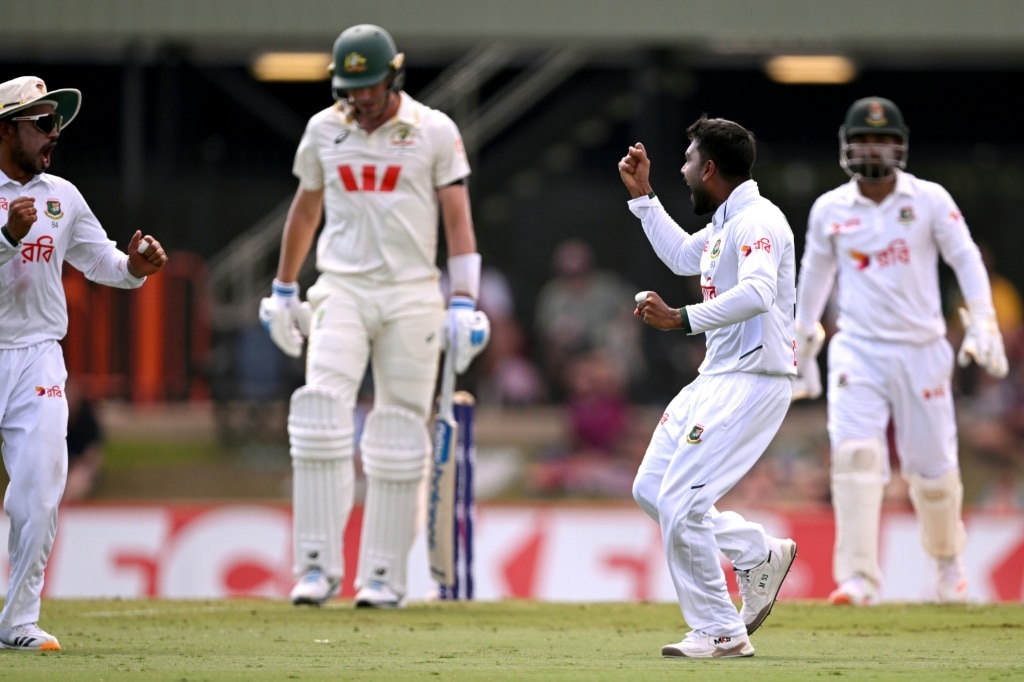
Cricket’s world number one Test side Australia is reeling from one of the most shocking upsets in modern international cricket, after an understrength Bangladesh side claimed a dominant nine-wicket victory in the series opener in Darwin that has left the hosts facing urgent calls for batting lineup changes. Openers Jake Weatherald and middle-order batter Marnus Labuschagne have emerged as the two players most at risk of being dropped ahead of the second Test, which kicks off this Saturday in Mackay.
Heading into the first match, the result was widely predicted to be a one-sided Australian win. Bangladesh had collapsed to an innings defeat in their only warm-up fixture, and arrived in Darwin without their injured pace spearhead Nahid Rana. But Bangladesh defied all pre-series expectations to dominate all four days of the Test, securing a historic victory that left the Australian camp shell-shocked and facing widespread internal and external recrimination.
This is not Australia’s first surprise home Test defeat in recent years — the side fell to an eight-run loss to the West Indies at the Gabba in 2024 — but the comprehensiveness of the Darwin loss has drawn unprecedented criticism. Australian media labeled the result a “national disaster” and the most embarrassing performance in the country’s modern Test cricket history on Monday.
Leading Australian cricket figures have joined the calls for immediate change, including legendary former captain Ricky Ponting, who argues the time has come for selectors to make tough decisions to kickstart long-overdue team regeneration. “I’m the last one to want to make change,” Ponting told Channel Seven as the Test neared its conclusion. “As a captain or as a player I wanted to keep a group together, so it has to get to a bad point before I start saying you’ve got to leave somebody out. But there’s been enough evidence coming here to suggest they weren’t going to lose anything, or much at all, by starting that regeneration, bringing in another opener, bringing in someone at three. I think that has to happen.”
Critics have pointed to Australia’s underwhelming batting performance as the core of the problem. With only Steve Smith, who scored 71 in the first innings and 44 in the second, and Cameron Green, who hit a match-saving century in the second innings, posting meaningful scores, the rest of the batting order collapsed through a string of soft, unforced dismissals. Since the start of the 2025 Ashes series against England, both Weatherald and Labuschagne have held batting averages below 27, leaving both running out of opportunities to prove their form.
Former Australian opener Matthew Hayden echoed Ponting’s concerns, noting that consistent early wickets put unnecessary pressure on Australia’s middle order. “The 1-2-3, as Ricky and I will tell you, are absolutely fundamental to the set-up of a batting team,” Hayden told Channel Seven. “When they are constantly putting that middle order under pressure, Steve Smith arriving way earlier than he ever needs to be, then you’ve got to start to answer those questions.”
Australian captain Pat Cummins has acknowledged that persistent batting failure has become a worrying trend, confirming selectors are willing to look beyond the existing 13-man squad for replacements. The most widely predicted change is veteran batter Matt Renshaw coming into the side to replace Weatherald at opener, but there is also growing momentum to hand opportunities to young, emerging players who have impressed in domestic cricket. Prospects including Sam Konstas, Campbell Kellaway, Ollie Peake and Cooper Connolly are all waiting in the wings for a first Test call-up.
Australian great Mark Waugh has argued selectors “have to bite the bullet at some stage,” while former star opener David Warner — whose retirement in 2024 left a gaping hole at the top of Australia’s batting order that has yet to be permanently filled — added: “I think we’ve got to start blooding some youngsters.” With Australia set to face a challenging three-Test tour of South Africa in October, giving young prospects match time in Mackay to gain international experience makes strategic sense for the long term.
For Labuschagne’s number three spot, media reports suggest Kurtis Patterson and Nathan McSweeney are the current frontrunners to replace him, though neither has been in outstanding recent domestic form.
While the batting unit is facing the most intense scrutiny, there are also questions over Australia’s veteran bowling attack, which has remained unchanged for several years. All four core bowlers — captain Pat Cummins, Mitchell Starc, Josh Hazlewood and Nathan Lyon — are still favored to retain their spots for now, despite their advanced ages. Hazlewood, returning from injury, silenced critics with a six-wicket haul in Bangladesh’s first innings that cemented his position as Australia’s first-choice fast bowler. The most vulnerable bowler is 38-year-old off-spinner Nathan Lyon, also returning from injury, who was outbowled by Bangladesh’s Mehidy Hasan Miraz. Twenty-five-year-old understudy Todd Murphy is the leading candidate to replace Lyon if selectors opt for change.