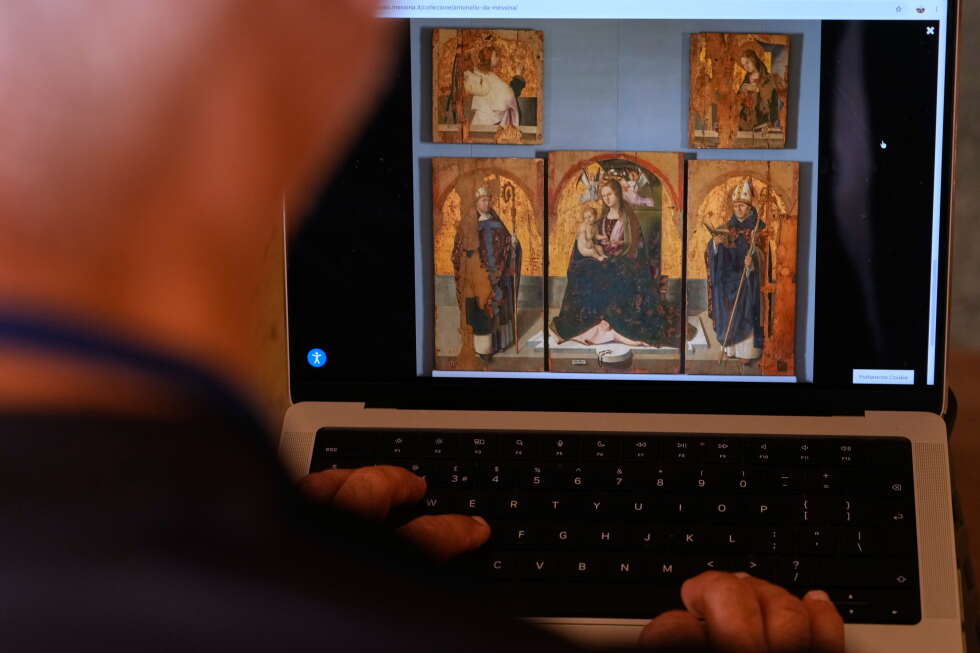
On Italy’s most celebrated summer public holiday, Ferragasto, a brazen art theft unfolded at Sicily’s MuMe Regional Museum that has sent shockwaves through the global art community. Thieves successfully bypassed the institution’s layered alarm and security infrastructure Saturday evening to steal four irreplaceable works attributed to iconic 15th century Sicilian Renaissance painter Antonello da Messina, Italian national news agency LaPresse confirmed in a Sunday report.
Among the stolen pieces are three of the only five surviving panels from da Messina’s 1473 San Gregorio Polyptych, one of the artist’s most celebrated early Renaissance commissions. The thieves also absconded with a rare double-sided panel that features the Virgin Mary on one side and a depiction of the dead Christ in Pietà on the other. LaPresse’s sources confirm that the thieves forcibly removed the double-sided work from its reinforced armored display case to complete the heist, which investigators have timed to just before 10 p.m. Saturday.
Museum leadership has described the theft as an incalculable cultural loss for the local community and the global art world. “We are devastated by what happened. They were two of Antonello da Messina’s most important and best-known works. It is a tremendous loss for the museum, the city, the community and the art world,” MuMe director Marisa Mercurio told Italy’s ANSA news agency in the immediate aftermath of the discovery.
The high-profile theft comes at a moment of growing public attention for da Messina’s work. Just months prior, in March 2024, the Italian government purchased another of the artist’s devotional works, titled “Ecce Homo”, for $14.9 million from Sotheby’s New York auction house, a move that significantly lifted the painter’s international profile and underscored the rarity and value of his surviving works.
Art crime experts warn that while the heist itself was successfully executed, the stolen works’ extreme notoriety makes any legitimate private sale on the art market nearly impossible. Lynda Albertson, chief executive of the Association for Research into Crimes against Art (ARCA) and a leading art-crime analyst, told Italian daily *La Repubblica* that the works are so widely recognizable that they cannot be moved through any reputable sales channels. “Stealing an Antonello may be far easier than selling one. If these are ordinary thieves, they will soon discover that — to their cost,” Albertson said. She added that high-profile stolen cultural pieces like these rarely enter private collections; instead, they are often passed between criminal networks and used as collateral to fund other illegal enterprises.
In the wake of the theft, MuMe remained closed to the public Sunday as investigative teams from Italy’s Carabinieri cultural heritage protection unit processed the crime scene to gather forensic evidence. As of Sunday evening, neither senior museum officials nor Carabinieri investigators had released additional details on possible suspects or leads in the case.
The theft occurred during Ferragosto, the annual Italian holiday that marks the Feast of the Assumption of Mary and serves as the peak of the country’s summer vacation period, when many tourist sites and public institutions operate on reduced staffing. The heist also comes just days after Italian law enforcement announced a major win in a separate high-profile art crime case: police in the northern city of Parma confirmed they had recovered three stolen masterpieces by Renoir, Cézanne, and Matisse, with an estimated combined value of 10 million euros ($11.5 million), that were stolen from the Magnani Rocca Foundation in Parma province in March. Five suspects have been detained in connection with that earlier theft.