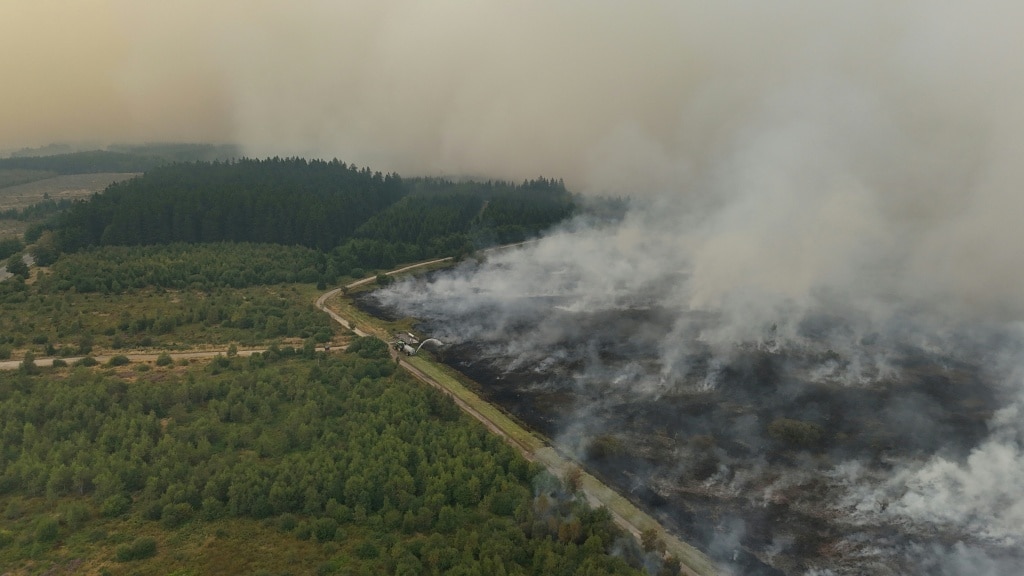
One of the most devastating wildfires in modern Belgian history is pushing emergency responders to their limits, after a fast-moving blaze tore through the ecologically sensitive High Fens nature reserve near the German border, growing exponentially in size just 48 hours after igniting. With terrain making ground operations extremely dangerous and difficult, cross-border and European aerial support has been deployed to reinforce hundreds of firefighters working to contain the inferno.
The blaze, which broke out on Friday in an area of fragile peatlands and pine forests popular with outdoor hikers, has already scorched roughly 3,000 hectares of protected land — up from just 80 hectares on the day of ignition, and 850 hectares by Saturday morning. It marks the largest wildfire to hit Belgium since a catastrophic blaze tore through the exact same region in 1911, during a historic period of heat and drought that mirrors current conditions across Western Europe.
As of Sunday, Belgian Interior Minister Bernard Quintin confirmed that while overall fire conditions remain highly challenging, two of the most active fire fronts advancing toward the settlements of Jalhay and Monschau have been successfully brought under control. More than 250 firefighters and emergency personnel from Belgium and neighboring Germany have been deployed to the scene, supported by specialized modern fire engines. On the ground, an AFP correspondent observed convoys of tractors pulling water tankers to supply crews, while helicopters conducted repeated water drops drawn from a nearby lake.
Difficult terrain has been one of the biggest barriers to containment. The High Fens region is a mosaic of heathland, waterlogged peat bogs, and narrow elevated boardwalks, where heavy emergency vehicles risk sinking into soft ground, preventing crews from getting close enough to tackle the deepest parts of the blaze. This has forced authorities to rely heavily on aerial support to slow the fire’s spread.
By Sunday, international assistance had arrived to boost firefighting efforts: two heavy water-bombing aircraft from Sweden joined four already deployed helicopters — two operated by Belgian forces and two by the Dutch military. A dedicated liaison officer has been assigned to coordinate all aerial operations to reduce the risk of mid-air or ground accidents. Belgian Prime Minister Bart De Wever publicly thanked European Union partners for the rapid support in a post on X, formerly Twitter.
The rapid spread of the fire has been fueled by a recent spell of record-breaking heat and severe drought across much of Western Europe, which pushed temperatures in parts of Belgium as high as 37 degrees Celsius on Friday — creating tinder-dry conditions ideal for wildfire ignition and spread.
Two nearby villages have been partially evacuated as a thick plume of yellowish smoke blanketed the entire fire zone. Around 20 displaced residents spent Saturday night in a local sports hall, per officials from Liege province, while many other evacuees arranged alternative shelter with friends or family. A small number of residents even defied evacuation orders to remain in their homes. Smoke has drifted as far as the neighboring province of Namur, where local authorities were forced to urge residents to stop overloading emergency phone lines with reports of smoke odors.
Shifting wind patterns have further complicated containment efforts, but provincial officials confirmed Sunday that the defensive fire line protecting evacuated residential areas remains intact. As of the latest update, no homes have been damaged or destroyed by the fire, though the blaze remains uncomfortably close to residential areas, and smoke concentrations remain at hazardous levels across a wide area. The exact cause of the ignition remains unknown, as responders have not yet been able to safely access the point where the fire first started.