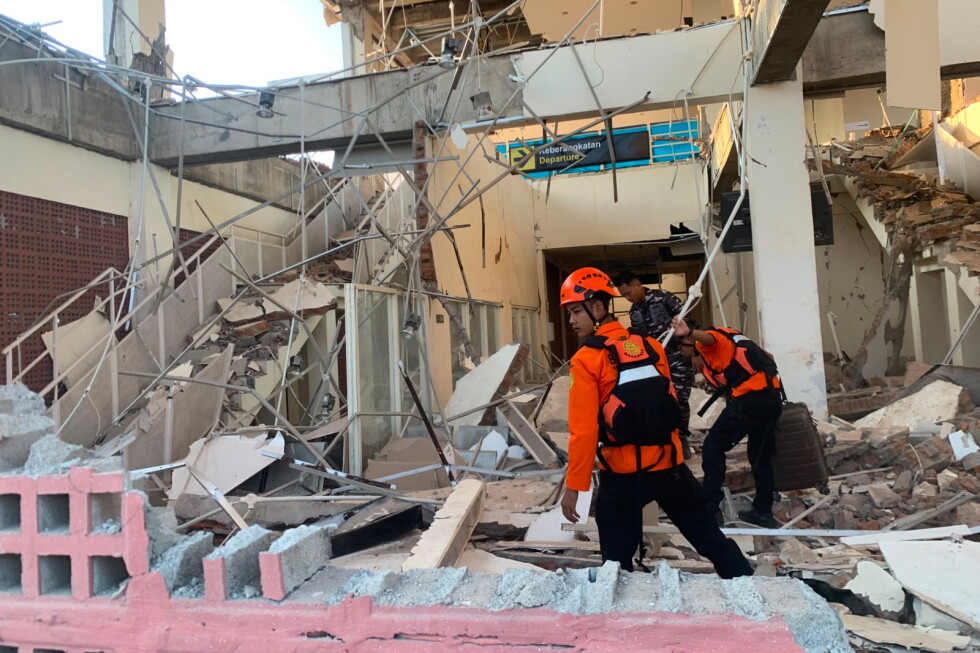
On the day after a powerful magnitude 7.7 earthquake struck eastern Indonesia’s Flores Island, search and rescue teams returned to the field Sunday, digging through crumbled structures and landslide rubble to recover victims and locate any trapped survivors. As of Sunday’s official update, the disaster has left at least 47 people dead, more than 100 injured, and thousands displaced from their homes.
Official casualty breakdown from Indonesia’s National Disaster Management Agency confirms 24 fatalities in Manggarai regency and 17 in adjacent East Manggarai, with additional deaths recorded across Sikka, Ngada and Ende regencies. Rescuers are still working to reach communities potentially buried under quake-triggered landslides that have impacted six regencies across the island, which is a majority-Catholic region in the world’s largest Muslim-majority nation.
According to the United States Geological Survey (USGS), the seismic event originated 68 kilometers north-northwest of Ende, in East Nusa Tenggara province, at a shallow depth of roughly 10 kilometers off Flores’ coastline. Shaking was felt across most of the island, sending panicked residents running for open ground, and tremors were also detected as far as neighboring West Nusa Tenggara and portions of southern Sulawesi.
Preliminary damage assessments count more than 900 homes completely destroyed and nearly 450 others partially damaged, forcing approximately 5,000 displaced people to seek safety in government-run temporary shelters. Thousands more chose to spend Saturday night in open outdoor spaces, rather than returning to structurally compromised properties out of fear of powerful aftershocks. At least 167 public infrastructure sites, including local schools, community health centers and churches, have also sustained damage.
The quake also impacted Labuan Bajo, the main entry point for the world-famous Komodo National Park, one of Indonesia’s top international tourist destinations. A series of landslides blocked multiple segments of the Trans-Flores Highway, a 700-kilometer corridor that connects scattered communities across the mountainous island.
For many residents like Anastasia Imad, a farmer based in Labuan Bajo who is now staying in a makeshift green tent pitched next to her damaged home, the horror of the quake remains fresh. “The shaking was terrifying, so intense that my house nearly collapsed,” Imuda explained. “We feared the aftershocks would bring it down on us while we slept.”
Emergency response teams have already begun distributing critical life-saving supplies, including rice, pre-prepared meals, clean drinking water, blankets and essential medications, while work continues to erect additional temporary shelters for displaced residents. Local authorities note that restoring downed power and telecommunications networks, alongside delivering aid to remote villages cut off by landslides, remain the most pressing challenges facing the response effort.
By Sunday, rescue crews had cleared most landslide debris and reopened access to many previously cut-off villages, though ongoing communication failures and blackouts continue to slow search operations, according to Fathur Rahman, head of the Search and Rescue Office in Maumere, Sikka’s capital. He added that teams are currently prioritizing searches through collapsed residential and commercial building rubble for any remaining potential victims.
Indonesia, an archipelago nation made up of more than 17,000 islands, sits along the Pacific “Ring of Fire”, a geologically active horseshoe-shaped network of seismic faults and volcanic systems that makes the country extremely prone to large earthquakes and volcanic eruptions. Flores has a long history of deadly seismic disasters: a 1992 quake and subsequent tsunami killed roughly 2,500 people on the island. More recently, a 2018 magnitude 7.5 quake on Sulawesi triggered a tsunami that claimed more than 4,400 lives, and the 2004 magnitude 9.1 quake off the coast of Sumatra unleashed a devastating Indian Ocean tsunami that killed approximately 230,000 people across a dozen coastal nations.
This report was compiled with additional contribution from Associated Press writers Niniek Karmini and Edna Tarigan in Jakarta.