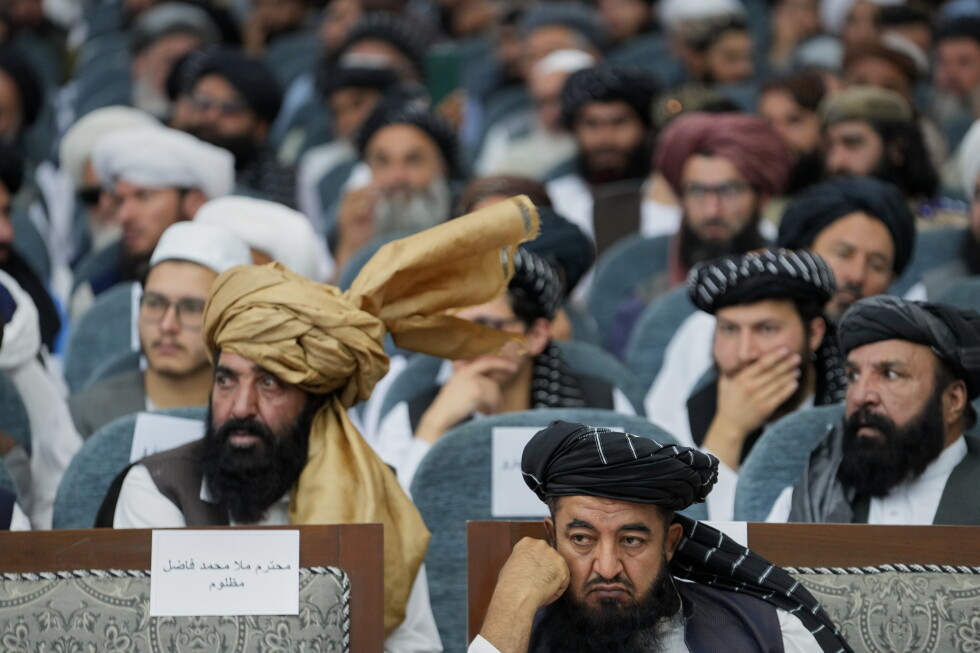
Five years to the day after seizing power amid the full withdrawal of U.S. and NATO forces, Afghanistan’s Taliban leadership gathered Saturday at Kabul’s historic Loya Jirga assembly hall to mark the anniversary of their return to governing control, framing the milestone as a victory that ended decades of foreign occupation and widespread conflict.
The anniversary event, which drew thousands of attendees including high-ranking Taliban officials, a small number of foreign representatives, and ordinary Afghan citizens, was billed as a celebration of national liberation. No women were allowed to participate in the main gathering in Kabul, and parallel celebrations were held across Afghanistan’s provinces, with Taliban flags and pro-regime posters plastered along major highways and public marketplaces.
Speaking at the Kabul ceremony, Taliban deputy spokesman Hamdullah Fitrat framed the group’s five-year rule as a new era for the war-torn nation. “We pray to Almighty God to forever protect our homeland from occupation, aggression, wars, and insecurity, and to enable our people to enjoy peace, tranquility, and prosperity under the auspices of the Sharia-based government,” Fitrat told the crowd.
The Taliban first took control of Kabul on August 15, 2021, as the United States wrapped up its withdrawal from the country after a 20-year military intervention that cost billions of dollars and hundreds of thousands of lives. The final days of the withdrawal descended into chaos at Kabul’s Hamid Karzai International Airport, where thousands of desperate Afghans crowded the facility in a frantic attempt to flee the country ahead of the Taliban’s full takeover. To date, the Taliban government remains widely isolated internationally, with only Russia formally recognizing its authority.
In the years since taking power, the Taliban administration has rolled back decades of progress on gender equality, implementing sweeping restrictions that bar all girls over the age of 12 from accessing secondary education, and later extending the ban to bar women from university education entirely. The restrictions go far beyond education: women are banned from most public spaces including gyms and national parks, prohibited from competing in sports, and required to have a male guardian accompany them on all long-distance travel.
Marking the anniversary in a sharply contrasting official statement, the United Nations’ top human rights monitor for Afghanistan warned that the country is now in the grips of a devastating, systemic human rights crisis that disproportionately targets women and girls. “While the era of war has ended, it’s questionable whether there’s real peace, and the human rights situation has steadily deteriorated, most dramatically for women and girls,” Richard Bennett, the U.N. special rapporteur on Afghanistan’s human rights situation, said in a pre-recorded video address. Bennett’s investigation has concluded that the Taliban’s systemic gender-based discrimination amounts to a crime against humanity of gender persecution.
Bennett emphasized that the crisis extends far beyond gender-based exclusion, documenting widespread abuses across all segments of Afghan society. “The crisis extends well beyond gender discrimination, even beyond gender apartheid,” he said. “Across Afghanistan we continue to document arbitrary arrests, torture and ill treatment, extrajudicial killings, corporal punishment, enforced disappearances, restrictions on freedom of expression, attacks on journalists and human rights defenders, persecution of ethnic and religious minorities, discrimination against LGBT plus persons, and the reduction of civic space.”
He also urged the international community to reject calls to normalize diplomatic relations with the Taliban, warning that legitimizing the regime would abandon victims of human rights abuses. “Normalizing the Taliban’s policies would legitimize the discrimination and tell victims their suffering is negotiable,” he added.
Taliban officials have pushed back on international criticism, framing their five-year rule as a success story for a country long plagued by instability. In an interview with the Associated Press this week, Molvi Hayatullah Mahajar Farahi, deputy minister for broadcasting at the Taliban’s Ministry of Information and Culture, acknowledged the administration faces “challenges and difficulties” but claimed the regime has delivered improved security, expanded infrastructure, and created new jobs for Afghans. When pressed on the ban on girls’ and women’s education, Farahi declined to address the issue directly, instead noting that investment in national universities has exceeded levels seen under previous governments.
U.N. agencies have repeatedly highlighted the catastrophic long-term impact of the education bans. UNESCO estimates that roughly 2.4 million Afghan girls are currently locked out of secondary education. U.N. Women said in a statement this week that Afghan women and girls face the harshest set of gender restrictions anywhere in the world, and that the sweeping bans are eroding Afghanistan’s long-term future. The exclusion of women from education and work has created critical shortages of teachers, doctors, nurses, and midwives, threatening to collapse the country’s already fragile social and economic foundations.