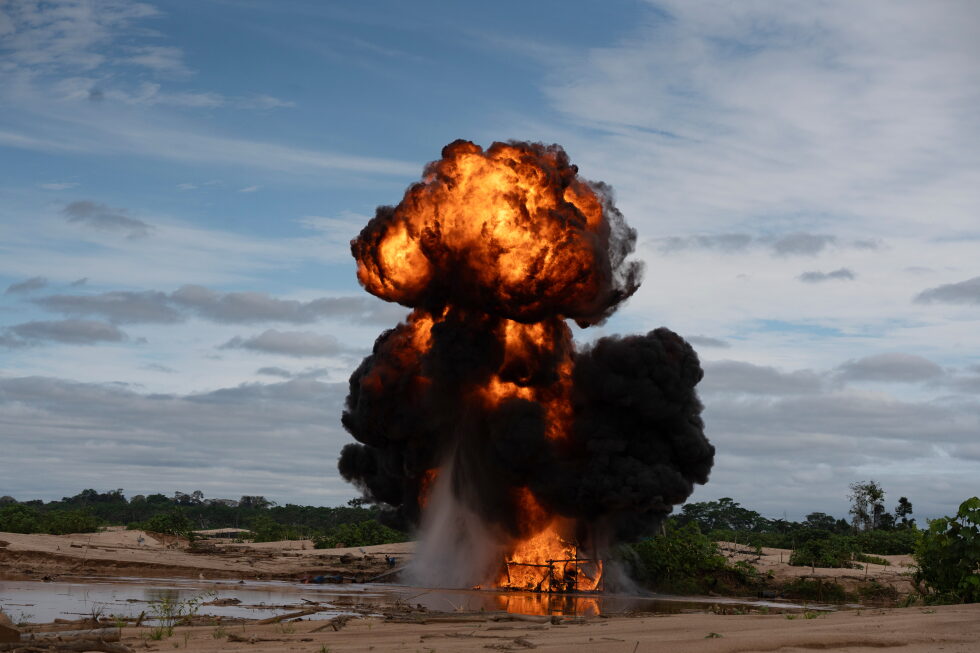
In the biodiverse Amazon heartland of Peru’s Madre de Dios region, an aggressive new government push to roll back illegal gold mining is underway, with Peruvian Navy special patrols launching multi-day raids deep into protected zones along the Malinowski River earlier this month. On August 11, 2026, eight navy commandos rappelled from a military helicopter into a clearing hacked out of old-growth rainforest by unauthorized mining operations, touching down in a landscape already scarred by the extractive industry. What greeted the troops was a devastating scene: massive craters gouged into the forest floor, filled with murky, polluted water where gasoline and toxic chemicals rested in glistening, contaminated slicks on the surface. Makeshift wooden mining platforms jutted out across these toxic pools, ringed by industrial pumps and thick plastic hoses designed to suck up river and soil sediment to sift out tiny flecks of profitable gold. As patrol members advanced on the site, a handful of miners lingered at the tree line watching the incursion. After the operation’s lead officer fired a single warning shot into the humid Amazon air, the group melted into the dense forest within seconds, leaving their operation and camp abandoned in a rush. Behind the fleeing miners, the navy found a hastily vacated settlement scattered with personal effects and supplies: crushed beer cans and empty liquor bottles littered the ground alongside half-eaten lunches of rice and plantain left in plastic containers, discarded mattresses, work clothes, and mining tools. Freezers, large fuel canisters, and even live chickens and guinea pigs kept for sustenance were all left behind as the miners fled. This raid was one of eight simultaneous deployments, with helicopters ferrying separate patrol teams to distinct drop-off points along the river before lifting off to reach the next target. Illegal gold mining has devastated vast swathes of Madre de Dios, one of Peru’s most ecologically rich regions, leaving behind a moonscape of contaminated waterways and reshaped river systems in the hunt for lucrative gold deposits. Most alarmingly, the activity has pushed steadily deeper into protected Amazon reserves, putting irreplaceable biodiversity and Indigenous communities at severe risk. Mercury, a toxic chemical widely used by illegal miners to separate gold from sediment, has seeped into rivers, accumulated in wildlife, and poisoned local populations, including Indigenous groups that rely on river fish as a primary food source. Edy Reynaldo Dariquebe, a senior official with FENAMAD, the regional Indigenous federation representing Madre de Dios communities, confirmed that criminal networks tied to illegal mining have already established operations near and inside protected Indigenous territories. “Mining is destroying our forests and poisoning our rivers with mercury that ends up in the fish we eat,” Dariquebe explained, noting that contamination spreads far beyond the immediate mining sites to impact communities hundreds of kilometers away. Ronald Flores Yáñez, deputy prosecutor with Peru’s Attorney General’s Office, told the Associated Press that illegal mining operations have advanced as far as military monitoring outposts and crossed into formally protected protected land. “We can confirm today that they have already entered the Tambopata National Reserve,” Flores said during an interview on site. “We are standing inside the reserve right now, and all around us we see hundreds of illegal mining dredges operating.” Peru first launched a large-scale military and police crackdown on illegal mining, dubbed Operation Mercury, in 2019, which successfully reduced unauthorized extraction across much of Madre de Dios. But in recent years, miners have gradually reoccupied territory and pushed farther into protected areas, prompting authorities to ramp up enforcement operations once again. Global Conservation, a U.S.-based environmental nonprofit partnering with Peruvian authorities, outlined that the new campaign will combine satellite surveillance, aerial reconnaissance, and sustained law enforcement raids over the next 12 months to map, target, and dismantle illegal mining camps and infrastructure. Navy Lt. Cmdr. Renato Miranda, who oversaw the August 11 mission, told troops during a pre-operation briefing that the core goal of the raids is to “neutralize and dismantle” all illegal mining activity. On the ground, this means systematically targeting the critical equipment that allows operations to run: pumps, batteries, fuel stockpiles, dredging gear, and all makeshift camp infrastructure. “The most important thing we can do is destroy the primary machinery,” Miranda explained. “And that machinery is the motors.” High-powered industrial engines are the most valuable piece of equipment for illegal miners, making them the most economically impactful target for authorities aiming to raise the cost of restarting operations. Larger mining motors can cost between $30,000 and $45,000 to purchase, and are capable of extracting 30 to 50 grams of gold per day — a haul worth roughly $4,000 to $7,000 at current gold market prices. Over the previous three months, officers told the AP that navy patrols have destroyed approximately 115 motors during near-weekly operations across the region. The remote, hard-to-reach location of most mining camps gives miners advance warning of approaching helicopters or patrol boats, allowing them to flee and often hide valuable motors under sand, behind foliage, or at the bottom of murky mining pools to recover later. To counter this, the navy deploys specialized divers to search the contaminated pools for submerged engines, even though the water is often laced with mercury and other toxic chemicals. When an engine is located, teams attach explosive charges and destroy it on site. During the August 11 raid, one soldier spotted disturbed sand on the bank of a mining pool and uncovered a hidden motor after digging. The engine was dragged to a pile of seized equipment, doused in gasoline, and set alight alongside a discarded mattress and chainsaw. One unexpected discovery, a stray dog abandoned by miners, was rescued by the team, who brought the animal along on the rest of the mission and back to their base after the operation. Across the operation zone, troops used explosives to destroy mining equipment and burned all reusable structures and supplies that could allow miners to reoccupy the camps. A 10-minute boat ride from the first raid site, a second, larger illegal mining camp offered a raw look at daily life for people working in the sector. A full chest freezer stocked with meat, wooden shelves holding kitchenware, and separate sleeping quarters scattered with personal items were all seized before being burned: a handwritten ledger of supply orders, freshly laundered underwear hanging to dry, vitamin bottles, and even over-the-counter pills marketed to boost sexual performance were all destroyed. Before moving to their next target, several soldiers cooked and ate preserved food found in the camp’s freezers. While the industry generates massive profits for criminal financiers, most rank-and-file workers live and labor in extremely precarious conditions. During the operation, one patrol encountered a young woman with her 1-year-old child at a small mining site. Prosecutor Flores told the AP that the woman had traveled to Madre de Dios from Cusco after being rejected from university, was abandoned by her child’s father, and took a job advertising for a cook to support herself, only to end up working for the illegal mining operation. While destroying high-value mining equipment is designed to hit criminal operators in their bottom line and raise the cost of restarting operations, Peruvian authorities acknowledge that enforcement raids alone cannot end the illegal mining crisis. With global gold prices remaining at sustained high levels, extraction remains extremely profitable, meaning operators can easily afford to purchase new engines and rebuild their operations in the same location or shift to a new untouched area of the forest after authorities leave. “Every single day, they advance more and more, and our response is far too slow,” Flores said, noting that a fundamental shift in enforcement strategy is needed. Prosecutors are now pursuing a two-pronged approach to break the repeating cycle of equipment destruction, miner return, and further deforestation: they will continue targeting mining equipment while also pursuing the financial networks that fund the trade, identifying the wealthy backers who put up capital for expensive machinery and tracing the flow of profits from illegally mined gold. “These operations have to be permanent,” Flores emphasized. This coverage of climate and environmental issues by the Associated Press receives funding from multiple private foundations, with AP retaining full editorial control over all content.
Peru steps up fight against illegal gold mining as activity enters protected Amazon reserve