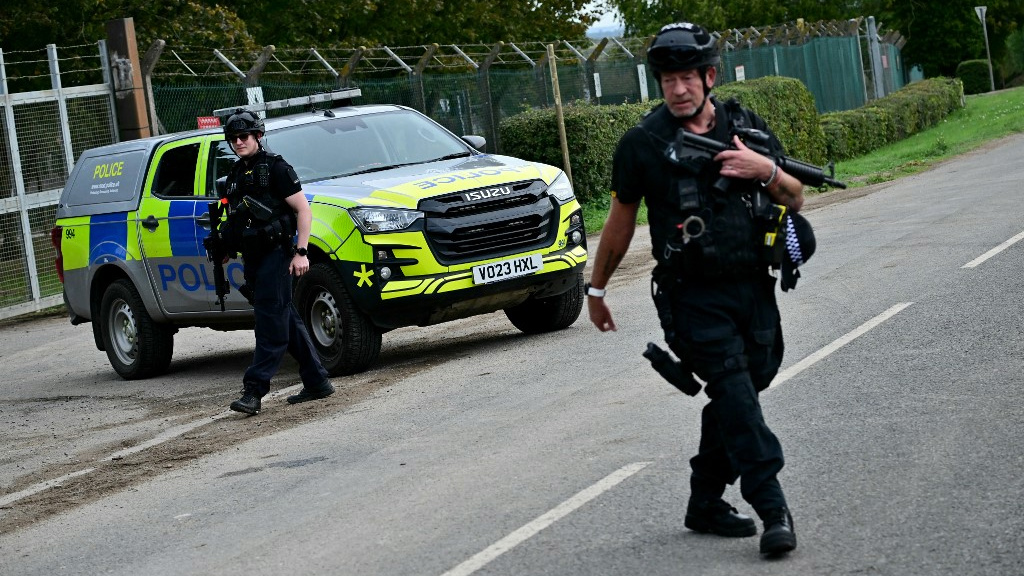
In the hours after five men were arrested near a U.S. Air Force base in rural England early Sunday morning, the story looked like a major counterterrorism success: authorities had narrowly foiled a large-scale planned attack against an American facility on British soil, one linked to foreign aggression. Within 24 hours, however, that narrative had completely unraveled, leaving behind a tangled web of contradictory claims from U.S. and UK officials, political opportunism, and ongoing uncertainty about what really unfolded.
The arrests took place near RAF Fairford, a British Royal Air Force base that has recently hosted U.S. bombers that launched strikes against Iranian missile sites. Following the detentions, multiple media outlets cited early police and intelligence suggestions that three vans seized near the base held barrels containing homemade explosives, indicating a pre-planned bomb plot against the installation.
In response to the perceived threat, British Prime Minister Andy Burnham called an emergency COBRA (Cabinet Office Briefing Room A) meeting on Monday afternoon to assess the situation and coordinate the government’s response. Reform UK leader Nigel Farage was quick to seize on the incident to advance his longstanding political agenda, claiming the alleged plot proved his argument that the Iranian Revolutionary Guards Corps (IRGC) should be designated a proscribed terrorist organization in the UK. He repeated unsubstantiated claims he had made earlier this year that the Iranian regime was smuggling operatives into Britain via small boats crossing the English Channel, claiming British authorities were allowing individuals who would carry out lethal attacks to enter the country.
U.S. officials also quickly embraced the narrative of a joint counterterrorism success. Former U.S. President Donald Trump released a statement Sunday hailing the collaborative effort between U.S. and British law enforcement, claiming the men had been under surveillance for a long time and that the operation had prevented “big damage” to the American base. “We had them under view for a long time, and we got them,” Trump said, praising the partnership with British authorities.
But that narrative of a foiled major terrorist attack began to crumble just hours after it first circulated. Investigations revealed that all five arrested men are British nationals in their twenties, not foreign operatives as Farage and some U.S. commentators had speculated. All five were subsequently released on police bail without being brought before a judge, a step that former chief prosecutor Nazir Afzal noted strongly suggested they were not facing credible terrorism suspicions.
Farage refused to backtrack from his claims, however, taking to social media platform X to question why the five suspects were granted bail while anti-migrant activist Daniel Thomas—known publicly as Danny Tommo, who has pleaded not guilty to charges of criminal damage for allegedly slashing a migrant dinghy in the English Channel—remains in custody. He decried what he called a “two-tier” system of justice in Britain.
Further contradicting early claims of an explosives plot, authorities confirmed Monday afternoon that tests of the materials in the three white vans found no viable explosive devices. Counter Terrorism Policing (CTP) said officers were still pursuing multiple lines of inquiry, including the possibility the activity was linked to proxies acting, knowingly or unknowingly, on behalf of a foreign state. But senior Whitehall officials pushed back against the U.S. claim of a long-running intelligence-led operation, noting that the arrests were not part of a pre-planned tracking operation involving CTP and MI5, contradicting Trump’s assertion that the men had been under surveillance for an extended period.
Even after the suspects’ release, Trump doubled down on his original claims, saying he was surprised by the bail decision and insisting “We know everything about them, we would not have released them.” He reaffirmed that U.S. and UK authorities had worked “very closely” on the case. U.S. Secretary of State Marco Rubio also maintained the severity of the incident, saying over the weekend that the situation was “very serious” and “clearly involves the hands of a foreign actor.”
Iran’s embassy in London was quick to condemn the unsubstantiated speculation linking the country to the incident, calling the claims “unfounded and malicious” and arguing that they only served to fuel anti-Iranian propaganda in the UK. Prime Minister Burnham has urged the public and media to avoid jumping to conclusions, saying “people should not speculate while the authorities establish the full facts.”
Despite the prime minister’s call for caution, the British public is now left with two starkly conflicting narratives about what transpired near RAF Fairford. Official UK sources have walked back nearly all early claims of a foiled major terrorist plot, while senior U.S. officials continue to stand by their original characterization of the incident as a successfully disrupted large-scale attack linked to foreign actors. As investigations continue, the full truth of the incident remains far from clear.