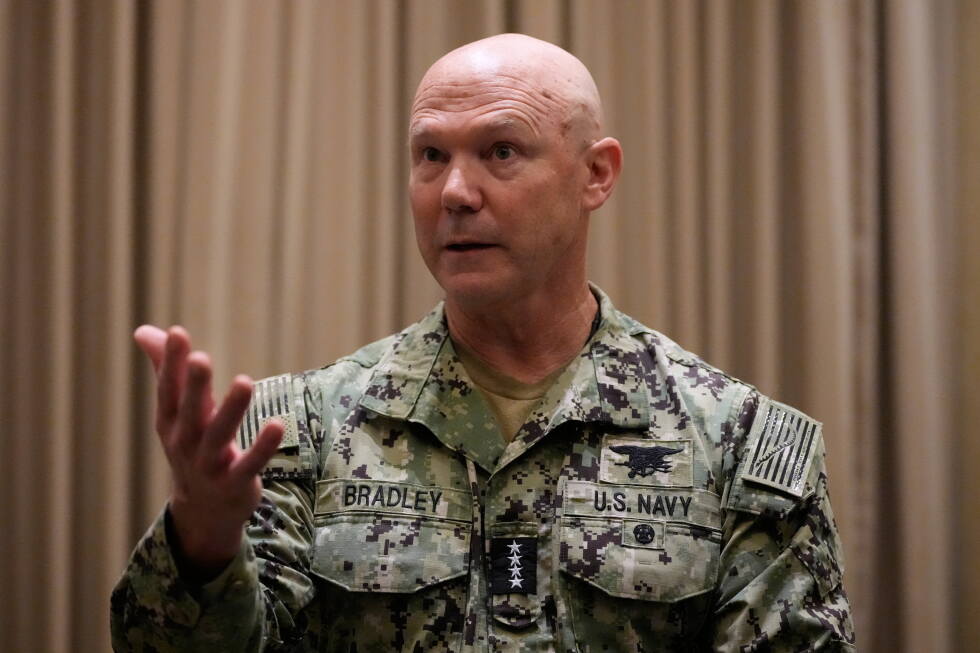
During a visit to Manila this Thursday, the top commander of U.S. Special Operations Command announced that American special operations personnel are prepared to scale up joint warfighting-readiness exercises with the Armed Forces of the Philippines and other regional Asian partners. The move is designed to strengthen long-standing security alliances and lower the risk of large-scale conflict in the strategically critical Indo-Pacific.
Admiral Frank Bradley, who leads the 80,000-strong U.S. Special Operations Command headquartered at Florida’s MacDill Air Force Base, arrived in the Philippines following an official stop in South Korea, with next scheduled talks with military leaders in Japan. His trip marks the latest in a series of high-level visits by senior U.S. military officials to key Asian allies in recent weeks, a diplomatic push aimed at reinforcing Washington’s unwavering commitment to regional security even as the U.S. maintains a sharp focus on ongoing conflict in Iran.
U.S. Special Operations Command oversees America’s military most sensitive and high-risk covert missions, with the majority of its personnel deployed across more than 80 nations globally, Bradley confirmed. During closed-door talks with Filipino military leaders, the two sides discussed the Philippines’ ongoing military modernization push, plans to intensify joint combat exercises with the U.S. and other partner nations, and efforts to expand a network of security partnerships designed to counter what the U.S. and Philippines frame as increasingly assertive Chinese actions in the disputed South China Sea.
The South China Sea has been the site of decades-long territorial disputes between China and a group of smaller claimant states, including the Philippines, Vietnam, Malaysia, Brunei, and Taiwan. Tensions have spiked sharply in recent years, particularly between Chinese and Philippine military forces operating in the contested waterway. As the United States’ oldest treaty ally in Asia, Washington has repeatedly reaffirmed its legal and security obligation to come to the Philippines’ defense if its forces face armed attack in the region.
Bradley argued that a united network of allied nations, each investing in their own defense capabilities and conducting regular joint readiness drills to prepare for potential contingencies, represents the most effective deterrent to large-scale regional conflict. “The best way to deter conflict is by being able to demonstrate convincingly to any adversary who may want to start a conflict that they won’t be able to win it,” Bradley told The Associated Press in an interview in Manila Thursday evening. “Where we have strong alliance structures … conflict has not come to it. Together, we are stronger, and together, we can prevent those conflicts from coming to us.”
In recent years, large-scale joint combat exercises between U.S. and Filipino forces have expanded to include a growing number of allied and partner nations, including Japan, Australia, Canada, and France, with a core focus on territorial defense of Philippine claims in the South China Sea. U.S. Special Operations commandos already take part in these annual large-scale drills, alongside smaller, more focused warfighting exercises with Filipino forces in western Philippine provinces bordering the South China Sea and in Batanes, the Philippines’ northernmost island province located just off the coast of Taiwan.
The plan to hold joint special operations training in Batanes was first announced by former U.S. Defense Secretary Pete Hegseth during a 2024 visit to Manila, when he stated the Trump administration would work with regional allies to ramp up deterrence against global threats, including what the U.S. frames as Chinese aggression in the South China Sea. Batanes, a chain of islands at the extreme northern edge of the Philippine archipelago, sits across a maritime border from Taiwan, the self-governing island that China claims as its own territory and has repeatedly threatened to seize by force if necessary.
Bradley declined to share specific details of the upcoming and ongoing joint special operations training and drills, including the number of U.S. commandos set to participate or the exact types of maneuvers that will be conducted. He did confirm that exercises are already ongoing and that scaling up activities remains a possibility moving forward. “In the future, how it might scale will be based upon the sovereign needs of the Philippines and where the Philippine government may want us to come and partner, but we will always be committed to be a strong partner,” Bradley said.
Reporting contributions to this article were provided by Joeal Calupitan and Aaron Favila in Manila, Philippines.