It has been five full years since the Taliban retook control of Afghanistan on August 15, 2021, a watershed moment that followed a sweeping territorial offensive launched as the United States and NATO withdrew their forces after 20 years of war. The withdrawal culminated in chaotic, widely documented scenes at Kabul’s Hamid Karzai International Airport, where tens of thousands of Afghans crowded the facility desperate to flee the country ahead of the new regime’s takeover.
As the Islamist administration marks its five-year anniversary in power, the legacy of its rule remains deeply divided: while many Kabul residents acknowledge an end to decades of open conflict that shook the country, widespread frustration over persistent economic hardship, systemic exclusion of women and girls from education and employment, and international isolation casts a long shadow over the regime’s claimed progress.
For many ordinary Afghans, the most immediate improvement cited is the end of large-scale war. “Thank God, the past five years have passed in safety,” said 30-year-old Mohammad Qasim, speaking amid the country’s ongoing economic crisis. Like many Afghans, he emphasized that the Taliban’s primary unfinished task is addressing widespread youth unemployment, calling on the administration to open pathways to work and education for the country’s growing young population. “We, along with the entire nation, call upon the government to create employment opportunities for the youth and to encourage them to pursue education,” Qasim added.
The most contentious and widely condemned policy of the Taliban administration remains its sweeping rollback of women and girls’ rights. Though the group initially pledged to protect women’s rights following its takeover, it quickly implemented a ban on girls above age 12 attending secondary education, followed by a full ban on women’s access to higher education, citing its own strict interpretation of Islamic law. Additional restrictions have since barred most women from formal employment and required women to be accompanied by a male guardian for domestic and international travel.
The United Nations has acknowledged that large-scale conflict has decreased across Afghanistan since the takeover, but has repeatedly warned that durable stability and economic recovery are impossible unless the Taliban reverses its gender-based restrictions. “A reduction in conflict has brought tangible benefits for many Afghans and created opportunities to focus on recovery, development and regional economic cooperation,” the United Nations Assistance Mission in Afghanistan (UNAMA) noted in a pre-anniversary statement. The mission added, however, that “the restrictions on women and girls impede Afghanistan’s recovery and its reintegration with the international community.”
This week, UN Women reinforced that warning, declaring Afghanistan is currently home to the world’s most severe women’s rights crisis. “Half a decade after the Taliban takeover in August 2021, Afghanistan has systematically dismantled the rights of half its population, making it a global outlier with no parallel in the modern world,” the agency said, adding that the exclusion of women from public life, education, employment, healthcare and the justice system has only intensified over the past year.
For Afghan women’s rights advocates like Fazila Soroush, a 39-year-old Kabul-based entrepreneur and activist, the five-year anniversary is a moment to demand concrete action from the Taliban to reverse education bans that have sidelined an entire generation of girls. “We consider it essential that the officials of the Islamic Emirate who had announced the closure of schools and universities until further notice, now make a clear and practical decision regarding this matter,” Soroush said.
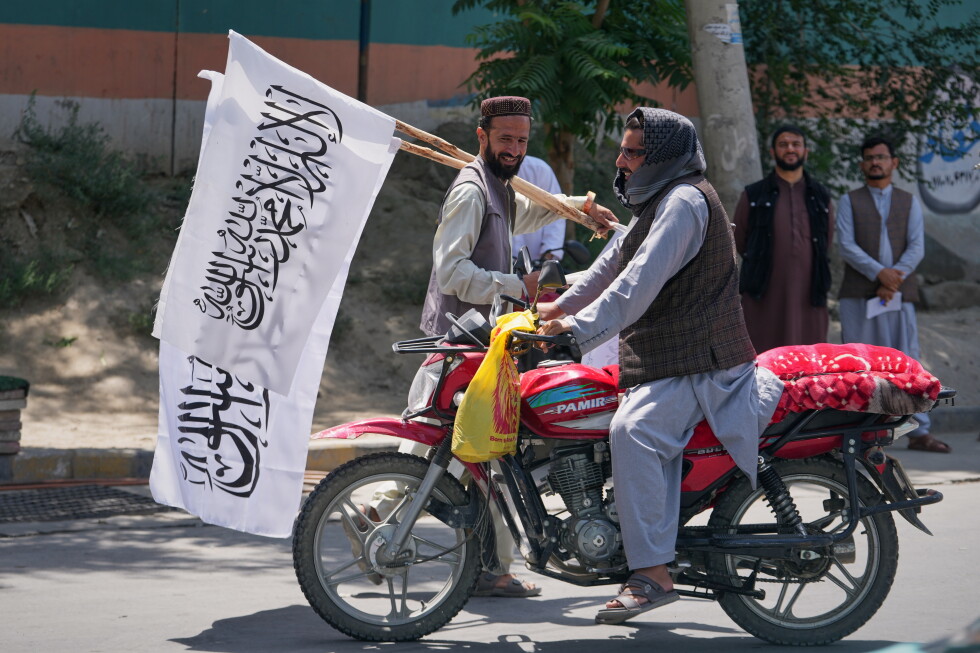
Across Kabul, the Taliban has moved forward with public preparations for anniversary celebrations, with street vendors selling the group’s distinctive white flag with black script, and workers painting pro-Sharia slogans on public walls, including messages that “The Islamic system has been achieved at the cost of the martyrs’ blood” and “Our commitment stands firm: Consolidation and implementation of Islamic Sharia.”
Taliban officials defend their five-year record, framing the end of decades of war as their core achievement. Molvi Hayatullah Mahajar Farahi, deputy minister for broadcasting at the Taliban’s Ministry of Information and Culture, told the Associated Press that in addition to delivering nationwide security, the administration has stabilized the Afghan currency, upgraded critical infrastructure, and established new industrial parks that have created new jobs for Afghans.
“Naturally, challenges and difficulties exist, yet we can highlight several accomplishments,” Farahi said. When pressed about the ban on girls’ and women’s education, Farahi declined to address the policy directly, instead noting that “the level of investment made in universities surpasses anything seen in the past.” He added that “the Emirate continues its efforts to further organize and improve services for our citizens in the fields of education and other sectors.”
Farahi rejected U.N. warnings that terrorist networks have reestablished footholds in Afghanistan under Taliban rule, dismissing the claims as “enemy propaganda, spread to portray the country as unstable.” On the issue of the Taliban’s ongoing international isolation, Farahi claimed the administration maintains working relations with roughly 40 countries, though to date only Russia has formally granted the Taliban government full diplomatic recognition. “The Islamic Emirate of Afghanistan has fulfilled all the requirements necessary for official recognition. It is now up to the international community and others to step forward and take the appropriate action,” he said.
New U.N. data released this week underscores the depth of the educational crisis triggered by the Taliban’s gender ban. UNESCO estimates that 2.4 million girls are currently excluded from secondary education in Afghanistan — an increase of 200,000 from just one year ago. The restrictions have reversed 20 years of incremental progress in expanding educational access across the country, the agency said, noting that the crisis extends beyond gender exclusion: overall, 53% of primary school-aged Afghan children are out of school, and most schools lack basic infrastructure including clean water, sanitation and heating, with hundreds more closed due to frequent natural disasters.
Compounding these challenges, the U.N. World Food Program warns that child malnutrition has reached critical levels in one-third of Afghanistan’s provinces, and conditions are expected to worsen as international funding shortfalls force cuts to food assistance and other life-saving support for vulnerable households.
Even among Afghans who support the Taliban administration and welcome the end of open conflict, many are pushing for policy changes to address the country’s multiple crises. Dost Mohammad Khan, a 38-year-old Kabul resident who backs the Taliban, said the past five years have delivered the stability Afghans longed for after decades of war, but the country needs trained professionals from doctors to engineers to move forward. “We also call upon the Islamic Emirate to permit women to attend school under the sharia dress code and we urge the public to heed the directives of the Emirate also,” Khan said.