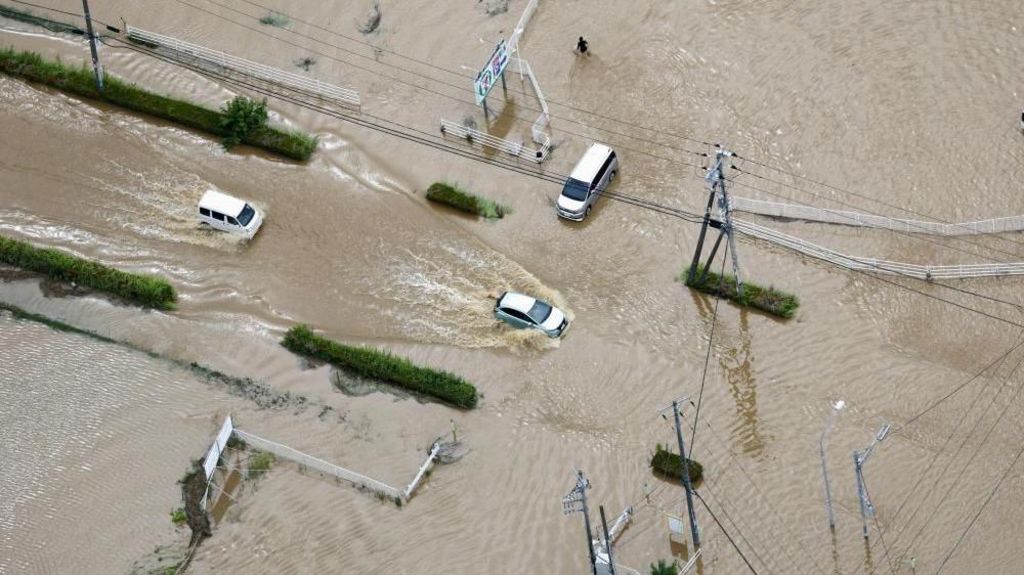
One of the most extreme rainfall events in modern Japanese history has devastated Chiba Prefecture, the populous eastern region adjacent to Tokyo, leaving at least four people dead and five others injured after days of unprecedented downpour.
Local officials first activated Japan’s highest-level Level 5 emergency warning on Thursday as hourly rainfall topped 100mm – three times the average August precipitation for the region and the highest hourly accumulation ever recorded in the country. By Friday morning, the alert was stepped down to Level 4, but authorities continued to urge caution, warning that residual risks of landslides and flash flooding remained high across the area.
The extreme weather has left widespread disruption in its wake: more than 20,000 households lost power, more than 100,000 households were ordered to evacuate, and roughly 7,000 air travelers were stranded overnight at Tokyo’s major Narita International Airport as transport networks collapsed. Vehicles were left abandoned on inundated streets in the city of Oamishirasato, while around 1,800 residents took shelter overnight at the Chiba Prefectural Government building. Rail lines and major highways remained out of service on Friday morning, though airport officials confirmed that regular flight operations were set to resume by the end of the day, with only minor delays expected from major carriers.
Japan Meteorological Agency experts explained that the extreme downpour formed when warm, moisture-heavy air flowing into eastern Japan collided with upper-level cold air, creating highly unstable atmospheric conditions that prolonged the rain. Forecasters projected the rainfall would continue through late Friday.
Chiba Governor Toshihito Kumagai described the event as an extraordinary anomaly even for a disaster-prone nation like Japan. “This case was an extremely unusual situation, even by Japan’s historical weather standards,” Kumagai told reporters Friday. “I have responded to many disasters in the past, but I have never experienced a case like this.” The governor confirmed that search and rescue operations would remain the top priority for local authorities in the coming days.
Local resident accounts highlight the sudden and destructive nature of the flood. One small business owner in Ichikawa city told public broadcaster NHK that the storm struck with no warning, leaving her concerned about the future of her enterprise amid extended power outages.
The deadly Chiba deluge is part of a broader pattern of extreme storm activity across East Asia this week, forecasters confirm. The region is currently experiencing what has been projected to be an unusually active Pacific typhoon season, with three back-to-back storms – Dolphin, Chan-Hom, and Peilou – having swept across Japan, the Philippines, and China earlier this week.
Storm Dolphin previously hit Japan’s Okinawa island, cutting power to tens of thousands of structures, felling trees, and forcing hundreds of flight cancellations. When the same system made landfall in eastern China over the weekend as the year’s strongest typhoon to hit the country, Chinese authorities evacuated more than one million residents to safety. To the south, Philippine officials have suspended classes and government operations across most of the country’s northern regions amid ongoing flood threats.