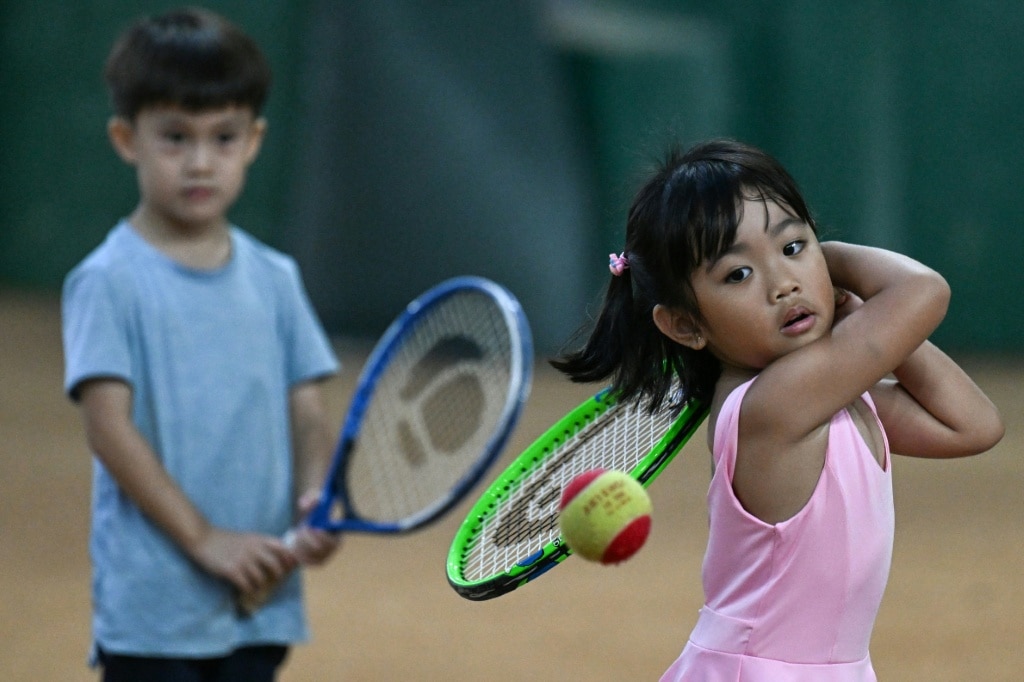
In the sunbaked outer districts of Metro Manila, a four-year-old girl sends a forehand sailing wide across a court paved from crushed seashells. She is far from alone: dozens of young children across the Philippine archipelago are now lacing up tennis shoes and picking up rackets, all chasing the trail blazed by Alexandra Eala, the country’s first homegrown tennis star to reach the upper ranks of global competition.
The 21-year-old’s rapid ascent to the world’s top 20 in the WTA rankings has upended the status of tennis in the Philippines, a nation long dominated by passion for basketball, professional boxing, and cockfighting, where tennis was long dismissed as a pastime exclusive to wealthy elites. Today, the sport is experiencing a surge of grassroots interest unseen in the country’s history: sales of entry-level tennis equipment have spiked, public and private courts are booked out weeks in advance, and parents are enrolling their preschool-aged children in training programs at a rate local tennis authorities never anticipated.
“Apart from just bringing new people to watch the sport, she’s actually gotten people to play,” Tonette Mendoza, executive director of the Philippine Tennis Association (PhilTA), told Agence France-Presse. “Many parents are looking at her success and thinking, ‘If she can do it, maybe my kid can be the next Alex.’”
For nine-year-old Mayumi Stevens, a single iconic photo of Eala diving full-stretch for a shot on Wimbledon’s Centre Court was enough to convince her to pursue tennis. “I felt like, wow, that’s going to be me,” Stevens said while waiting for practice at the Alabang Tennis Academy, an elite training facility in an exclusive Manila suburb. “I want to be Eala when I grow up.”
Major sporting goods brands have already moved to capitalize on the Eala-fueled boom. French retail chain Decathlon reported that beginner tennis racket sales have jumped 66 percent over the past year, prompting the company to rearrange in-store displays and overhaul its social media content to center Eala’s success. “We really had to jump onto the bandwagon, creating content that’s very relatable, that’s very timely for whatever’s happening with Alex right now,” said Vince Roque, Decathlon’s partnerships and communications manager in the Philippines.
The sudden surge in demand has exposed longstanding infrastructure gaps in the country, a sprawling archipelago of more than 7,600 islands that PhilTA estimates has fewer than 1,000 tennis courts in total. Many of these are unique local shell courts, built from a low-cost blend of crushed seashells, sand, and clay that is cheaper to construct and maintain than traditional red clay. Even so, booking a court has become a major challenge. “It’s super crazy to book tennis courts nowadays,” said Czarina Arevalo, coach of the Philippines’ under-12 and under-14 national girls’ teams, adding that she never expected to see a Filipino player break into the world’s top 20 in her lifetime.
Eala, a former US Open junior girls’ champion, climbed to 20th in the WTA rankings just 12 months after qualifying for her first senior Grand Slam, the 2025 French Open. After reaching the fourth round of Wimbledon in July 2025, she claimed her first senior WTA title earlier this month in Washington, D.C., defeating former world number one Naomi Osaka and top-ranked player Jessica Pegula in back-to-back upset wins.
Her historic run has earned her a loyal national following, even among the 10 million Filipinos who live and work overseas in search of better economic opportunity. Many overseas Filipino fans have paid hundreds of dollars for center court seats to watch Eala compete, bringing the raucous, passionate energy typical of Philippine basketball matches to traditional tennis crowds that once prioritized quiet etiquette. “People were screaming like in a basketball match,” Mendoza said of Eala’s appearance at the 2025 Australian Open earlier this year. “Many of them had never watched a tennis match in their entire lives, but this excitement makes sense. She’s our first who’s gone this far.”
Despite the grassroots boom, Philippine tennis still faces steep structural barriers. Outside of Eala, the nation has almost no representation in the upper tiers of professional tennis: just four Filipino men hold ATP rankings, and none are ranked inside the world’s top 1000. Eala is the only ranked Filipina in the WTA. For a population of 116 million, public tennis courts are extremely scarce, and a quality entry-level racket can cost the equivalent of a full month’s wages for the average Filipino worker. Eala herself had to leave the Philippines at age 13 to accept a scholarship at Rafael Nadal’s renowned tennis academy in Spain to pursue her dream, a path not available to most young Filipino players. Most top emerging local players end up moving to the United States for college and transition to coaching after graduation, often out of economic necessity, Mendoza said.
In response to the surge of interest, local governments across the country are now rushing to construct new hard courts, most often in multipurpose facilities that can host multiple sports. Decathlon reported it has received a growing wave of sponsorship requests from local communities building new courts and hosting free beginner tennis clinics. PhilTA is scheduled to break ground this year on a government-funded National Tennis Center north of Manila, which will include a development academy and an 8,000-seat competition stadium.
For tennis advocates, the growing wave of young Filipinos taking up the sport can only increase the odds of producing the next Alexandra Eala. While that next star is “not in the pipeline yet,” Mendoza conceded, “But I’m sure there’s someone out there.”