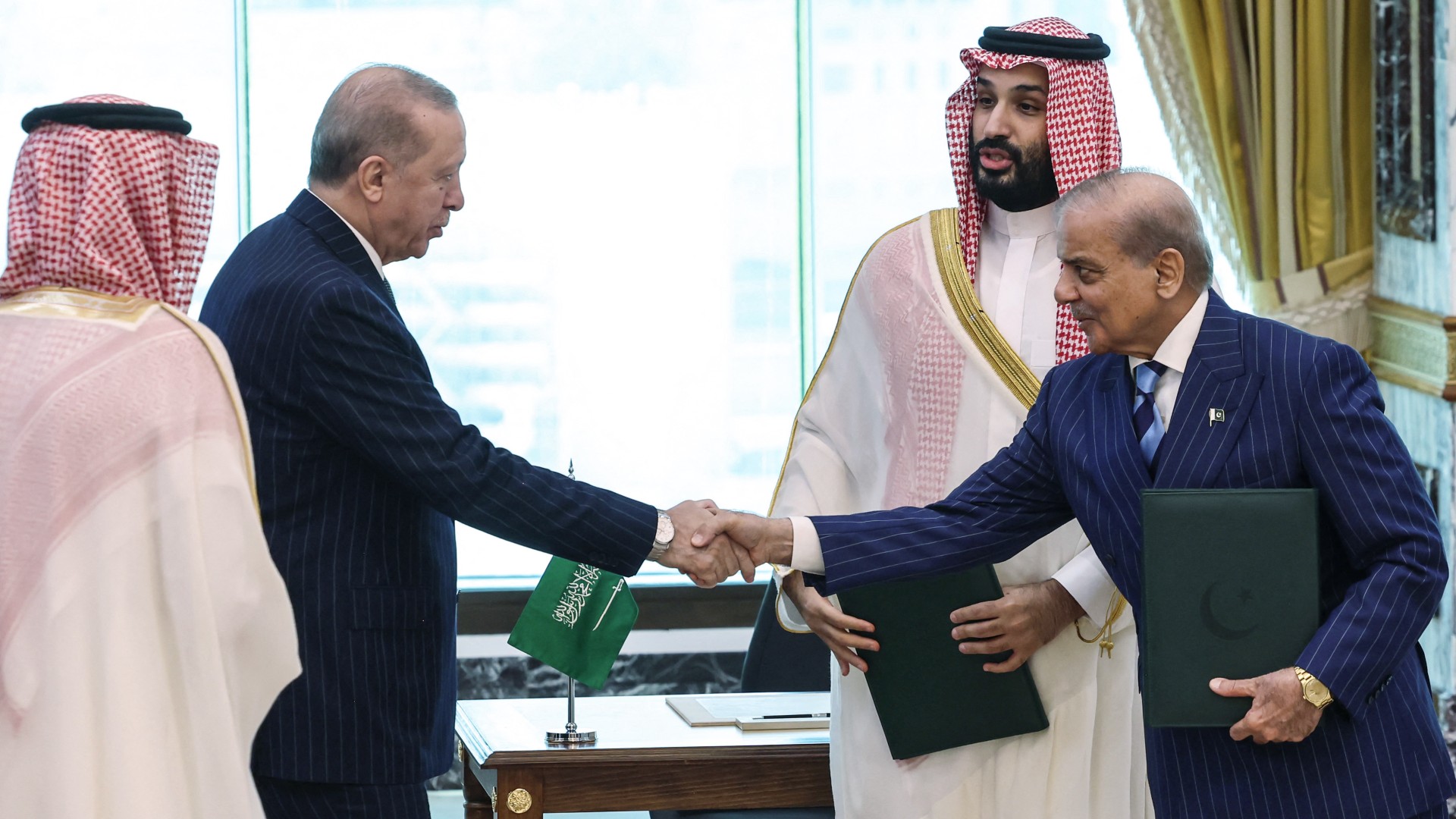
The signing of the Mecca Joint Defence Agreement by Saudi Arabia, Pakistan, and Turkey on August 7 caught many off guard, yet its emergence follows clear regional trends that make it far from unpredictable. While some outsiders have rushed to frame the pact as a sectarian Sunni alliance – pointing to Saudi Arabia’s role as custodian of Islam’s two holiest sites, Mecca and Medina, Pakistan’s status as a nuclear-armed Islamic republic in South Asia, and Turkey’s assertive brand of Europe-facing political Islam – this characterization misses the mark: the agreement has no basis in religious sectarianism.
Rather than creating a new, unified military alliance with a centralized command structure, the Mecca pact consolidates three deep, long-standing bilateral defense and economic partnerships into a single collective framework. It builds directly on a separate mutual defense agreement signed between Pakistan and Saudi Arabia in September 2025, a deal that sparked widespread speculation that it would provide Saudi Arabia with a nuclear defense umbrella, a detail all three parties have intentionally left ambiguous. The addition of Turkey to this existing bilateral dynamic created the tripartite agreement finalized in Mecca.
Regional analysts broadly frame the pact as a key step toward regional countries taking ownership of their own security architecture, rather than relying on outside powers. “It was about time that regional agency takes shape,” explains Bahraini analyst Abdullah Aljunaid. “Put it this way: it’s not Islamic. It’s not about containing Iran either. It is there to prove that the region can produce its own security. You have three major players within the region: Pakistan, Saudi Arabia, and Turkey. What you need to look out for now is the geographical gaps between those three domains, all the way up to Syria.”
The depth of pre-existing military and industrial ties between the three nations underpins the new framework. Pakistan and Turkey have maintained a close defense partnership for decades, and it is an open secret that Turkey’s defense industry leverages Pakistani engineering expertise for advanced research and development: roughly 200 Pakistani engineers currently work on Turkey’s Kaan fifth-generation fighter jet program. For its part, Saudi Arabia has relied on Pakistani military personnel, including soldiers and pilots, for decades, provided critical funding for Islamabad’s nuclear program, and repeatedly injected emergency financial support to shore up Pakistan’s fragile economy.
Turkey also serves as a key arms supplier and strategic partner to Pakistan, contributing modular components to high-profile platforms such as the JF-17 Block III multirole fighter jet, which integrates Turkish ASLPOD targeting pods, MURAD AESA radars, and Bozdogan short-range air-to-air missiles. Over the past five years, Saudi Arabia and Turkey have also steadily aligned their strategic outlooks, with their cooperation in Syria earning praise from Washington as the pair built deeper strategic ties. Today, the partnership holds growing economic and strategic importance for Riyadh as it pursues its 2030 Vision goal of localizing 50% of its military spending, with a focus on armored vehicles, missiles, loitering munitions, and drones. Turkish defense firms such as Baykar and Aselsan have emerged as ideal partners, as they are far more willing than many Western suppliers to engage in technology transfer, joint production, and collaborative research.
Despite these deep connections, merging three separate bilateral relationships into a cohesive tripartite framework poses significant challenges. Senior Ankara-based Center for Iranian Studies researcher Oral Toga notes that negotiations for the Mecca Agreement stretched over two years, meaning its scope was set long before the 2026 U.S.-Israeli war on Iran. Even so, its timing directly reflects growing regional instability around the Strait of Hormuz and the Red Sea.
American security guarantees have lost much of their credibility in the region following the 2025 Hormuz crisis. Former U.S. ambassador to Qatar Patrick Theros argues that Washington’s strike on Iran turned the long-standing American security umbrella into a strategic liability for regional partners, as the U.S. failed to prioritize or deliver reliable air defense coverage for Gulf allies, creating a critical gap in the existing regional security order. “The Saudis have understood that the Abraham Accords have been a security guarantee for Israel, not the kingdom,” notes Dr. Yeghia Tashjian of the Issam Fares Institute at the American University of Beirut.
This realization has pushed Gulf states to build new, regionally rooted defense architectures. Qatar moved early to deepen its strategic partnership with Turkey, well before the 2025 Israeli raid on Doha. Saudi Arabia and the United Arab Emirates have taken divergent paths: the UAE has doubled down on its partnership with Israel, which has deployed outer layers of its Iron Dome defense system in the Gulf, while Saudi Arabia has turned to its long-standing historical security partner Pakistan while steadily expanding its ties with Turkey.
The core question that remains is the ultimate purpose and end state of the new agreement. Dr. Gallia Lindenstrauss, a leading expert on Turkish-Israeli relations at Tel Aviv’s Institute for National Security Studies, argues that while the pact is explicitly framed as defensive, it sends a clear strategic signal to Iran, Israel, and even the UAE. Retired Pakistani Air Marshal Saeed Khan, a former ambassador to Syria, projects that shifting U.S. strategic priorities will reshape the regional order in the near term: “Slowly and gradually, in the next one-two-three years, we will see America reducing its presence in the Gulf, and concentrating in the South China Sea.”
A key point of ongoing ambiguity is whether the agreement qualifies as a full military alliance. By definition, an alliance requires a shared understanding of core national security threats and a unified command structure – two elements that remain absent more than a month after the pact’s signing. While Pakistani troops and pilots have deployed repeatedly in Yemen under Saudi command, it remains unlikely that Pakistan would deploy its own armed forces directly to confront the UAE, a key economic partner. The April 2026 withdrawal of more than $3.5 billion in Emirati deposits from Pakistan’s central bank served as a clear warning that Islamabad’s alignment with Riyadh carries tangible economic costs. Islamabad will also avoid direct confrontation with Iran: the two countries share a 1,000-kilometer unstable border and face the common threat of Baloch separatist groups, giving Pakistan strong incentive to avoid tensions with Tehran.
Similarly, Ankara is unlikely to deploy forces to Yemen and risk conflict with Iran, as both countries face shared challenges from Kurdish separatist groups. Even Saudi Arabia has repeatedly sought to avoid stoking Sunni-Shia sectarian tensions, a reluctance that has been reinforced during successive U.S.-Israeli campaigns against Iran.
Despite these divergent national priorities, the three nations do share interests in addressing common security challenges, particularly in the Red Sea region. Turkey’s Turksom military camp in Mogadishu serves as a key hub for its power projection in the Horn of Africa, and Pakistan has complemented this presence by signing a new military cooperation agreement with Somalia that allows for the deployment of a Pakistani expeditionary force. On the opposing side of this alignment, Israel recognized Somaliland’s independence in December 2025, and the UAE uses infrastructure at Bosaso port and airport to support its operations in Sudan’s ongoing conflict, creating a clear if messy polarization between camps supporting the status quo and those seeking to revise it – a far cry from the clear alignment of Cold War-era blocs such as NATO.
Whether shared strategic outlooks will translate to coordinated joint military action depends on a range of contextual factors, and overlapping competing interests remain. Turkish-Emirati defense industrial cooperation continues to grow, and Pakistan relies heavily on remittances from the 1.6 million Pakistanis living in the UAE. As military analyst Kamal Alam notes, no one should expect Saudi Arabia to sever ties with India over New Delhi’s arms sales to Israel should the need arise.
Overall, the Mecca Agreement delivers an intentionally ambiguous strategic message. The three underlying bilateral partnerships remain separate and compartmentalized, even as a broader regional polarization solidifies between status quo powers and revisionist actors. Across Ankara, Manama, Riyadh, and Beirut, analysts widely view the Emirati-Israeli alliance as seeking to revise the regional security status quo, just as Iran seeks to change the status quo around the Strait of Hormuz. This polarization creates risks, particularly for Israel, which also faces uncertainty over long-term U.S. commitment to the region.
For Israel, the agreement makes the long-sought goal of normalizing relations with Saudi Arabia even more out of reach. “From an Israeli perspective, normalisation between Israel and Saudi Arabia, if not harder, is at least a more distant reality,” notes Lindenstrauss, adding that this is a major setback for Israeli Prime Minister Benjamin Netanyahu, who made expanded Abraham Accords a top policy priority.
What unites the three Mecca signatories is a shared commitment to upholding the existing territorial status quo, in contrast to the UAE’s support for sub-state actors across the region. As Toga explains: “All three signatories have backed central state authority where the UAE has backed sub-state actors: the Sudanese army against the RSF, Yemen’s recognised government against the STC, Somalia’s territorial integrity against Somaliland’s recognition. Riyadh no longer faces that network alone, and after the Yemen confrontation of late 2025, that is a meaningful change. But I would not overstate it.”
This consensus marks a foundational shift: the Mecca Agreement is a public statement of intent to defend the regional territorial status quo as the U.S. gradually draws down its military presence in the Gulf. Looking ahead, analysts say the next major development could be additional Chinese mediation to ease tensions between Iran and the Mecca signatories, as the U.S. is no longer seen as having the credibility or convening power to bring regional parties together.