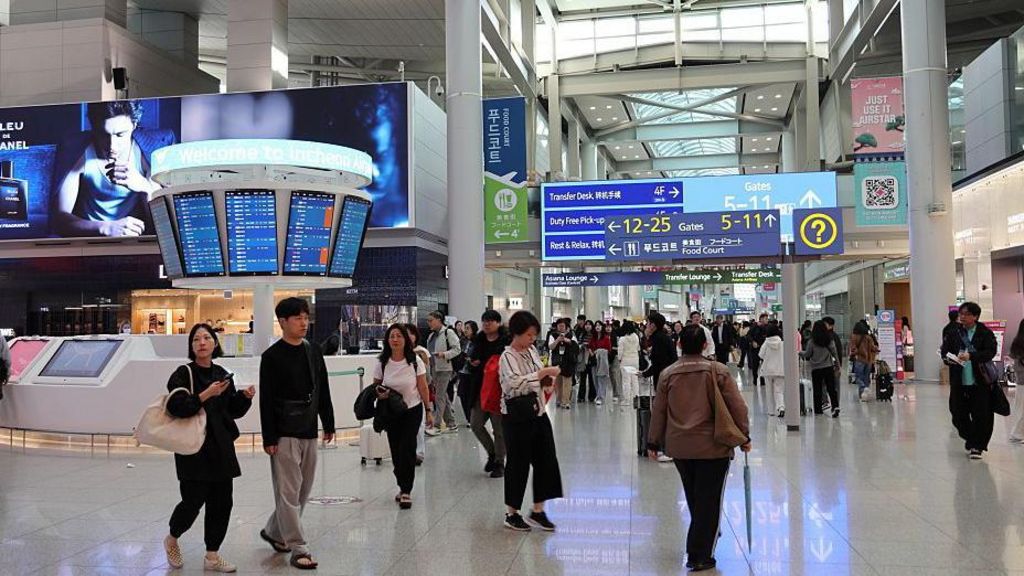
New preliminary data released by Airports Council International has marked a historic milestone for global aviation: South Korea’s Incheon International Airport, the country’s primary international entry point, has overtaken long-standing industry leaders to become the world’s busiest airport for international passenger traffic in the first half of 2025.
According to the recently published figures, Incheon handled 38.4 million international passengers between January and June this year. This puts it just ahead of the United Kingdom’s London Heathrow Airport, which secured second place with 37.79 million passengers. Singapore’s iconic Changi Airport follows closely in third position, recording 38.4 million passengers, recording 34.53 million international travelers over the same period.
The shift in rankings marks a dramatic reversal of position from just a few years ago. Full-year statistics from 2024 and 2025 placed Incheon at 12th and 13th respectively, while London Heathrow sat at fifth in 2024 and seventh in 2025. Most notably, Dubai International Airport — a long-time staple in the top two of this global ranking over the past two years — is now projected to drop out of the top five entirely in this mid-year update.
Officials from Incheon International Airport Corporation have pointed to two key factors driving the unexpected surge in passenger numbers. First, ongoing geopolitical tensions between the United States and Iran have pushed many international travelers to divert transit routes away from major Middle Eastern aviation hubs. “Travelers who previously transited through Dubai en route to European destinations are now choosing to connect through Incheon instead,” the corporation explained. This shift has driven an 18% year-over-year increase in transfer passengers overall, with the number of transfer passengers heading to final destinations in Europe spiking 63.2% to 210,000.
The second core contributor is Incheon’s years-long investment in expanded infrastructure, which has equipped the airport to accommodate the growing passenger volume. Since opening in 2001, the airport has expanded its route network to connect to 158 international destinations, outpacing other major regional hubs: Hong Kong International Airport serves 139 destinations, while Shanghai Pudong International Airport connects to 92 and Tokyo Narita International Airport serves just 86.
Expressing gratitude for the achievement, Incheon International Airport Corporation’s acting president Kim Beom-ho credited the result to government backing, public support, and the relentless work of all on-site airport staff. “We are grateful for the South Korean government’s support, the public’s encouragement, and the hard work of everyone stationed at the airport in making Incheon the world’s No. 1 airport,” Kim said. Looking ahead, the corporation plans to build on this new status by further strengthening its competitiveness through targeted improvements to passenger convenience and experience.