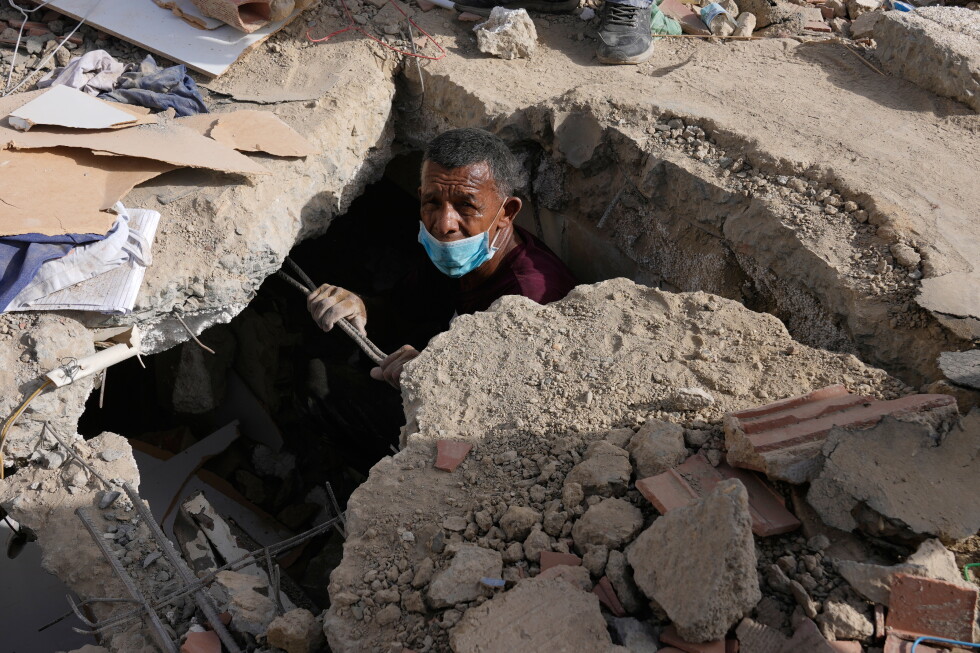
Two major seismic events struck South America within two months this year, leaving behind flattened buildings, grieving communities, and urgent calls for help that spread across social media. As nations from every continent stepped forward to offer assistance, a sharp contrast in how the two impacted countries—Colombia and Venezuela—mobilized their disaster responses has laid bare deep divides in political structure, institutional capacity, and available resources between the neighboring Latin American nations.
On Monday, a 7.4-magnitude earthquake hit western Colombia, toppling buildings in multiple provinces including the country’s third-largest city, Cali. Barely an hour after the ground stopped shaking, Colombia’s newly inaugurated President Abelardo de la Espriella had already established a central emergency command post to coordinate search-and-rescue operations. By contrast, when two consecutive earthquakes hit Venezuela on June 24, acting President Delcy Rodríguez waited nearly four full hours before addressing the nation about the unfolding crisis.
This gap in response speed was just the first of many stark differences. In the days after Colombia’s quake, trained rescue teams deployed heavy machinery including cranes and excavators to dig through rubble for trapped survivors. In Venezuela, ordinary civilians spent weeks digging through collapsed structures by hand, with no heavy equipment provided by the state. Venezuela’s government was forced to rely entirely on international rescue teams to fill critical gaps in its disaster response, while Colombia confirmed it has sufficient domestic personnel to lead search efforts, only accepting support from the United States and requesting humanitarian supplies rather than foreign rescue crews.
For Colombia, the rapid response came even amid an unprecedented political transition. De la Espriella, a conservative former criminal defense lawyer with no prior national political experience, was only sworn in 72 hours before the earthquake struck. His narrow electoral victory over former leftist president Gustavo Petro, Colombia’s first left-wing head of state, was initially disputed, with Petro refusing to recognize the result and alleging electoral fraud. This political feud delayed the formal handover of power, leaving key agencies including the national disaster management authority in the hands of officials de la Espriella had criticized during his campaign. Despite this disruption, humanitarian workers and international observers note that Colombia’s disaster response rose above political tensions, highlighting the resilience of the country’s democratic institutions.
“All the institutions have worked,” said María José Torres Macho, the United Nations’ top representative in Colombia. “Our ability to be working with them has not been affected by the change of government.”
Just an hour after the quake, de la Espriella released a public video confirming he would take personal leadership of the response, telling impacted communities in the hard-hit coffee-growing region, “You’re not alone.” Within hours he was coordinating with national officials and relief agencies in Bogota, and within 36 hours he had already toured disaster zones in the western cities of Quibdo, Cali and Pereira, while dispatching cabinet ministers to more remote impacted areas.
Ana Karina García, director of Fundación Juntos Se Puede, a Colombian-based aid group for Venezuelan migrants, explained the strength of Colombia’s institutional framework: “There is an entire system that means that even when you change the person at the top, the institution keeps functioning.”
Still, Colombia’s response has not been without criticism. De la Espriella’s decision to decline most international rescue teams has sparked questions about his administration’s handling of foreign aid, with China’s ambassador publicly noting on social media that he could not even identify which Colombian official was responsible for coordinating international assistance. Rugged mountain terrain, decades of underinvestment in rural infrastructure, and post-quake communication disruptions have also slowed the collection of casualty data from the hardest-hit areas. The national government’s official count stands at at least 265 dead and 500 missing, a figure far lower than counts released by local authorities, while an independent public database lists more than 4,100 people as unaccounted for.
In Venezuela, by contrast, experienced political leaders have faced widespread backlash over their chaotic, delayed response to the June quakes. Rodríguez, who has nearly 20 years of experience in Venezuela’s highest levels of government, failed to project clear authority over the disaster response from the start. Hours before Rodríguez addressed the nation to declare a national emergency, ruling party rival and interior minister Diosdado Cabello went on state television to release his own damage report, revealing competing power struggles within the ruling socialist party that undermined a unified response. When Rodríguez released the first official casualty count, she excluded La Guaira—the earthquake’s epicenter and the area that suffered the worst destruction. Many of La Guaira’s victims lived in low-cost government-built housing complexes constructed during the 2000s oil boom, part of a massive subsidized housing program that became a core pillar of the ruling party’s political patronage system. Rodríguez remained in Caracas for a full day before traveling to La Guaira to assess damage, and for weeks the government only updated the death toll without releasing any data on missing persons, fueling widespread accusations of undercounting as civilians struggled to recover remains without heavy machinery.
More than six weeks after the Venezuelan quakes, an opposition-run database widely cited by independent observers lists 29,000 people as unaccounted for. The government now updates the death toll just once a week; as of this week, the official count stands at 6,301. Years of systematic political repression have also left most Venezuelans deeply distrustful of the official response to the disaster.
“It was very difficult for citizens to access important information about the emergency, get themselves to safety and know where to seek help,” said Gabriel Bastidas, a Venezuela-based journalist now living in Argentina who runs Monitoreamos.com, an independent outlet critical of the ruling movement that is one of dozens of independent media outlets blocked within Venezuela’s borders.
Experts note that geographic and timing differences also separate the two disasters: Venezuela’s twin quakes struck densely populated La Guaira around nightfall, complicating immediate search and reconnaissance efforts, while Colombia’s quake hit largely rural areas during daylight hours. It also typically takes weeks for full casualty data to emerge after a disaster of this magnitude, and Colombia is only days into its response efforts, with thousands still unaccounted for. Still, the contrast is impossible to ignore for many Venezuelans, who have watched their country’s state capacity hollowed out after years of crippling economic crisis and mass migration under former President Nicolás Maduro.
“From the very beginning, we saw the news media broadcasting live from the sites of the catastrophe; mayors, governors, health secretaries, emergency officials providing details about the dead and missing,” Bastidas said.
That transparency and rapid response has even struck Venezuelans with family caught up in Colombia’s disaster. Juan Mogollon, a 28-year-old Venezuelan who now lives in Orlando, Florida, learned Monday morning that his 16-year-old cousin José Juan Vivas and the boy’s grandparents were trapped in the rubble of their collapsed Cali apartment building. Vivas, a U.S. permanent resident, had been staying with his grandparents, who resettled in Colombia after fleeing Venezuela’s crisis. Having watched Venezuelan civilians beg for rescue equipment and support after the June quakes, Mogollon expected the worst.
Yet within just a few hours, footage from the collapse site showed excavators, cranes, and other heavy machinery already on the ground, alongside firefighters flown in from Bogota. Colombian security forces deployed search dogs and thermal-equipped drones to scan for survivors across impacted towns.
“They are prepared, they have the equipment, they have the protocols, they know what to do,” Mogollon said, as he waits anxiously for news of his relatives. “That’s the least we should expect as citizens in every country, you know? That’s the difference between my country and Colombia right now.”
Ronal Rodríguez, a Venezuela specialist at Colombia’s Rosario University, summed up the lesson of the side-by-side disasters: “The differences between an authoritarian regime and a democratic system can be seen clearly in the institutions and in their capacity to respond to an emergency. Crises are also political opportunities.”