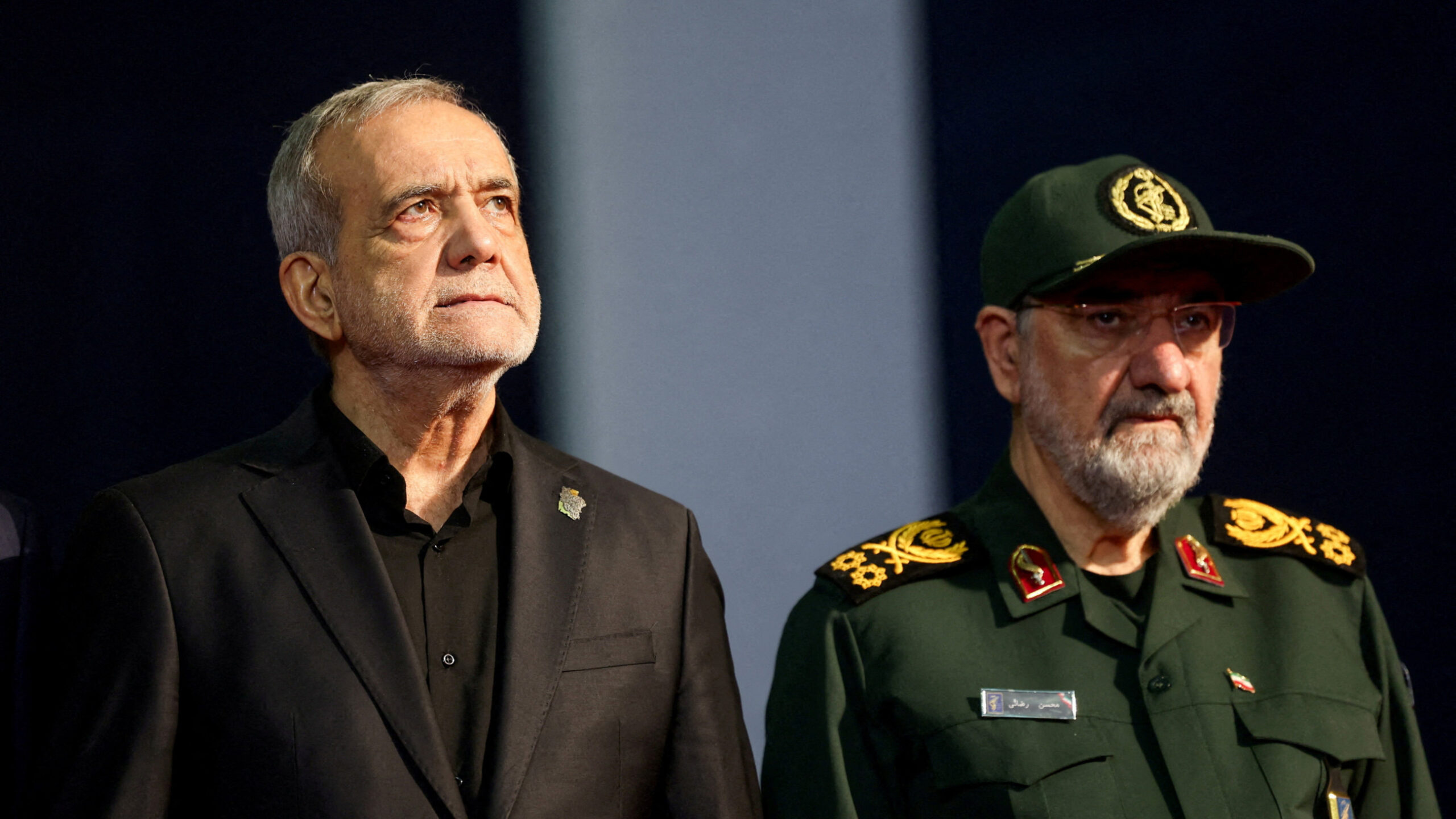
Weeks after Iranian and American negotiators finalized a historic Memorandum of Understanding to put an end to months of escalating cross-border hostilities in late June, Iran’s top security body, the Supreme National Security Council (SNSC), publicly threw its weight behind the breakthrough agreement in an official statement. The statement carried the signature of Mohammad Bagher Zolghadr, a former hardline general from the Islamic Revolutionary Guard Corps (IRGC) who stepped into his role after the killing of prominent moderate Ali Larijani. Larijani, a vocal backer of a diplomatic deal with Washington, was killed in a joint US-Israeli airstrike on March 17.
In Iran’s political structure, the SNSC secretary – a role appointed by the sitting president – holds no voting power on the council. But Zolghadr had simultaneously been named as supreme leader Ali Khamenei’s personal representative to the body, a post that grants full voting authority, putting him in a unique position to formally back the deal.
Zolghadr’s public endorsement of the agreement caught Iran’s ultraconservative principlist faction completely off guard. Unprepared for the turn of events, the hardline bloc launched a sustained smear campaign against Zolghadr, even circulating unsubstantiated claims that his son resides in Austria to discredit him.
Days after the SNSC released its statement, Iran’s new supreme leader Mojtaba Khamenei released his own public remarks, revealing that he held “in principle” opposition to the agreement while placing full responsibility for the deal squarely on the negotiating team. Political analysts say the statement effectively abandoned negotiators to backlash, emboldening ultraconservatives to ramp up their attacks against the agreement, the reformist-leaning government led by President Masoud Pezeshkian, the negotiating team, and Zolghadr personally.
According to two anonymous sources within Iran’s conservative camp, Zolghadr penned a direct letter to Khamenei following the supreme leader’s statement, voicing clear dissatisfaction with the move. Zolghadr argued that Khamenei had already been fully briefed on all details of the agreement prior to its public announcement, and submitted his formal resignation from his posts on the council.
Citing insider accounts, the sources confirm Khamenei accepted Zolghadr’s resignation nearly immediately. The departure marks a highly unusual moment in Iranian politics: it is rare for a senior government official to resign in explicit protest of a direct decision from the supreme leader.
Principlist lawmakers and allies have publicly framed Zolghadr’s exit as a removal, arguing he was ousted for aligning with President Pezeshkian and backing the deal instead of opposing it. But reporting from Middle East Eye, speaking to multiple conservative sources with direct knowledge of the episode, directly contradicts that narrative.
The sources confirm that President Pezeshkian lobbied heavily to convince Khamenei to reject the resignation and keep Zolghadr in his role as SNSC secretary, noting Zolghadr’s broad alignment with the government’s goal of securing a diplomatic deal with the United States. Pezeshkian’s efforts ultimately fell short, however.
In Zolghadr’s place, Khamenei appointed former IRGC commander Mohsen Rezaei as his new representative to the SNSC. The appointment effectively forced President Pezeshkian to name Rezaei as SNSC secretary, despite the president’s initial resistance to the pick, which he only signed off on at the eleventh hour.
At 71 years old, Rezaei has been a core figure in the Islamic Republic’s military, security, and political establishment for nearly 50 years. In the aftermath of the 1979 Islamic Revolution, he helped build the IRGC’s intelligence apparatus, and became the IRGC’s commander at just 27 years old. He held the top IRGC post for 16 years, leading the force through the entirety of the 1980s Iran-Iraq War.
Rezaei was already involved in behind-the-scenes diplomacy with the United States as early as the mid-1980s, during the Iran-Contra affair, a scandal that saw the US secretly sell weapons to Iran to fund anti-government Contra rebels in Nicaragua. Former Iranian President Akbar Hashemi Rafsanjani once told local media that his nephew Ali Hashemi, a key go-between for contacts with Ronald Reagan’s White House, briefed both him and Rezaei on meetings with US officials.
Per Rafsanjani’s account, Rezaei encouraged the backchannel talks, telling him “Keep going. We need weapons.” Rafsanjani also recalled that Rezaei instructed him to hand off his contacts to allies Rezaei named to keep the process moving forward, and confirmed after a second round of negotiations that Ayatollah Ruhollah Khomeini, the founder of the Islamic Republic, was fully aware of the secret talks. As the contacts progressed, Rafsanjani and two IRGC officials even traveled to Washington for closed-door negotiations.
In the 1990s, Rezaei’s eldest son relocated to the United States, where he sought asylum and became a public critic of the Islamic Republic. He eventually returned to Iran, but died years later under suspicious circumstances in a Dubai hotel.
By the end of the 1990s, Rezaei sought to transition from his military career to a more prominent political and policy role. He enrolled in economics studies at the University of Tehran, completed a doctorate, and increasingly focused his work at the Expediency Discernment Council on macroeconomics, national development planning, and broad institutional policy priorities. He has launched multiple campaigns for the Iranian presidency, but never secured victory. In September 2021, the late President Ebrahim Raisi appointed Rezaei as vice president for economic affairs and secretary of the Supreme Economic Coordination Council of the Heads of the Three Branches of Government. Rezaei stepped down from the vice presidency in June 2023, but retained his post as secretary of the economic coordination council at Raisi’s request.
In comments on April 6, Rezaei argued that the US naval blockade of Iran was “vulnerable” and amounted to little more than psychological warfare, saying it would not shift Iran’s negotiating position. “I do not personally support extending the ceasefire. It should happen only if a final agreement is reached and our rights are secured,” he stated. He also added that Washington has no coherent strategy to end the ongoing conflict, noting that the US tests one approach, fails, and then pivots to another. He laid out two possible outcomes: that the US is coming to terms with its defeat, or that former US President Donald Trump would so severely damage US global standing that he would eventually be removed from office.
On July 7, just days after the MoU was finalized, Rezaei said: “Those opposed to negotiations should wait. The Americans themselves will derail these talks.”
Despite Rezaei’s increasingly harsh public rhetoric against the current negotiations, a senior Iranian political source familiar with his thinking told Middle East Eye that Rezaei is personally a pragmatist who has long favored restoring diplomatic relations with the US and ending the long-running conflict. The source added, however, that Rezaei’s long-standing political calculations and his commitment to retaining his place in Iran’s power structure have consistently led him to “go with the flow,” shifting his public positions to align with changing political tides. The source described this adaptability as one of the defining traits of Rezaei’s decades-long political career. The source added that it will soon become clear whether Rezaei’s hardline rhetoric reflects genuine opposition to the ongoing negotiations, or is simply a political tactic to undermine the current negotiating team because he was excluded from the core of the current process.
Middle East Eye provides independent, in-depth coverage and analysis of the Middle East, North Africa, and surrounding regions.