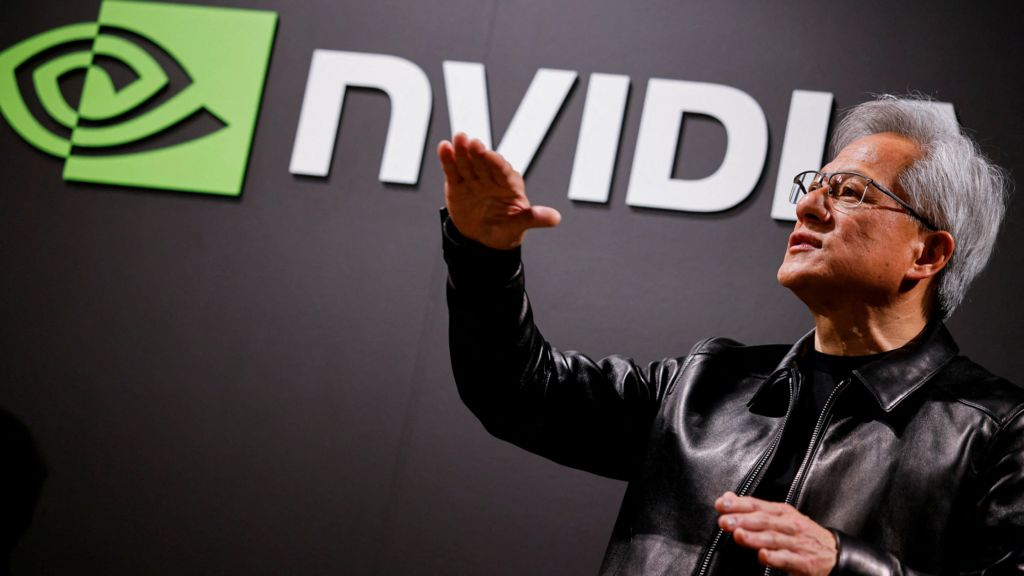
The global artificial intelligence boom has already reshaped tech industry valuations, and now it is set for an even larger expansion after leading chip designer Nvidia announced a historic partnership with some of Wall Street’s most powerful financial institutions. The California-based firm is working with six major investment and financial groups — Apollo, BlackRock, Blackstone, Brookfield, Goldman Sachs, and KKR — to raise a massive $500 billion capital pool dedicated exclusively to building out global AI infrastructure.
A core innovation of this new initiative is that it formally classifies AI computing hardware and supporting infrastructure, commonly shortened to “compute” in tech circles, as a standalone, investable asset class for the first time. This shift marks a major turning point for how global capital markets engage with the fast-growing AI sector, as major long-term investors increasingly recognize the sustained economic value of AI infrastructure.
“In AI, compute is revenue,” Jensen Huang, Nvidia’s co-founder and chief executive officer, said in an official statement. “We are bringing the world’s leading long-term capital providers together to independently underwrite AI infrastructure.”
The pooled capital will support two key categories of projects: large-scale AI infrastructure initiatives led by Nvidia itself, and similar projects being developed by the chipmaker’s extensive network of global industry partners. Most planned investments will go toward the construction of new, purpose-built data centers, which are required to house, power, and cool the dense stacks of GPU chips that process AI workloads and power generative AI tools. A portion of the funding will also go toward building new manufacturing facilities to increase production of Nvidia’s high-demand AI chips, addressing ongoing supply shortages that have plagued the sector for years.
Industry leaders across finance and technology have echoed Huang’s outlook on the critical role of AI infrastructure. “Compute has become a critical infrastructure asset,” Joe Bae and Scott Nuttall, co-chief executives of global investment firm KKR, noted in a joint statement. “As we’ve scaled our approach to digital infrastructure, we’ve learned that delivery, not ambition, is the hard part.”
Nvidia currently holds a near-dominant position in the global market for high-performance AI chips. Virtually every major technology and AI developer, from Google and Meta to Amazon, Microsoft, OpenAI, and Anthropic, relies on Nvidia’s graphics processing units (GPUs) to power their AI platforms, cloud services, and consumer chatbots. This unmet demand has already driven exponential growth for Nvidia: over the past three years, industry-wide spending on AI projects and infrastructure has surpassed $1 trillion, and Nvidia’s own market capitalization has grown fivefold over the same period as companies rush to secure access to its chips.
Huang framed the new capital initiative as the next major step in Nvidia’s evolution beyond its core origins as a chip manufacturer. “Today, we are helping create a new class of productive, investable infrastructure: AI factories,” he said.
For the companies developing AI tools, this new funding framework will open up new avenues to finance rapid expansion, keeping pace with exploding consumer and enterprise demand for AI services. Jim Zelter, president of Apollo — a global alternative asset manager that oversees more than $1 trillion in total assets — noted that AI computing has moved far beyond a niche tech trend to become a core global resource. “Modern compute has emerged as a scarce, mission-critical asset class,” he said, adding that the sector is “positioned to drive significant long-term economic growth and productivity gains.”
The new partnership builds on a wave of recent independent moves by major financial firms to invest directly in AI infrastructure. Just last month, BlackRock reached a separate deal with Meta to finance a Texas data center, taking a majority ownership stake in the facility. AI startup Anthropic, the developer of the popular Claude chatbot, recently secured a customized infrastructure investment deal with Macquarie Asset Management and Singapore’s sovereign wealth fund GIC, after demand for its AI service grew so quickly that it required massive new computing capacity. While the company did not disclose the full size of that deal, Anthropic made clear that widespread adoption of its platform has left it needing far more capital to expand capacity.
Market analysts expect the $500 billion initiative to accelerate global AI development by closing the gap between high demand for computing capacity and the limited supply of infrastructure that can support growing AI workloads. As the AI sector continues to mature, the formal recognition of compute as an investable asset class is likely to unlock trillions more in long-term institutional investment in coming years.