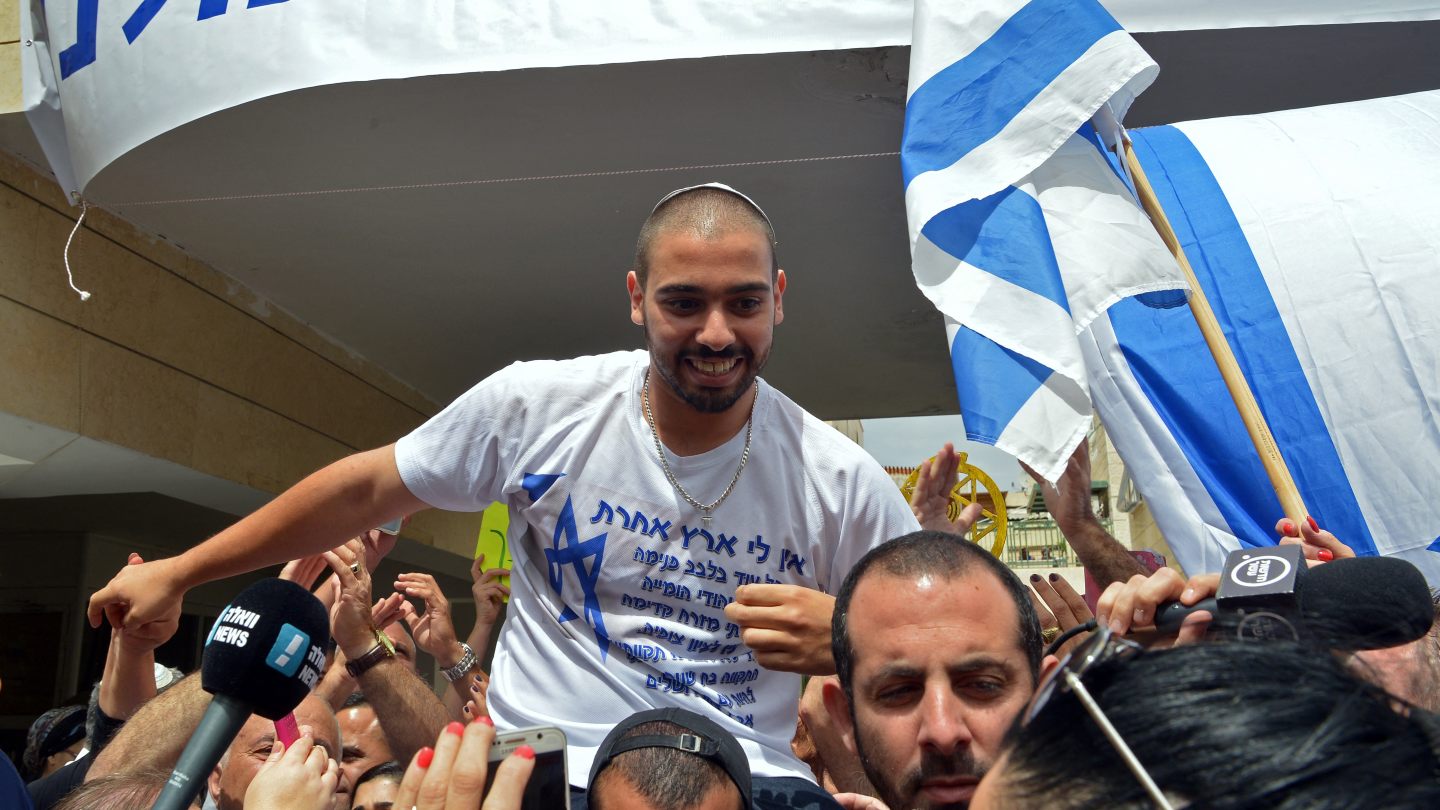
More than a decade after a fatal shooting that split Israeli society and roiled the country’s political landscape, Israeli President Isaac Herzog has issued a full pardon to former Israeli soldier Elor Azaria, overturning his 2017 manslaughter conviction and wiping clean his criminal record. The announcement, first reported by Israeli newspaper Haaretz on Saturday, comes amid deep divisions over the decision, which directly contradicts official advice from Israel’s top military leadership.
The incident that sparked this long-running debate dates back to 2016, in the occupied West Bank city of Hebron. Azaria, then a young Israeli soldier, shot 21-year-old Palestinian Abdel Fattah al-Sharif in the head moments after al-Sharif had already been wounded by Israeli fire during a reported stabbing attack in the Tal Rumeida neighborhood. A Palestinian photographer working for Israeli human rights organization B’Tselem captured the killing on video, turning the case into an international incident that sparked mass outrage across the occupied Palestinian territories and deep polarization within Israel.
At the time of the shooting, the Palestinian Ministry of Foreign Affairs labeled the killing an “extrajudicial execution”, while the Israeli military openly acknowledged that Azaria had violated the service’s official code of ethics. In his 2017 military court trial, Azaria was found guilty of manslaughter and sentenced to 18 months in military prison, a term that was later reduced to 14 months by then-military chief Gadi Eisenkot. He ultimately served just nine months of the shortened sentence before being released in May 2018.
From the moment of Azaria’s arrest, the case became a lightning rod for Israeli right-wing politics. Mass demonstrations were organized demanding his release, and sitting politicians quickly joined the calls for clemency. Just three months after the Hebron incident, then-Defense Minister Moshe Yaalon, who had openly condemned Azaria’s actions, resigned from his post, citing a breakdown of trust in then-Prime Minister Benjamin Netanyahu over his handling of the controversy. Avigdor Liberman, a public supporter of Azaria, was appointed to replace Yaalon, and began pushing for a presidential pardon almost immediately, an effort that former President Reuven Rivlin rejected.
In justifying his decision to grant the pardon this year, Herzog framed the move around the spirit of Yom Kippur, Judaism’s Day of Atonement and one of its most sacred holy days. In an official statement released Saturday, the president’s office noted that Azaria had already “bore the consequences of his actions” for many years, and that the former soldier had expressed remorse for the harm resulting from the shooting. “This decision was made out of a belief in the importance of repair, reconciliation, and the ability to move forward,” the statement read.
However, the move runs directly counter to the explicit recommendation of current Israeli military chief Eyal Zamir, who sent a formal letter to Herzog opposing the pardon. Zamir argued that Azaria has never shown public remorse for the killing of al-Sharif. That objection was echoed by Yaalon, now one of Netanyahu’s most prominent political critics, who condemned the pardon as “a disgrace” on social media platform X. Yaalon also accused Herzog of aligning with political attacks on Eisenkot, who is currently leading public opinion polls ahead of Israel’s scheduled October general election. Pointing to Azaria’s own words from the trial, Yaalon noted that the former soldier never claimed he shot al-Sharif out of fear for his life, saying instead that the Palestinian “deserved to die”.
Defense Minister Israel Katz, who submitted the official pardon request to Herzog, praised the president’s decision as “a correct, humane, and fitting decision”. Katz argued that the pardon sends a clear message to active-duty Israeli soldiers and their families: “We do not abandon soldiers and do not leave them behind.” Far-right Israeli National Security Minister Itamar Ben Gvir, who participated in public protests for Azaria a decade ago, said he was “thrilled” by the ruling, claiming that if the current far-right government’s updated rules of engagement had been in place in 2016, Azaria would never have faced conviction at all.
Azaria himself reacted to the pardon with open celebration, telling Channel 14 News that it had been “a blessed week”. “Thank God we have reached this moment,” he said, adding that, “It is important that no fighter goes through what I went through.” He also publicly thanked his family, Katz, and Herzog for the outcome.
The pardon has renewed longstanding concerns over impunity for Israeli security forces operating in the occupied Palestinian territories, highlighted in a recent report from B’Tselem. The group documented that between October 2023 and June 2026 alone, Israeli forces killed 1,087 Palestinians in the occupied West Bank and East Jerusalem, including 242 children and 21 women. B’Tselem described current Israeli policy in Palestinian territories as “a sweeping Israeli assault that is systematically and at an accelerating pace dismantling the foundations of Palestinian existence”, noting that Israeli soldiers, police, and settlers are granted “broad impunity” for violence against Palestinians. Data from the group shows that between 2016 and 2024, just 22.7 percent of formal complaints against Israeli soldiers resulted in investigations, and only 0.9 percent ended in criminal indictments.