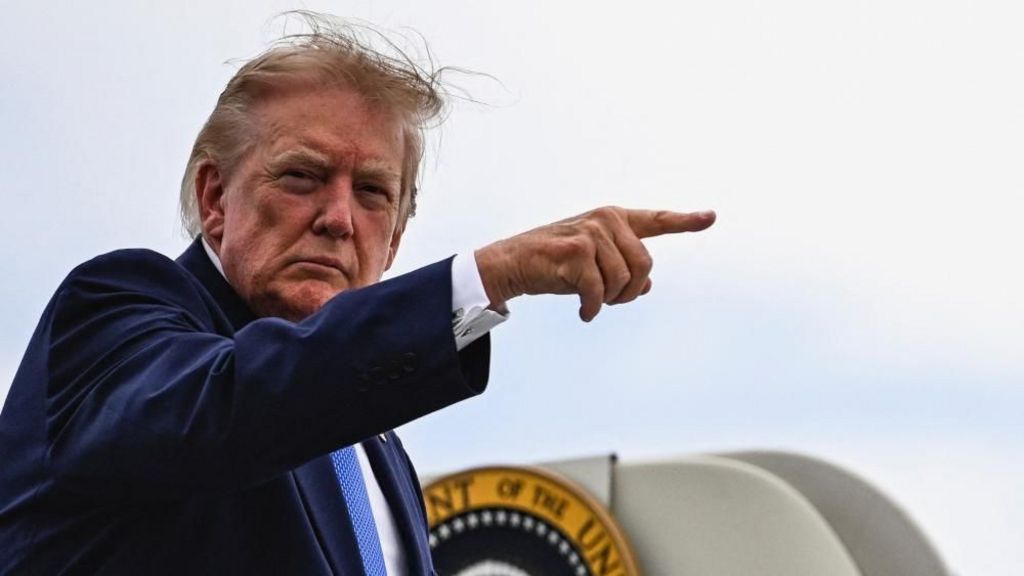
Nearly five years after the Trump administration upended decades of international consensus on Western Sahara by formally recognizing Moroccan sovereignty over the disputed territory, Rabat has moved to honor the former U.S. president with a high-profile naming gesture. Morocco’s state-run press agency has released a previously unannounced letter from King Mohammed VI to Donald Trump, confirming that the strategic 1,055-kilometer Tiznit-Dakhla highway that stretches into Morocco-occupied Western Sahara will be renamed in Trump’s honor.
The honor was first revealed by Trump himself last week, when the former president posted a message of thanks to King Mohammed on his Truth Social platform, alongside a video highlighting the nearly $1 billion infrastructure project. Until the royal letter’s publication over the weekend, Moroccan officials had not publicly confirmed the decision. In the correspondence dated July 2, King Mohammed described the renaming as a deeply personal gesture of respect, noting that the decision is rooted in gratitude for Trump’s landmark 2020 policy shift.
That 2020 policy change came as part of a broader brokered deal between the two nations: Morocco agreed to normalize diplomatic relations with Israel, in exchange for the U.S. breaking with longstanding global neutrality to recognize Rabat’s claim over the entire Western Sahara region. In his letter, the Moroccan monarch emphasized that this decision will hold a permanent place in Moroccan collective memory, writing that Trump’s “historic recognition… of Morocco’s sovereignty over its Sahara” would “forever be etched in the memory of Moroccans, from generation to generation.” He added that while bilateral ties between Morocco and the U.S. have long been defined by close friendship and steady loyalty, the relationship has grown more dynamic and productive than ever during Trump’s two presidential terms.
The highway itself is framed by Moroccan authorities as a critical strategic corridor connecting the northern and southern areas of the country, a designation that aligns with Rabat’s formal position that Western Sahara is an integral part of Morocco, referred to officially as the kingdom’s “southern provinces.”
The Western Sahara dispute is one of the longest-running territorial conflicts on the African continent, spanning more than 50 years. The territory was a Spanish colony until Spain’s withdrawal in the 1970s, and the United Nations still classifies it as a non-self-governing territory pending a final resolution. Morocco controls and claims most of the territory, while the Algeria-backed Polisario Front leads an armed independence movement for the indigenous Sahrawi people, controlling a smaller portion of the region. The UN has long advocated for a binding referendum that would allow Sahrawi residents to determine their own future, but that vote has never been held.
International stances on the dispute have shifted in recent years. The African Union formally recognizes the independence of the Sahrawi Arab Democratic Republic, while many European nations maintained a neutral position for decades. In recent years, however, key powers including the United Kingdom and Spain have publicly backed Morocco’s proposal for regional autonomy under Moroccan sovereignty, rejecting full independence for the territory.
In his Truth Social post, Trump expressed enthusiasm about the honor, writing that he looks forward to traveling the full length of the renamed highway someday in the near future.