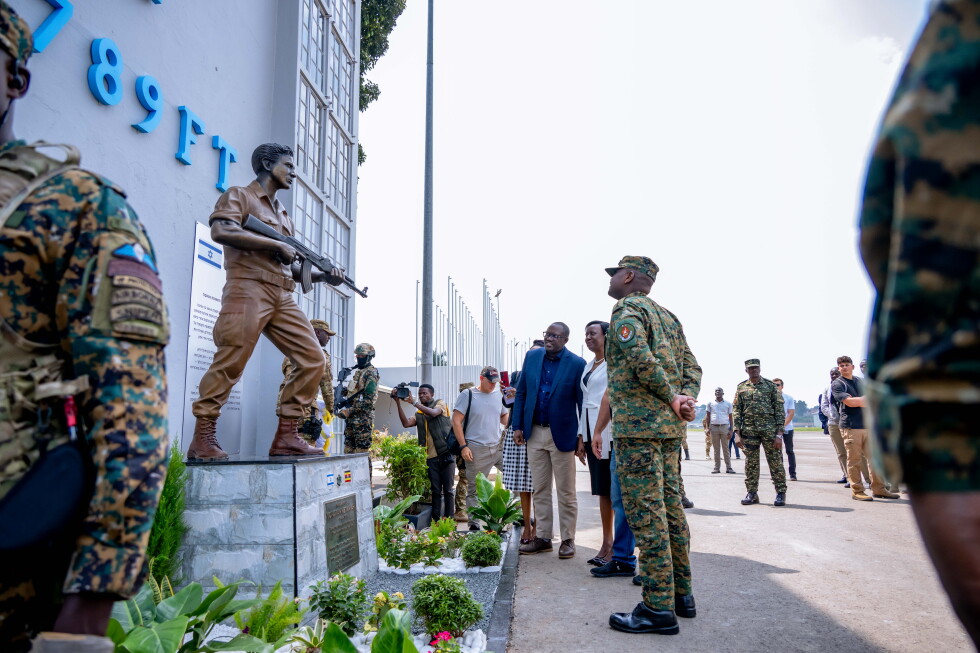
Nearly half a century after one of the most audacious hostage rescue missions in modern military history played out on Ugandan soil, Uganda’s military has dedicated a permanent memorial to the fallen Israeli commando who led the operation: Yonatan Netanyahu, older brother of current Israeli Prime Minister Benjamin Netanyahu. The bronze statue, which depicts the lieutenant colonel holding an assault rifle in a combat-ready stance, was formally unveiled Saturday by Gen. Muhoozi Kainerugaba, Uganda’s top military commander and the eldest son of long-serving President Yoweri Museveni, widely viewed as his likely political successor. Kainerugaba, who personally commissioned the monument, used the opening ceremony to honor the fallen soldier’s extraordinary courage and commitment. The memorial stands on the grounds of Entebbe International Airport, the exact site where the 1976 raid unfolded, and the event drew a crowd that included Israeli nationals based in the region, among them local businessman Barak Orland. The story of the Entebbe raid began when pro-Palestinian hijackers — two Palestinian militants and two German collaborators — seized an Air France passenger flight carrying 106 people, diverting it to Entebbe Airport. The hijackers separated Jewish and Israeli passengers from the rest of the group and issued an ultimatum: they would execute the hostages unless Israel released dozens of imprisoned Palestinian militants within a week. Over seven days of stalled negotiations, Israeli military planners secretly prepared a high-risk rescue mission that would go down in military legend. On the night of July 3, 1976, Israeli commandos landed at Entebbe, stormed the terminal, and engaged hijackers and responding Ugandan forces. In the under-an-hour operation, Yonatan Netanyahu, the raid’s commander, was fatally struck by enemy gunfire — the only Israeli commando killed in the mission. Just three hostages died in the crossfire, and the vast majority of captives were brought to safety. Dozens of Ugandan soldiers were also killed during the clash. At the time of the 1976 raid, Uganda was ruled by dictator Idi Amin, who had cut diplomatic ties with Israel and openly supported the Palestinian independence movement. Israel’s successful rescue severely humiliated Amin, and the operation drew sharp criticism from the Organization of African Unity, the precursor to the modern African Union, which condemned the raid as a violation of Ugandan national sovereignty. For Israel, however, the mission has become a defining moment in the nation’s modern history, widely celebrated as one of the most extraordinary military achievements in its history. Benjamin Netanyahu has repeatedly stated that his brother’s death during the raid fundamentally altered the trajectory of his own life and political career. In his remarks at the unveiling, Kainerugaba emphasized the enduring meaning of the memorial beyond just remembrance. “Today, this memorial stands not only in remembrance of a distinguished soldier, but also as a tribute to the enduring values he embodied: courage in the face of danger, unwavering commitment to protecting innocent lives, and steadfast devotion to duty,” he told attendees. Today, relations between the Ugandan government and Israel are officially cordial, with President Museveni having repeatedly stated his public support for a two-state solution to resolve the long-running Israeli-Palestinian conflict. The unveiling of the monument marks a striking shift from the diplomatic tensions that surrounded the original raid, representing a public acknowledgment of the fallen soldier’s sacrifice decades after the historic mission.
Uganda’s military unveils statue of Netanyahu’s brother who died in 1976 Entebbe hostage rescue