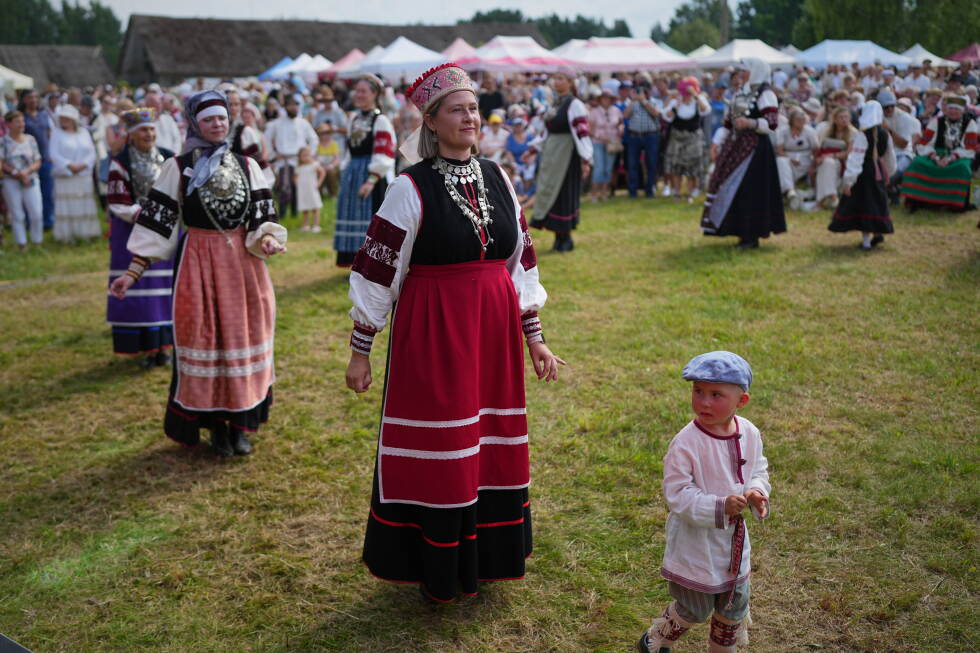
Beneath the open sky in the tiny Estonian village of Mikitamäe, the cheerful trill of an accordion drifts across a lush grass field. Eighty-year-old Maime Kapten twirls across the green, her hand-embroidered traditional skirt flaring out around her, while the silver chains and antique coins strung around her neck jingle in rhythm with her steps. For Kapten, this dance is far more than a festive performance—it is an act of cultural reclamation, part of a one-day annual celebration that turns this quiet southeastern Estonian village into the symbolic “Kingdom of Setos.”
This unique celebration, launched in 1994, was born out of necessity. For centuries, the Seto ethnic community has called the borderlands between modern Estonia and Russia home. When the Soviet Union collapsed, the newly drawn Estonian-Russian border split the Seto people apart, cutting off families from one another and from their ancestral lands. What began as a small gathering to lift up the community’s distinct identity and protect their endangered language has grown into a beloved annual tradition, complete with ceremonial entry visas instead of event tickets, custom printed mock currency, and a lighthearted symbolic military parade.
Today, the Seto community is scattered across Estonia and beyond. Estonia’s 2021 national census recorded roughly 25,000 people who reported some ability to speak Seto—a tongue closely related to Estonian, but regarded by the Seto themselves as a fully separate language with unique pronunciation, grammar, and vocabulary. Linguists warn, however, that only a few thousand people still use Seto in daily life. Fewer than 3,000 people remain in Setomaa, the Seto’s traditional ancestral parish, and after the border split, less than 200 Seto stayed on the Russian side of the divide. For dispersed community members, the annual Kingdom Day is the most important chance to reconnect. “This is an important cultural day for us,” Kapten explained. “We get to meet people we know, we get to talk, exchange a few words, give each other a hug.”
On the day of this year’s celebration, Mikitamäe’s normally quiet streets overflowed with attendees clad in vibrant, handcrafted traditional folk dress. A centuries-old local proverb says “you hear a Seto woman before you see her,” a nod to the jangling silver adornments that are a staple of traditional women’s dress. What was everyday wear 100 years ago is now reserved for special occasions, but these garments still carry deep cultural meaning. “Seto clothes say a lot about the person who wears them,” noted 62-year-old Seto cultural activist Piret Torm-Kriis. “If you look at a Seto woman, you can understand whether she is married or single, whether she is going to the church or to the market, to a party or to work.”
A core tradition of Kingdom Day is the annual election of the Ülemsootska, the Seto community’s symbolic leader who serves as the messenger for Peko—the ancient Seto folk deity of fertility and the legendary mythic king of the Setos. The Seto’s unique cultural heritage blends pre-Christian pagan mythology with Eastern Orthodox religious traditions, a fusion that has shaped their identity for hundreds of years. For the election, candidates stand atop aged tree stumps to lay out their agendas for the coming year, and supporters form long lines holding threads that stretch hundreds of meters to their chosen candidate. This year, folk costume maker Ingrit Kala won the role by drawing the longest line of supporters.
Kala’s top priority is straightforward: expanding outreach for Seto culture and securing the future of the Seto language. “We have so many different things, so many skilled craftspeople, to show what a rich culture we have and to really introduce it,” she said.
The celebration’s centerpiece this year, as always, was leelo—the Seto’s centuries-old traditional polyphonic singing, a practice dating back more than 1,000 years that is listed on UNESCO’s Register of Intangible Cultural Heritage. The distinctive style features a solo singer opening each verse, with a full choir joining in on the final syllables before the voices blend into a unified harmony. For millennia, leelo lyrics, which draw heavily from Seto mythology, have been passed down orally between generations, and the songs once accompanied every part of daily life, from farm work to religious rituals to holiday feasts. “Leelo singing contains a lot of information about the world and people at the time of its origins, how were they thinking, what was important, what did they believe in,” explained Mari Palolill, a researcher and teacher of the tradition who performed with her choir at this year’s event.
Despite growing recognition of Seto culture, the community faces steep challenges to preserve their language and traditions. Most Seto traditions have been preserved through oral transmission, and while small wins have been made—including a Seto-language kindergarten group, a regional Seto newspaper, and even translations of popular books like *The Little Prince* into Seto—the language still relies heavily on being spoken at home to survive. “If Seto isn’t spoken at home, then what children learn at school doesn’t help much,” Kala acknowledged.
Still, young Seto community members are stepping up to carry the tradition forward. Twenty-three-year-old Maria Grünberg learned Seto as a child by singing along to traditional leelo songs, and she now leads the youth leelo choir. Her goal is to reframe Seto culture as a living, relevant tradition for all ages, not just a relic of the past. “We all together try to preserve the songs, the language, and show also other young people that Seto songs and Seto language is not only for old people,” said Grünberg, who performed in a customized traditional Seto dress paired with her grandparents’ antique silver jewelry. “We want to show that this is for everyone.”