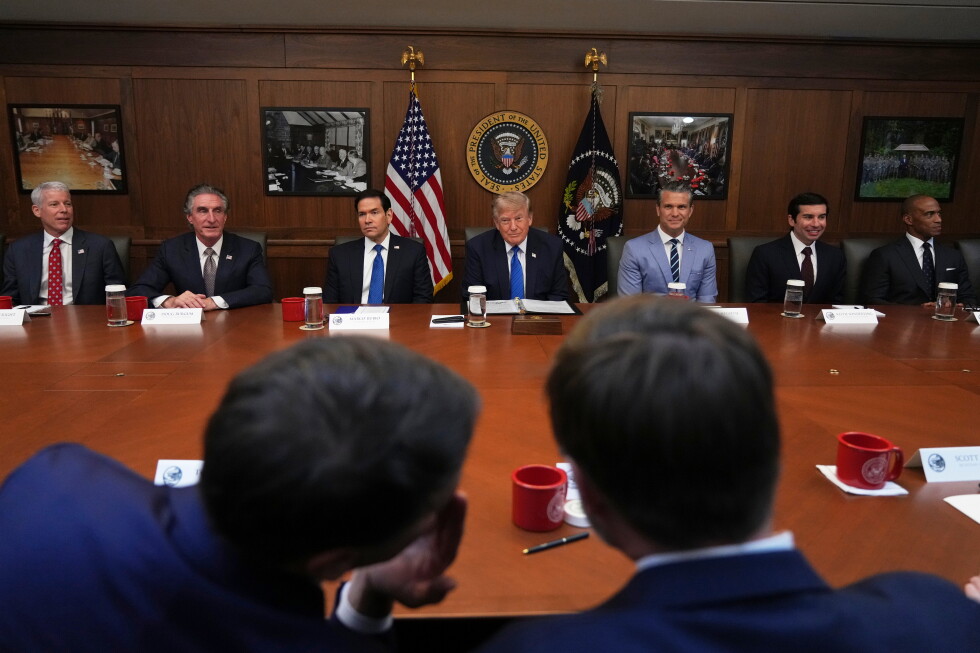
CAMP DAVID, Md. – In a break from regular Washington protocol, former President (current 2025 office-holder) Donald Trump brought his Cabinet’s weekly meeting to the wooded, historic presidential retreat of Camp David in northern Maryland on Friday, leveraging the iconic location’s symbolic weight to tout his administration’s policy wins and frame a looming immigration warning for midterm election voters.
Marking a first for the storied site, this gathering was the first-ever televised Cabinet meeting held at Camp David, a detail the White House prioritized in its morning communications leading up to the event. Opening the session, Trump emphasized the uniqueness of the setting, noting “It’s Camp David, and this room is a very, very special room.”
After opening remarks, Trump moved through his standard campaign-season talking points, highlighting economic growth, border security policy and the administration’s approach to Iran before pivoting to a sharp political warning. Pointing to the recent dramatic surge of undocumented migrants arriving in Ceuta, a small Spanish overseas territory in North Africa, Trump framed the unrest as a cautionary tale for American voters ahead of the upcoming midterm elections.
“You know I saw Spain yesterday, and I watched the catastrophe that took place. It looks like an invasion of a country by hundreds of thousands of people,” Trump told the assembled Cabinet. “And that same thing is going to happen to us if the Republicans don’t get elected. Except worse, much bigger.”
Following Trump’s opening address, top administration officials including Secretary of State Marco Rubio and Defense Secretary Pete Hegseth delivered brief remarks, before the president opened the floor for questions from the press pool. Journalists exited the closed meeting after nearly an hour of questions and discussion.
This gathering marked the first successful in-person Cabinet meeting at Camp David during Trump’s second term. A planned May meeting at the retreat was canceled entirely due to severe inclement weather, though Trump held one similar session at the site during his first term in office. Unlike the format used by many previous presidents, Trump has opened the full public portion of his Cabinet meetings to press access, a move his aides have framed as proof of his commitment to government transparency. In previous sessions, public portions of meetings stretched as long as three hours, with every Cabinet head offering department updates that often included personal praise for the president’s leadership. More recently, however, Trump has pushed for tighter time limits, urging brief remarks and cutting back on the number of oral department reports to avoid overly long sessions. “Everybody around here has got a lot to say. But we did that once, and it lasted for like four or five hours. It was a little much,” Trump explained during the scuttled May meeting.
Beyond its role as a setting for Friday’s political gathering, Camp David has occupied a unique place in American presidential history for more than 80 years. First established in 1942 during Franklin D. Roosevelt’s administration, the retreat was created after military and Secret Service officials raised safety concerns about Roosevelt’s habit of relaxing aboard a presidential yacht on open water during World War II. Roosevelt asked the National Park Service to identify potential rest sites within 100 miles of the White House, and ultimately selected the Catoctin Mountain location, originally naming it Shangri-La after the fictional utopia from James Hilton’s novel *Lost Horizon*. President Dwight Eisenhower later renamed the retreat Camp David, in honor of his grandson and father.
Every U.S. president since Roosevelt has used the 180-acre mountain retreat, which offers both a private escape from the pressures of Washington and a secure, discrete location for sensitive diplomatic negotiations. Its most iconic diplomatic moment came in 1978, when President Jimmy Carter hosted Egyptian and Israeli leaders for 13 days of closed talks that ultimately produced the landmark Camp David Accords, a historic peace agreement between the two nations. In 1979, Carter also gathered a cross-section of American civic leaders at the retreat for discussions ahead of a nationally televised energy policy address that later became known as the “malaise speech,” despite Carter never using the term in his remarks.
In 2019, during his first term, Trump made headlines when he canceled a planned secret Camp David summit with Taliban and Afghan government leaders just days before the 18th anniversary of the September 11 attacks. The cancellation came after a Kabul bombing killed 12 people, including one U.S. service member.
During his first term, Trump was a frequent visitor to Camp David, often spending multiple weekends a month at the retreat. In his second term, his visits have been far less frequent, with his most recent prior stay coming in June for a Father’s Day weekend break.
Today, the Navy-operated, Marine-guarded retreat includes the presidential Aspen Cabin, roughly a dozen guest cabins, a main lodge with conference facilities, a presidential dining room and private office, and a wide range of recreational amenities, including a fitness center, bowling alley, movie theater, heated swimming pool, tennis and basketball courts, and an on-site chapel for religious services. Its core purpose, maintained across eight decades, remains to give sitting presidents a private, secure space to rest, recharge and meet away from the public spotlight of Washington.
Superville and Kim contributed reporting from Washington, D.C.