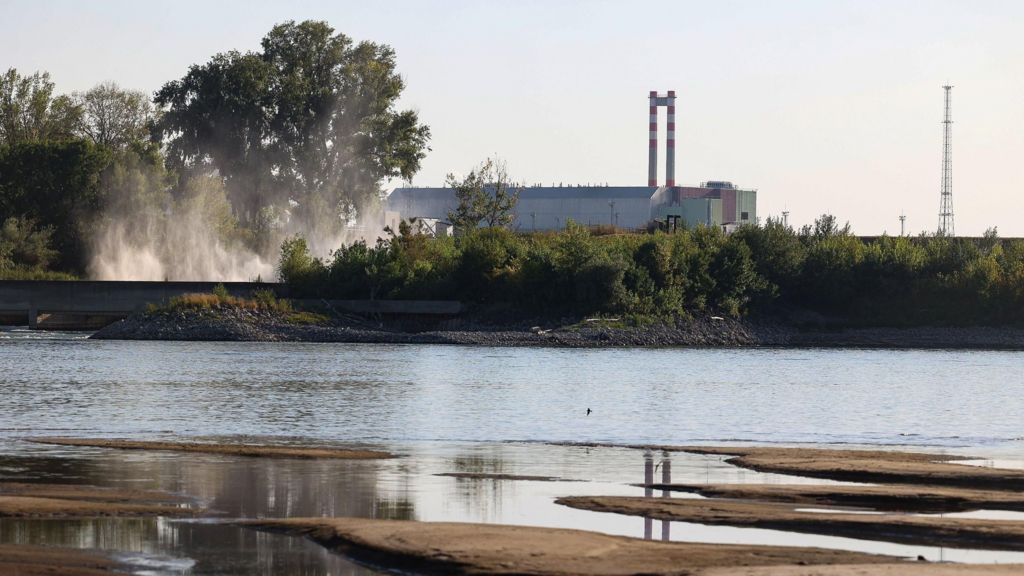
A historic climate-fueled drought has pushed water levels in the Danube, Europe’s second-longest river, to their lowest point in decades, triggering cascading energy disruptions, shutting down key nuclear infrastructure, and halting shipping across multiple Central and Eastern European nations this summer. What began as a gradual drop in water levels amid months of below-average rainfall and a sustained record-breaking heatwave has escalated into a full-blown energy and transportation crisis, with implications that underscore the growing vulnerability of European infrastructure to accelerating climate change.
Hungary’s prime minister, Péter Magyar, announced last week that the country’s only nuclear power plant, the Soviet-era Paks facility, will be forced into a complete, temporary shutdown for the first time in its history. The plant relies on Danube water to cool its reactors, but receding waters have left the facility’s water suction nozzles unable to reach the river’s surface. Magyar warned that the combination of the Paks shutdown and ongoing heatwave, which will keep temperatures hovering around 37°C for a full week, could push Hungary’s national energy supply into a “critical” state starting Monday.
To avoid a total grid collapse, the prime minister has called on all Hungarian residents to cut back on high-energy activities during peak evening demand hours between 17:00 and 22:00, including electric vehicle charging and heavy use of air conditioning. He added that authorities are also preparing a contingency plan for rotational power outages if voluntary conservation fails to balance grid supply and demand, and the government is currently compiling a list of commercial and industrial users whose electricity and water consumption can be restricted if necessary.
Hungary is far from alone in facing crisis. Neighboring Romania has already shut down one of its two operational nuclear reactors at the Cernavoda power plant, which generates roughly 20% of the country’s total electricity output. The 706-megawatt unit was taken offline earlier this week due to the catastrophic drop in Danube levels, and state power firm Nuclearelectrica was working frantically late this week to prevent the shutdown of the remaining reactor. If the second unit goes offline, Romania will join Hungary in losing 100% of its nuclear power generation temporarily, a devastating blow to national energy security. Official hydrological data from Romania’s National Institute of Hydrology shows that average July flow of the Danube at the country’s entry point is 4,700 cubic meters per second; this week, that figure dropped to less than a third of the normal level at 1,600 cubic meters per second, with forecasts calling for further declines to 1,500 cubic meters per second by next Tuesday.
The current crisis is the product of months of abnormal weather that has gripped much of Europe, a continent that the European Union’s Copernicus Climate Change Service confirms is warming twice as fast as the global average, making it the fastest-warming continent on Earth. Climate change has amplified the frequency and intensity of summer heatwaves, dried up continental water reserves, and increased the risk of catastrophic wildfires across the region. This summer, persistent drought and high temperatures have pushed Danube levels to their lowest point in 30 years across most of the river basin, with some Serbian hydrologists noting levels have not been this low in 50 to 60 years. Low rainfall this spring combined with summer’s extreme heat has compounded the problem, according to experts, and no significant recovery in water levels is expected before mid-September.
Alongside energy disruptions, the falling river has all but halted commercial and passenger shipping along large stretches of the Danube. In Bulgaria, shipping has completely stopped, and earlier this week border police were forced to evacuate 186 passengers from the Viking Ullur river cruise ship after the vessel ran aground near the border city of Vidin. Stranded passengers faced dwindling food and water supplies after the ship could not dock in Vidin, and a secondary rescue vessel initially struggled to reach the grounded craft due to shallow waters. “I have never heard of such low levels over the years. There has certainly not been a similar situation since 1990,” Ivan Zhekov, head of river supervision at Bulgaria’s maritime administration agency, told local news outlet BTA. The low waters have even exposed vast stretches of riverbed around the Bulgarian-Romanian border, leaving dozens of small boats stranded on dry ground near the Calafat-Vidin cross-border bridge.
While the crisis has brought severe disruption, the receding waters have also uncovered rare long-submerged artifacts and natural remains. In Croatia, the wreck of a sunken Hungarian cargo ship has resurfaced, while in Serbia’s Prahovo region, the hulk of a World War II German warship that had been submerged for decades is now fully exposed. Most remarkably, a resident of the Bulgarian city of Ruse discovered well-preserved mammoth bones on the exposed riverbed, including a lower jaw, two tusks, and what experts believe to be a rib bone.
The Danube, which stretches 2,857 kilometers across 10 European countries, is a critical transportation artery and key water source for power generation and agriculture across Central and Eastern Europe. Its tributaries, including the Sava and Tisa in Serbia, are also hitting record low levels this summer, compounding regional stress. Beyond the Danube basin, the broader European climate crisis continues to escalate: extreme fire weather is spreading toward central Europe, after France and Spain experienced some of the most intense and widespread wildfires on record in recent weeks, forcing hundreds of thousands of people to evacuate their homes. Greece and Turkey remain the worst-affected countries for wildfire activity this season.