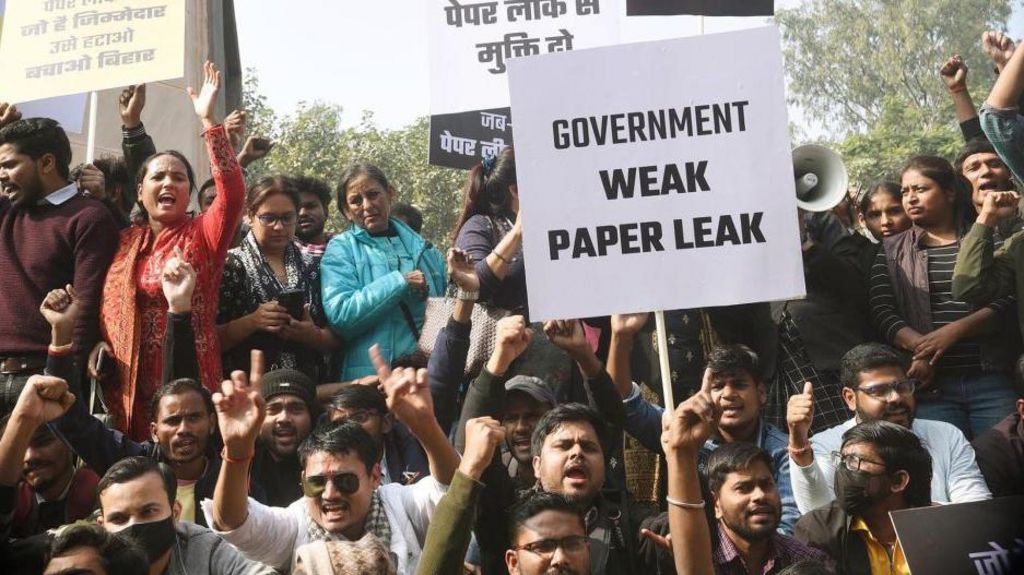
India’s decades-long battle against entrance exam question paper leaks has boiled over into national crisis in 2026, following widespread countrywide protests over the breach of the National Eligibility cum Entrance Test (NEET), the country’s top medical school entrance exam. The unrest ultimately forced the resignation of India’s education minister, and families of more than 20 students who died by suicide have linked their deaths directly to the uncertainty and despair sparked by the exam scandal.
In response to the public outrage, Prime Minister Narendra Modi moved quickly to assemble a high-level expert task force led by Nandan Nilekani, co-founder of Indian IT giant Infosys, to overhaul the National Testing Agency (NTA) — the government body that administers the country’s largest national entrance exams. Modi has thrown his support behind a proposal to shift all high-stakes entrance exams from traditional pen-and-paper formats to fully computer-based testing (CBT), framing the digital shift as the most effective path to blocking the recurring leaks that have eroded public trust in India’s education assessment system.
India’s Supreme Court, which is currently hearing public interest petitions on the proposed reforms, has praised the government’s commitment to addressing the crisis but issued a critical warning: digital testing alone cannot fully eliminate the risk of paper leaks. This caution highlights the core challenge facing the task force: can technology solve a problem that is rooted at its core in weak governance, skewed incentives, and broken public trust, rather than just format?
Two separate NEET leak incidents, in 2024 and 2026, illustrate just how complicated this issue is, with breaches occurring at very different stages of the exam process to expose systemic flaws. In 2024, the leak occurred after question papers were printed, when sealed transport containers were opened en route to exam centers. Investigators found the breach involved only 40 to 50 connected individuals, and the Supreme Court ruled that the overall integrity of the exam remained intact, rejecting widespread demands for a retest. In contrast, the 2026 leak was traced all the way back to the NTA itself, with internal teachers accused of leaking the papers before they even entered the secure printing and supply chain. Officials confirmed that safeguards for transport, printing, and on-site distribution held firm — the vulnerability existed at the source, long before the secure custody process began.
V Kamakoti, director of the Indian Institute of Technology (IIT) Madras and a member of the expert task force, explains that these two incidents lay bare where trust in an examination system ultimately lives. “The roots of trust lie in two places: the teachers who set the question papers and the invigilators who supervise candidates. If either is compromised, the system is vulnerable,” he explained in comments to the BBC.
Officials have already proposed upgrades including widespread CCTV coverage with live central monitoring, and Kamakoti notes that artificial intelligence can add another layer of security, automatically flagging unusual activity such as prolonged unauthorized contact between invigilators and test-takers to allow for real-time intervention. “At least the invigilator part we can certainly handle,” he said.
But for Kamakoti, the most significant jump in security will come from a full shift to online, computer-based testing. He argues that CBT would make large-scale entrance exams far more resistant to tampering, noting that “compromising the technology would be extremely difficult” — a claim backed by more than 10 years of successful large-scale digital testing run by IIT Madras.
IIT Madras already manages Swayam, India’s government-backed national online learning platform, and has administered major high-stakes entrance exams including the Graduate Aptitude Test in Engineering (GATE) and the advanced Joint Entrance Examination (JEE) for India’s top engineering colleges via CBT for years. Kamakoti explains that these secure systems use constant red teaming — dedicated teams that continuously probe for vulnerabilities — and air-gapped networks that are physically disconnected from the public internet. “No one can hack into that network,” he says, adding that the systems are built to withstand technical disruptions: if a test-taker’s device crashes or loses power, the exam timer automatically pauses and resumes seamlessly on a replacement machine.
Even the most robust digital infrastructure, however, cannot eliminate the human element of risk. For Kamakoti, the single greatest challenge remains securing the question-setting process. NEET is one of the world’s largest multilingual entrance exams, administered in 13 languages to more than 2.2 million candidates annually. Creating a single NEET paper requires a large team of subject experts, translators, reviewers, and moderators, numbering around 50 people total. “If even one person in that entire set is compromised, we are gone,” he warned.
Even with this human risk remaining, CBT does eliminate one major long-standing vulnerability: it removes the need to print, transport, and store millions of physical question papers, the step where many past leaks have occurred.
So why has NEET not shifted to digital testing already? Kamakoti explains that the test has remained pen-and-paper based to preserve fairness: all test-takers take the exam in a single session to prevent any advantage from question exposure across multiple slots. Currently, India’s national digital testing infrastructure can only accommodate around 300,000 candidates per session, a fraction of NEET’s 2.2 million annual test-takers. A full shift to CBT would therefore require either a massive rapid expansion of testing capacity or splitting the exam across multiple testing sessions, a change that brings its own fairness concerns.
Not all experts agree that a shift to digital testing alone is enough to solve India’s leak crisis. Debananda Misra, a policy researcher at the IIT Delhi School of Public Policy, agrees that CBT can cut down on opportunities for physical paper leaks, but argues that the current debate has become overly focused on technology as a cure-all.
“CBT is not a silver bullet,” Misra told the BBC. “It can strengthen exam security and improve efficiency, but it does not address the deeper incentives that drive malpractice.”
Those incentives are driven by extreme scarcity of high-quality, affordable higher education opportunities. This year, nearly 2.2 million students took NEET, and just over half qualified for medical school admission. But heavily subsidized government medical colleges, where a full degree can cost less than 30,000 rupees (around $313), only have seats for fewer than 6% of qualified candidates — or less than 3% of all students who take the exam. Students who miss out on government seats face private college tuition that can run into hundreds of thousands of rupees, a cost out of reach for most Indian families.
Investigators say this extreme scarcity has fueled increasingly sophisticated criminal paper-leak networks that connect corrupt insiders, middlemen, and exam center staff. While CBT closes off old vulnerabilities, it creates new ones. Misra notes that even minor technical disruptions can have lasting, unmeasurable impacts on candidate performance: “A non-functional mouse is not just about pausing the timer. It is also about disruption to concentration.”
Misra also warns that a full shift to CBT risks widening equity gaps in Indian education. Success on digital exams depends not just on subject mastery, but on prior digital experience and access to practice in simulated testing environments — advantages that are heavily concentrated among students who can afford expensive private coaching, and out of reach for many students from low-resourced rural and government schools.
Most fundamentally, Misra argues that India’s examination system puts too much catastrophic pressure on a single high-stakes test. “As long as a single test determines access to scarce opportunities, there will be strong incentives for exam malpractice, regardless of the testing format,” he said.
Misra proposes deeper reforms beyond digital testing: stronger governance of exam agencies through tighter protocols, regular independent audits, greater public accountability, and stricter penalties for malpractice. He also suggests structural changes such as random allocation of multiple equivalent question papers, or localized test versions, so that a single breach in one area does not invalidate an entire national exam. Long-term, he argues India must reduce its over-reliance on single high-stakes entrance tests by creating multiple assessment opportunities and broader pathways into higher education.
“If the purpose is to generate a ranked list and match students to institutions, perhaps we should also think about creating greater diversity on both sides,” he said.
Prime Minister Modi has repeatedly pledged to crack down on exam fraud, promising since 2023 that the “paper-leak mafia” would be held accountable, saying that “those playing with the future of young people will not be spared,” and framing the government’s response as a “war footing” effort to end leaks. After the 2024 NEET leak, the government appointed a high-level review committee led by India’s former space agency chief that produced the most comprehensive assessment of India’s exam system to date. But reportedly only 57% of the committee’s more than 100 recommendations have been implemented, and leaks have continued to disrupt national exams.
The task force faces a tight deadline to deliver its overhaul: India’s annual entrance exam season for medicine, engineering, university, and postgraduate programs runs from December through May, so major reforms must be finalized within the next one to two months to be ready for the next cycle.
Ultimately, experts agree the task force’s success will not be measured by how many exams shift to digital formats, but by whether it can restore the faith of India’s young people that the system that determines their future is fair.