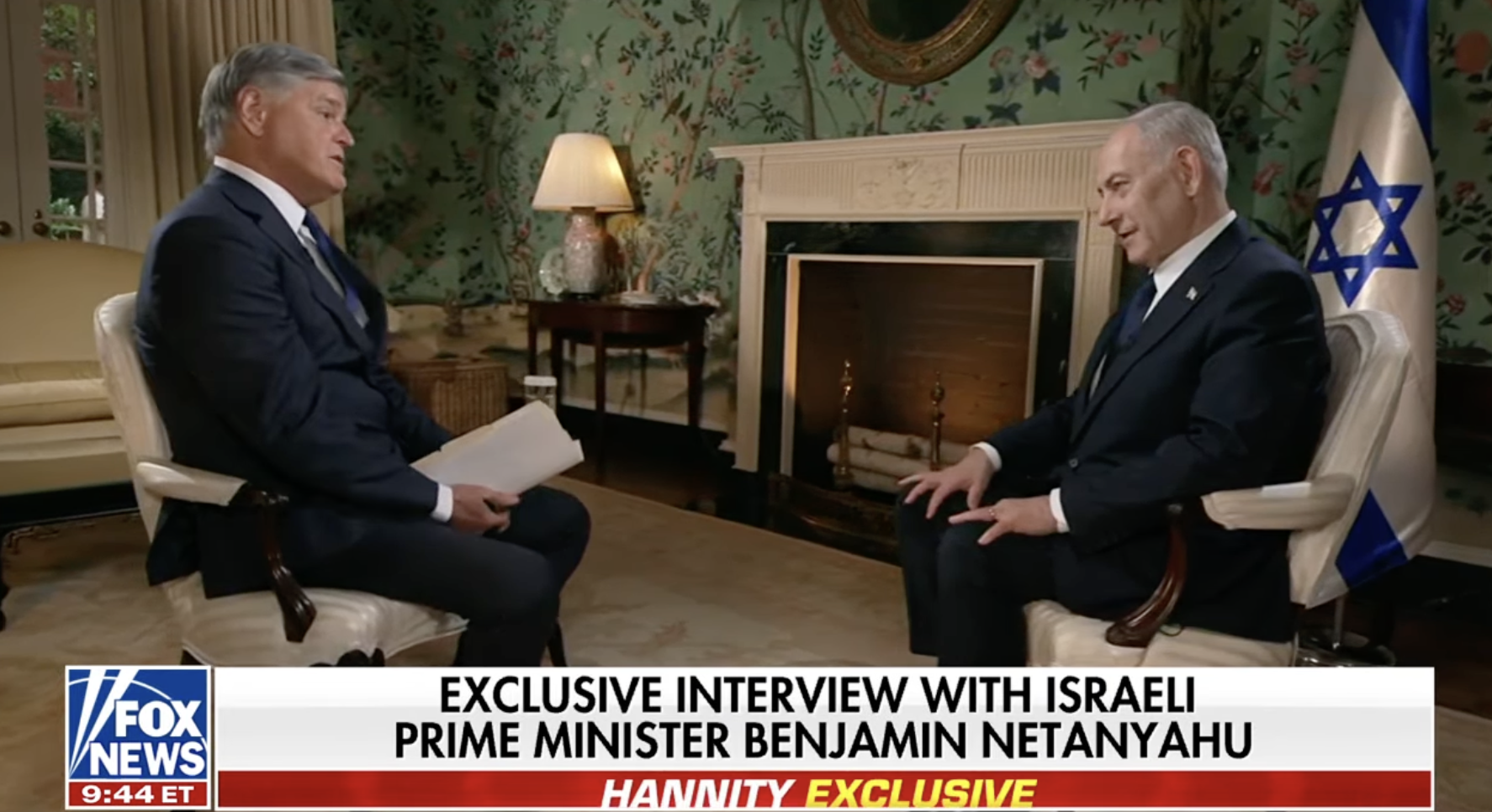
In a wide-ranging interview with Fox News host Sean Hannity, a long-time personal associate of Israeli Prime Minister Benjamin Netanyahu, the Israeli leader brushed off concerns over the International Criminal Court’s (ICC) November 21, 2024 arrest warrant targeting him, stating that Israeli special operations forces would prevent any attempted detainment if he travels to a state that recognizes the court’s authority.
When Hannity asked whether the warrant could complicate international travel for Netanyahu amid medical emergencies or official trips, the prime minister acknowledged the scenario had crossed his mind, but noted his own military background and the capabilities of Israeli special units. After Hannity highlighted the strength of the Israel Defense Forces (IDF), Netanyahu joked that the military would be given a new mission to secure his safety.
The interview came as Netanyahu traveled from Israel to Washington D.C. aboard the official Israeli government jet ‘Wing of Zion’ for talks with U.S. President Donald Trump at the White House. Flight tracking data confirmed the jet transited the airspace of four ICC member states—Greece, Italy, France, and Canada—all signatories to the Rome Statute that established the Hague-based court. This transit prompted widespread criticism from global observers, who accused the four governments of facilitating travel for an internationally wanted suspect.
The ICC’s arrest warrant cites reasonable grounds to conclude Netanyahu bears criminal responsibility for multiple war crimes and crimes against humanity in Gaza, including the use of starvation as a method of warfare, murder, persecution, and other inhumane acts. Netanyahu dismissed the court as a corrupt, unelected international bureaucracy, warning that the body could eventually target American leaders and service members just as it targeted him, given that the U.S. does not recognize the ICC’s jurisdiction, just as Israel does not.
The prime minister also confirmed he intends to travel to New York City for the United Nations General Assembly in September regardless of any potential legal action New York Mayor Zohran Mamdani may pursue. Mamdani has called on the U.S. federal government to arrest Netanyahu based on the ICC warrant, a move that has led Israeli officials to accuse him of antisemitism. Netanyahu labeled the mayor a hate-spewing official who is stoking division against Jewish New Yorkers, drawing a parallel to rising antisemitism in 1930s Europe. Mamdani has repeatedly pushed back on these claims, reaffirming his commitment to protecting the safety and rights of all Jewish residents of New York.
Following his Tuesday White House meeting with Trump, which lasted just under 90 minutes, Netanyahu called the gathering one of the best meetings the two leaders have ever held. However, he clarified to Israeli reporters that the meeting included multiple senior officials, rather than the private one-on-one session many observers had expected. This arrangement has fueled speculation that Trump’s senior advisers sought to limit Netanyahu’s ability to sway the president unilaterally on key policy issues. Netanyahu rejected suggestions of a rift in the U.S.-Israel alliance, telling Hannity that critics looking for fractures would instead find a ‘wall of granite’ holding the partnership together.
Despite Netanyahu’s framing of the alliance as rock-solid, Trump has publicly expressed frustration with the Israeli leader in recent weeks. Earlier on Tuesday, Trump told Fox News that Netanyahu has pushed him to maintain aggressive action against Iran, a course the U.S. president may no longer favor.
Netanyahu acknowledged that both the U.S. and Israel share the core goal of preventing Iran from acquiring nuclear weapons that could threaten American interests, global stability, and Israeli sovereignty, noting that this goal could be achieved through either diplomatic or military channels. But the prime minister made clear he remains deeply skeptical of diplomatic outreach to Iran, a stance that has already put him at odds with the Trump administration.
Shortly after the U.S. and Iran signed a joint memorandum of understanding in June, which included a requirement for Israel to end hostilities against the Iranian-allied militant group Hezbollah in Lebanon, Israel escalated its offensive across southern Lebanon, pushing attacks as far north as the Lebanese capital Beirut. Trump publicly criticized the escalation, saying Israeli strikes were disproportionate and causing excessive civilian casualties.
Pressed on whether moderate Iranian factions could successfully negotiate a diplomatic solution, Netanyahu repeated his skepticism, arguing that Iranian factional divides are rooted less in ideology than in differing assessments of Western and Israeli resolve. He emphasized that the only path to a successful outcome, whether diplomatic or military, rests on shared U.S.-Israel resolve to block Iran’s nuclear program.
The trip comes amid lingering tensions from the joint U.S.-Israel war against Iran launched on February 28. Before the war began, the entire U.S. intelligence community under the Trump administration assessed that Iran posed no imminent threat to the U.S. or its allies. This assessment led to the immediate resignation of Joe Kent, director of the National Counterterrorism Center, within hours of the first offensive missile strikes.