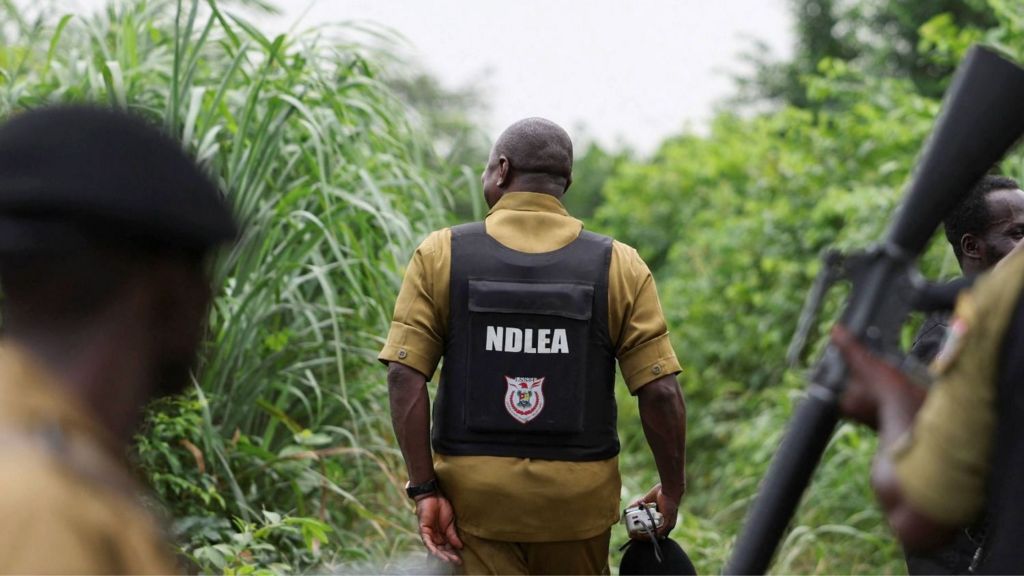
In an extraordinary, unprecedented step for Nigeria’s judicial system, a federal high court hearing did not unfold in the air-conditioned, secure confines of a Lagos courtroom this week. Instead, Justice Musa Kakaki, robed in formal judicial attire, alongside lawyers adhering strictly to legal decorum and protocol, traveled two hours outside the city to conduct proceedings in the heart of a dense, remote western Nigerian forest — inside an alleged illicit methamphetamine manufacturing laboratory.
Handcuffed and escorted by heavily armed anti-narcotics officers, 10 suspects — three Mexican citizens and seven Nigerian nationals — were paraded before the court as the judge inspected the cache of chemicals and production equipment authorities say the syndicate used to cook crystal meth, the potent synthetic drug known locally as “ice”. The acrid, bitter stench of active drug production hung thick in the unfinished building: one large drum held liquid meth mid-crystallization, while open vats of dark, viscous unprocessed “crude” meth emitted a second sharp, toxic odor. Scattered across the site were additional production materials, including propane gas cylinders and sacks of caustic soda, all evidence of a full-scale, operating manufacturing operation.
When Nigerian anti-narcotics authorities from the National Drug Law Enforcement Agency (NDLEA) first raided the site in May, they called the seizure the largest methamphetamine bust in Nigeria’s history, uncovering more than two tonnes of finished product with an estimated street value of $360 million. At the time, the agency announced it had delivered a “crippling blow” to a sophisticated, multi-million-dollar joint Nigerian-Mexican meth production syndicate, dismantling a network that had operated undetected in the secluded forest location for months. The unusual decision to move the court to the lab site itself, NDLEA officials explained, was intended to let the judiciary directly observe the full scale of the criminal operation, rather than relying on secondhand descriptions or photographs.
This bust was not an isolated incident. Just one month after the May raid, NDLEA agents discovered a second hidden meth lab in a forest in neighboring Oyo State, arresting five additional suspects including a Mexican national described as a specialist meth “cook.” These connected seizures are part of a rapidly growing, well-documented trend: transnational criminal cartels, led by major Mexican drug syndicates, are no longer just using West Africa as a transit hub for drug shipments bound for Europe and Asia. They are now shifting core operations to the continent, building local production bases staffed by Mexican meth manufacturing experts working alongside local criminal partners.
Law enforcement officials across the globe confirm this accelerating shift. James Griego, who leads counter-narcotics operations for U.S. Africa Command (Africom), which provides intelligence support to national anti-drug agencies across the continent, told reporters that Mexican meth specialists have become increasingly common in illicit labs across Africa and Europe. Over decades, Mexican cartels have refined meth production to a high art, creating product with unmatched purity and potency that is in high demand across global illegal markets.
“Anybody who is looking to consume methamphetamine understands that the Mexican meth is the best in the world for that purpose,” Griego explained.
The first Mexican-linked meth super lab uncovered by the NDLEA dates back to 2016. Since that first discovery, connected laboratories with Mexican operatives have been found across the continent: in Kenya, Mozambique, and South Africa, among other nations. Since 2023 alone, Griego said, authorities have raided 14 Mexican-operated meth labs across Africa. Of the five discovered so far this year, four are located in Nigeria.
Intelligence gathered by Africom and the U.S. Drug Enforcement Administration links many of these African labs to Mexico’s two most powerful cartels: the Sinaloa Cartel and the Jalisco New Generation Cartel. Testifying before the U.S. Congress in May, Africom commander General Dagvin Anderson warned of an alarming emerging alliance: terror groups based in Africa are increasingly funded by Mexican drug cartels, expanding the militant groups’ operational reach and lethal capacity.
Unlike plant-based illicit drugs such as cocaine or heroin, which require specific climate and geographic conditions to grow and process, synthetic methamphetamine can be manufactured anywhere that the right precursor chemicals and technical expertise are available. This flexibility allows organized crime groups to rapidly scale up production in new locations, avoiding increased law enforcement pressure in their traditional hubs.
Methamphetamine produces a fast-acting, long-lasting euphoric high, but it carries devastating long-term health consequences: users face elevated risk of life-threatening cardiovascular disease, severe malnutrition from suppressed appetite, and blood-borne diseases for people who inject the drug. Withdrawal from meth addiction is also notoriously difficult, marked by crippling anxiety, deep depression, extreme fatigue, and intense drug cravings that often lead to relapse. As cartels expand distribution networks beyond traditional supply routes, more populations across Africa and the globe are being exposed to these harms.
West Africa offers a unique set of advantages for Mexican cartels looking to relocate production. Vast expanses of remote, densely forested land provide perfect secluded locations for hidden labs, far from civilian population centers and routine law enforcement patrols. The region’s large, young population also offers two key benefits: a ready supply of low-cost labor for the labs, and a fast-growing local consumer market for the finished product.
Fears of rising local meth consumption in Nigeria are well-founded: a 2018 national survey found that 14.4% of Nigerian adults had used an illicit drug, more than double the global average estimated by the United Nations Office on Drugs and Crime (UNODC). The Global Initiative Against Transnational Organized Crime confirms meth use has spread rapidly across the entire continent: it is widely available across East Africa in Kenya and Tanzania, and in southern Africa, particularly South Africa, where it is known locally as “tik.”
Beyond the growing local market, cartels are equally focused on accessing lucrative international consumer markets in Europe and Asia, and West Africa’s geographic location cuts shipping times and reduces risk for traffickers. Proximity to Atlantic shipping routes, combined with porous regional borders and weak regulation of legal chemical imports, allows cartels to operate at lower cost while reducing their risk of interception compared to shipping from traditional production hubs in Latin America.
Global demand for meth has surged over the past decade: the UNODC reports a 47% increase in meth use across Europe between 2014 and 2024, and seizures of the drug in East and Southeast Asia hit an all-time record high in 2024. By moving production to West Africa, cartels dramatically shorten their supply lines to both European and Asian consumer markets, Griego explained.
Increased pressure on cartel operations in Latin America is a key driver of this shift. Since returning to office in 2025, U.S. President Donald Trump has ramped up counter-narcotics operations targeting Latin American cartels, increasing enforcement pressure on their traditional production and trafficking routes. NDLEA spokesperson Femi Babafemi notes that increased pressure has pushed cartels to look for new, under-monitored production hubs, making West Africa an attractive target.
“These cartels are feeling the pressure from other parts of the world, and so they are looking at West Africa as a corporate production hub,” Babafemi said.
While increased pressure on traditional routes is a contributing factor, experts emphasize it is only part of the story. Mexico’s largest cartels have operated across Africa since the 1990s, building long-standing networks that they are now expanding to meet growing global demand. The rising number of lab raids across the continent, Griego argues, indicates that cartels are becoming far more deeply entrenched in African production and distribution operations.
What is undeniable is that the illicit drug trade in Africa has fundamentally changed: cartels are no longer just moving drugs through the continent — they are building permanent manufacturing infrastructure and growing local consumer markets. Despite the growing challenge, Nigerian authorities say they are prepared to confront the threat, pointing to measures such as the on-site court hearing, expanded surveillance, and increased intelligence sharing to disrupt networks before they can expand.
“It’s definitely a concern but it helps us stay vigilant and be proactive. This is why we are able to get them before they’re able to move out into our communities and into the international market,” Babafemi said. “We’ve been able to prove that Nigeria won’t be a safe haven for them.”