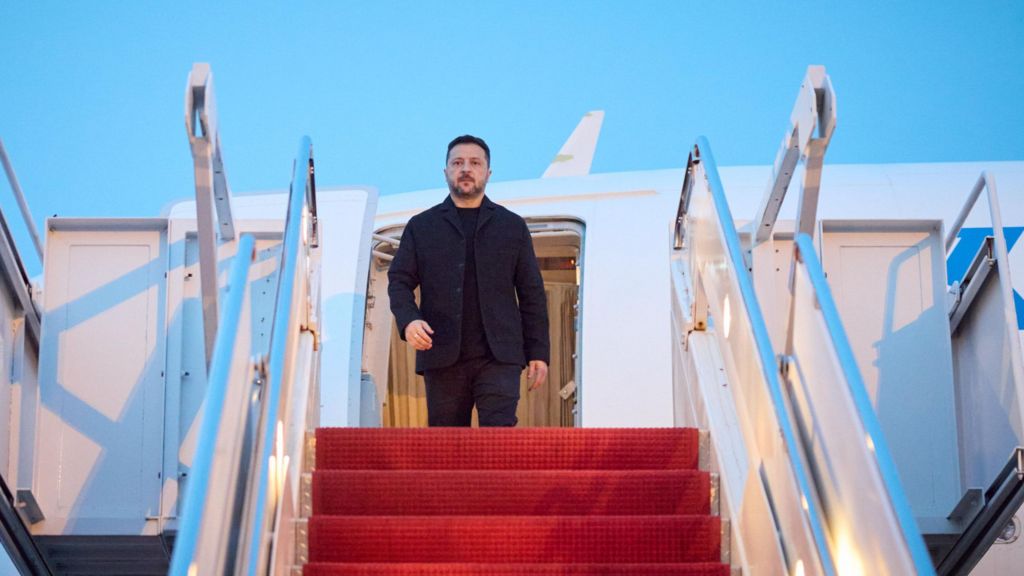
As Volodymyr Zelenskyy touches down in Washington for high-stakes talks with U.S. President Donald Trump at the White House, the Ukrainian leader is prioritizing one urgent, long-sought goal: locking in firm commitments to strengthen Kyiv’s air and ballistic missile defense capabilities amid a sharp escalation of Russian long-range attacks.
The visit comes at a pivotal moment in Russia’s full-scale invasion of Ukraine, with both sides ramping up cross-border drone and missile strikes. In overnight operations this week, Moscow reported that more than 390 Ukrainian drones targeted the Russian capital and surrounding regions between 8:30 p.m. Monday and 6:30 a.m. Tuesday local time. Russian air defense systems intercepted most of the unmanned aerial vehicles, but verified footage from BBC Confirm shows damage to a high-rise residential building in Chekhov, south of Moscow, and a large fire at a warehouse in the western Moscow suburb of Berezhki. Local authorities confirmed no fatalities or serious injuries from the strikes.
Since Zelenskyy’s last conversation with Trump in early July, Ukrainian forces have increasingly targeted Russian logistics infrastructure, including four warehouses belonging to major Russian e-commerce retailer Wildberries. The strikes have worsened operational disruptions for small and medium-sized businesses across multiple regions of Russia.
Zelenskyy’s top ask at this week’s White House meeting is moving forward on a previously floated plan to grant Ukraine a license to domestically produce Patriot air defense interceptors. Russian forces have dramatically stepped up deadly ballistic missile attacks on Ukrainian cities in recent weeks, and Zelenskyy has repeatedly emphasized that Kyiv faces a critical shortage of interceptors to protect civilian infrastructure. While Patriot systems have topped Ukraine’s military assistance wishlist for years, global stockpiles of the U.S.-made interceptors have been depleted by ongoing conflicts in both Ukraine and the Middle East, leaving very limited supplies available for transfer.
Turning a license agreement into full co-production of the advanced PAC-2 and PAC-3 Patriot variants on Ukrainian territory will require navigating a complex web of political, legal and technical hurdles, a process that could take many months to complete. Still, there are early signs of movement: a delegation from Raytheon, the U.S. defense manufacturer that produces Patriot systems, traveled to Kyiv last week, and Zelenskyy said the company has expressed readiness to deepen bilateral defense cooperation.
The Washington visit is not limited to talks between Zelenskyy and Trump. Both Zelenskyy and Israeli Prime Minister Benjamin Netanyahu are in the U.S. capital to attend the funeral of longtime Republican Senator Lindsey Graham, who passed away earlier this month at the age of 71. After meeting with Zelenskyy, Trump will hold his first in-person meeting with Netanyahu since the outbreak of the U.S.-Israel war with Iran in late February.
Tensions between the two conflict zones spilled over over the weekend, when Ukrainian forces struck an Iranian cargo vessel operating in the Caspian Sea. Kyiv has labeled Iran a direct accomplice to Russia’s invasion, claiming it has evidence that Russia has shared classified satellite intelligence with Tehran that has enabled Iranian attacks on U.S. military installations and Gulf Arab states. When asked about the allegation last week, Trump said he would question Russian President Vladimir Putin to verify the claim, but added that even if it proved true, it would not change U.S. policy at this time.
On the Russian side, President Putin struck a defiant tone during remarks to the Russian State Duma on Monday, framing recent Ukrainian strikes on Russian territory as “terrorist methods” targeting civilians that would never break the spirit of the Russian people. “We will achieve our objectives and will together do everything for victory, for Russia,” Putin told lawmakers.
The war took an unexpected diplomatic turn over the weekend, when Kazakh President Kassym-Jomart Tokayev, a longstanding Russian ally, publicly questioned Moscow’s war aims. Tokayev said that the roots of the full-scale invasion remained “not understandable” to him, and called for an immediate cessation of hostilities to open the door for peace negotiations. He proposed revisiting the 2022 Istanbul negotiation framework, labeled “Istanbul formula 2.0,” as a starting point for talks. But Kremlin spokesman Dmitry Peskov rejected the proposal on Monday, saying that a freeze in hostilities was impossible under current conditions “given Kyiv’s position.”