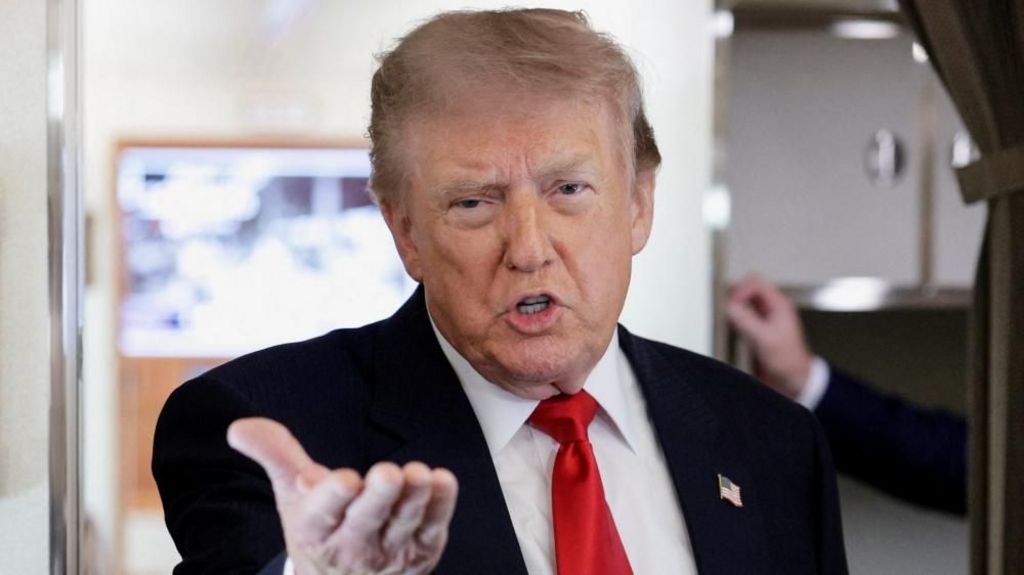
Three full days have passed without direct military exchanges between the United States and Iran, and U.S. President Donald Trump has announced that what he describes as “very friendly negotiations” are underway to de-escalate the ongoing regional conflict, expressing public optimism that a lasting end to hostilities could be reached soon.
Speaking to reporters traveling with him aboard Air Force One this Monday, Trump laid out his outlook for the diplomatic process. “I think there’s a good chance that something positive could happen,” he stated. But the president also issued a clear warning: if the current negotiating efforts collapse, the U.S. will immediately resume the large-scale military operations it was conducting before the current lull in fighting began.
Iran’s government has directly pushed back on Trump’s claim, denying that any direct negotiations with the United States are taking place at this time.
Trump explained that he made the decision to halt U.S. airstrikes on Iranian targets last Friday at the request of third-party nations mediating between the two adversarial sides, who asked for additional time for diplomatic dialogue to progress. Following the U.S. pause, Iran also suspended its own cross-border and regional attacks, creating the current calm.
This de-escalation comes after nearly two consecutive weeks of daily U.S. airstrikes and tit-for-tat retaliatory attacks between the two powers, which completely unraveled the ceasefire agreement that was reached between the two sides back in June. At the time the U.S. resumed strikes, the U.S. military stated its operations were explicitly aimed at degrading Iran’s capacity to disrupt commercial shipping moving through the Strait of Hormuz, a critical global chokepoint that carries roughly a fifth of the world’s daily oil supplies.
Market hopes for a lasting de-escalation triggered a sharp drop in global crude oil prices on Monday, with benchmark prices falling more than 9% at one point to hit $87.59 per barrel as traders priced in lower risk of supply disruptions.
During his remarks on Air Force One, Trump also addressed recent media reporting suggesting that five months of continuous combat operations have left U.S. military ammunition stockpiles depleted. The president rejected these claims outright. “We have a lot of ammunition. We have a lot of the mid-level stuff too, more than we could ever use, no matter what,” Trump said. “But we have a lot. I’d like to have more.”
He added that U.S. defense manufacturers are ramping up production of a range of military equipment, most notably Patriot anti-ballistic missile systems, one of the most in-demand defensive weapons produced by the U.S. defense industry. “That system is going up. We have a lot,” he noted.
White House spokesperson Anna Kelly doubled down on the administration’s stance in a separate statement, saying the U.S. military “has more than enough munitions, ammo, and stockpiles to serve all of President Trump’s strategic goals and beyond.” She also emphasized that Operation Epic Fury, the codename for the U.S.-led military campaign against Iran, “has exposed what happens when you mess with the United States.”
“Even still, the president has urged our defence contractors to constantly produce more made-in-America weapons, which are the best in the world,” Kelly added.
The current round of open hostilities between the two powers dates back to February 28, when the United States and Israel launched coordinated opening strikes against Iranian targets. Tehran quickly retaliated, launching a wave of missile and drone attacks targeting U.S. military bases and other assets across Gulf Cooperation Council states, as well as military and civilian targets inside Israel.
In June, Iran and the U.S. signed a memorandum of understanding that committed both sides to halt all offensive military operations, reopen the Strait of Hormuz to commercial shipping, and work toward a comprehensive permanent peace agreement over the course of 60 days. That truce collapsed on July 13, after Iranian forces launched attacks on commercial tankers transiting the Strait of Hormuz. In response, Washington resumed large-scale air strikes against Iran and reimposed a strict naval blockade on all of Iran’s commercial ports.
Tehran retaliated with a series of coordinated attacks on U.S. military facilities and bases across the Middle East, which killed four active-duty American soldiers. According to Iran’s Ministry of Health, U.S. airstrikes carried out in the period since hostilities resumed have killed dozens of Iranian civilians and military personnel.