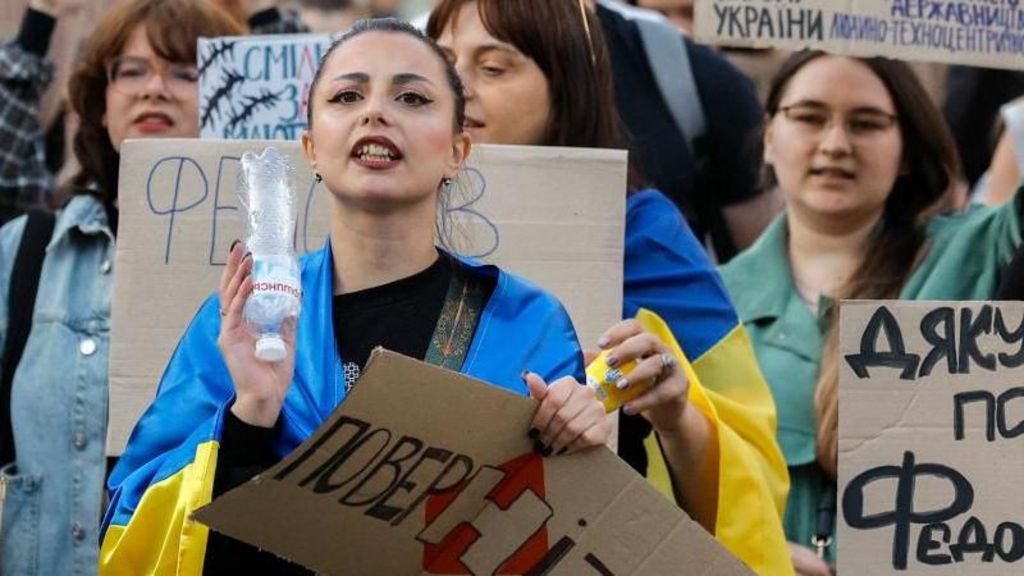
In the wake of President Volodymyr Zelensky’s mid-July cabinet reshuffle that removed Mykhailo Fedorov from his post as defence minister, Ukraine’s political landscape remains roiled by unrest, even as Russian airstrikes and drone attacks continue to threaten civilian and military infrastructure across the country. While the appointment of a new military commander-in-chief has been broadly welcomed by the public, ongoing street demonstrations led largely by Fedorov’s young base of supporters have kept pressure on Zelensky’s administration to reverse the decision.
Fedorov, a popular 40-something technocrat widely credited with accelerating Ukraine’s groundbreaking military and technological innovation over the course of the war, has rejected all alternative government positions offered to him by Zelensky. In a public statement last Thursday, he made clear he believes only three roles carry enough influence to meaningfully shape Ukraine’s war effort: defence minister, commander-in-chief, or the presidency itself.
That comment has sparked widespread speculation about Fedorov’s long-term political ambitions, with many political observers asking whether the ousted minister now positions himself as a potential rival to Zelensky. One former senior defence official went so far as to argue that Fedorov became a legitimate presidential contender the moment he was dismissed from cabinet. But with wartime constitutional rules barring national elections for the duration of Russia’s full-scale invasion, some political insiders have questioned the wisdom of Fedorov’s high-profile stand. Speaking on condition of anonymity, one opposition MP described his actions as childish, arguing that prioritizing personal political advancement amid an ongoing existential war is reckless and short-sighted.
Zelensky’s supporters have pushed back against criticism, noting the president took extensive steps to de-escalate the broader crisis by consulting nearly all senior Ukrainian military leaders before tapping 43-year-old Major General Mykhailo Drapatyi, a highly decorated, battle-proven former commander of Ukraine’s Land Forces, to replace the widely unpopular outgoing commander-in-chief Oleksandr Syrskyi. Former government advisor Yuriy Sak told the BBC that Zelensky’s decision was well-informed and broadly supported, framing Drapatyi as a modern, forward-thinking leader who can strengthen Ukraine’s defensive capabilities. But despite general acclaim for Drapatyi’s appointment, analysts agree it has only partially mitigated the political damage caused by Fedorov’s removal.
In an ironic turn, Zelensky – who rose to power in 2019 on a platform of youth-led change and anti-establishment reform – appears to have misread the priorities of young Ukrainians, who overwhelmingly see Fedorov as a representative of their values and aspirations. Oleksandr Merezhko, a ruling Servant of the People party MP, notes that young Ukrainians are hungry for young, anti-corruption, modernizing leaders in a political landscape they often see as corrupt and hypocritical, turning Fedorov into a popular folk hero. Merezhko added that Fedorov’s rising public profile and potential political ambitions likely led to his ousting, pointing to a long-standing pattern of Zelensky sidelining figures he views as potential political threats. Echoing a principle from Robert Greene’s *The 48 Laws of Power*, Merezhko observed that “Don’t outshine your master” proved to be an unwritten rule Fedorov failed to follow.
Most political analysts agree the core goal of last week’s reshuffle was to curb Fedorov’s growing influence – but that Zelensky’s gambit has backfired dramatically. Since his dismissal, Fedorov’s approval rating has skyrocketed among the Ukrainian public, amplifying rather than diminishing his political standing.
While few question Fedorov’s personal commitment, creativity, and work ethic, some defence insiders argue his outsized public reputation may exceed his actual individual impact. They point out that Ukraine’s advanced medium- and long-range strike capabilities were already well under development before Fedorov took office as defence minister, and that the country’s thriving defense innovation ecosystem is the product of work by thousands of people across 2,000-plus private and public entities, not a single leader. One anonymous opposition MP argued that protesting young Ukrainians hold an overly simplified, inaccurate view of Fedorov’s contributions and the operations of Ukraine’s defense establishment, a simplification that is understandable amid more than a decade of exhausting war with Russia. Many Ukrainians, worn down by mass conscription and devastating human losses, are naturally drawn to the idea that technological innovation like drones and autonomous systems can reduce the human cost of defending the country.
Across the political spectrum, there is broad agreement that Ukraine must resolve this toxic political dispute before autumn, when Russia is expected to launch another large-scale campaign targeting Ukraine’s energy infrastructure ahead of winter. In a recent Telegram post, Zelensky emphasized that the country’s top priority must be preparing to withstand the coming cold season. Most politicians and analysts interviewed for this report agree that while the ongoing crisis has eroded Zelensky’s authority and reputation, it is unlikely to cause major setbacks for Ukraine on the battlefield. Ukraine’s “long-range sanctions” campaign targeting Russian economic assets remains in full swing, inflicting growing damage on Moscow’s war economy, and front lines have remained largely static thanks to a sprawling 15-30 kilometer “kill zone” where all Russian movements are tracked and eliminated by Ukrainian drone operations.
As a young democracy still refining its institutional frameworks, Ukraine has faced enormous strain from Russia’s full-scale invasion. But despite the internal political friction, many observers stress the country remains remarkably resilient. As opposition MP Andrii Osadchuk put it, “The secret of Ukraine’s success is that we are much stronger horizontally than vertically,” expressing hope that the political damage from the current dispute will prove minimal.