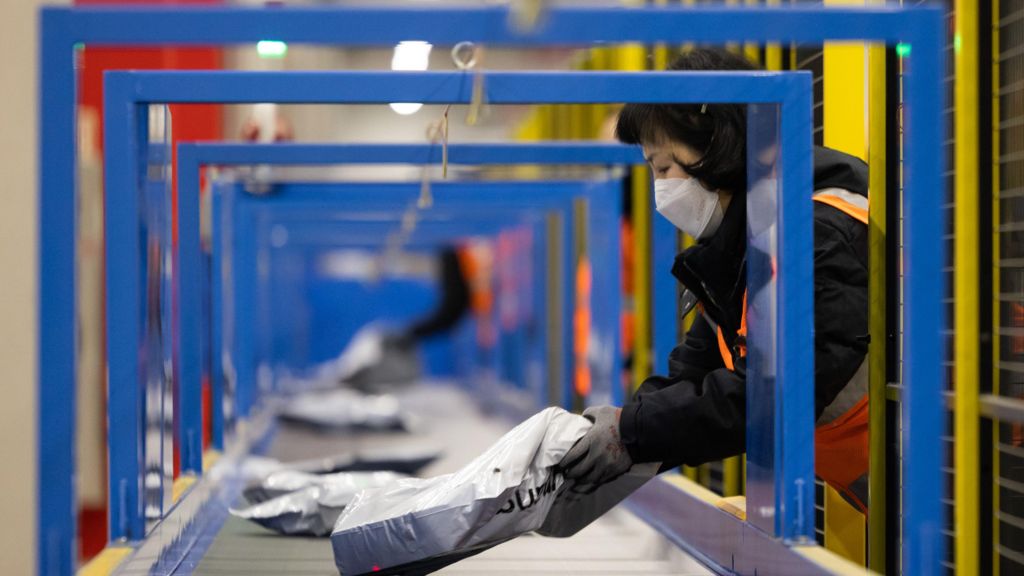
Six years ago, 27-year-old Jang Deok-jun collapsed unconscious in his bathtub after working more than a year of overnight warehouse shifts for Coupang, South Korea’s largest online retail platform. He was pronounced dead of a heart attack shortly after arriving at the hospital, and a subsequent investigation by South Korea’s state-run workers’ compensation insurer Comwel officially ruled his death a work-related fatality caused by chronic overwork.
Jang’s death was not an isolated incident. Between 2000 and May 2026, Comwel has attributed 46 work-related deaths of warehouse and delivery workers to stroke or heart disease, conditions widely linked to excessive overwork. Today, his mother Park Mi-suk has spent six years carrying on a relentless advocacy campaign to ban overnight deliveries, the working practice she blames for robbing her of her son.
South Korea’s delivery sector has exploded into a massive industry built on the promise of unrivaled speed and convenience. In the country’s hyper-connected digital economy, customers who place orders before midnight are guaranteed delivery by 7 a.m. the next day – a service that relies entirely on an sprawling network of overnight warehouse staff and delivery drivers. Coupang, founded by a Korean-American entrepreneur, has dominated this market since expanding its overnight fresh produce delivery in 2015, now employing nearly 100,000 workers across its nationwide logistics network.
But this industry-defining convenience has come at a steep hidden cost to frontline workers, public health experts and labor advocates warn. The UN International Agency for Research on Cancer classifies overnight work as a probable human carcinogen, and research from South Korea’s Catholic University of Korea professor of occupational medicine Kang Mo-yeon adds that mounting evidence also links irregular night shifts to elevated risks of cardiovascular disease, diabetes, and chronic mental illness.
Unlike the UK, which caps overnight delivery driving at 10 hours per 24-hour period, South Korea imposes no legal limits on overnight working hours, creating a regulatory gap that has allowed extreme working conditions to become normalized. The debate over overnight delivery also reveals deep divides among workers themselves: while the national delivery workers’ union has called for a full ban on overnight deliveries since 2025, many drivers opt for night shifts voluntarily, drawn by higher pay and the flexibility to care for children or ill family members during the day.
One subcontracted Coupang driver, who spoke to the BBC on condition of anonymity, explained that he earns roughly 7 million won ($4,600) per month – nearly double South Korea’s national average income – working 10-hour overnight shifts five to six days a week. “I know this is destroying my body long-term, but the pay makes it worth it,” he said. “Critics who call for banning overnight deliveries aren’t listening to the choices we’ve made to support our families.” Still, he acknowledged the constant pressure: drivers are paid per package, and failure to complete all deliveries by the 7 a.m. deadline can result in losing their assigned delivery route to a competitor, leaving no time for scheduled breaks. His wife, he added, still worries he will fall asleep at the wheel during long shifts.
Park argues that as demand for faster deliveries grows, the sacrifice of these frontline workers has been rendered invisible to the consumers who benefit from their labor. In Jang’s case, she says, holding the company accountable was an uphill battle: South Korean law places the burden of proving overwork on grieving families, and Coupang was only required to share Jang’s work records and CCTV footage with Comwel, not with Park. It took months of lobbying lawmakers and government agencies for her to obtain the documents that confirmed Jang’s working hours met the legal threshold for overwork-related death: his shift count met the standard of an average 60-hour workweek over 12 weeks, with overnight hours weighted 30% more heavily under Comwel rules.
The controversy deepened in 2025, when local media published leaked chat logs allegedly between Coupang’s chairman Bom Kim and a former chief privacy officer, showing Kim ordering staff to remove references to Jang “working hard” from internal reports. Coupang has dismissed the claim as groundless, alleging the leak came from a disgruntled former employee, but labor unions filed a criminal complaint alleging evidence tampering, and South Korean police launched a formal investigation into the company in December 2025. Coupang maintains it has fully cooperated with all investigations and submitted all requested documentation to regulators.
Jang’s case was followed by another high-profile death that renewed public anger: 34-year-old Oh Seung-yong, a driver for a Coupang-contracted logistics firm, died after crashing his truck into a pole during an overnight delivery run. Comwel also ruled Oh’s death work-related. His sister told parliament that Oh had worked six days a week, clocking more than 11 hours per shift almost entirely overnight – and even continued working for four hours after his father’s sudden death before traveling to the hospital to be with his family. Coupang says it enforces a 52-hour weekly cap for all employees, gives subcontracted drivers a full weekend off every two weeks, provides free health screenings for all direct and contracted staff, and claims it holds the best safety record in the global logistics industry with no recorded industrial accident deaths. Unions argue that safety rules are rarely enforced by third-party subcontractors.
In December 2025, Coupang CEO Harold Rogers was summoned to South Korea’s national parliament to answer questions about the deaths of Jang and Oh, as well as the country’s largest ever data breach that exposed the personal information of 37.5 million Coupang users, resulting in a record $410 million fine against the company. During the televised hearing, Park publicly demanded Chairman Bom Kim be held criminally liable for her son’s death, while Oh’s sister pressed Rogers for a formal apology. Rogers offered “deepest condolences” and said he was sorry for the families’ loss, but remained silent when pressed for further comment.
The controversy has also put pressure on South Korean President Lee Jae Myung, who made reducing workplace injuries and deaths a top campaign priority, capitalizing on his own experience of a disabling factory injury earlier in life. South Korea has long struggled with one of the highest workplace fatality rates among developed nations, and the government has already passed major labor reforms: capping overall weekly work hours at 52, and introducing legislation that allows for jail time for executives found negligent in workplace death cases. Ironically, the governing party recently proposed new legislation to relax overnight delivery restrictions for smaller retailers to weaken Coupang’s market monopoly, a move that has angered unions and activists, including Park, who argue the core problem is unregulated overwork, not just Coupang’s market dominance.
Six years after her son’s death, Park’s advocacy has upended her own life. She was forced to close her small furniture-making business after spending years navigating legal battles for compensation and accountability, and moved from her longtime home to a small rental apartment in Daegu. She still keeps all of Jang’s belongings, including his collection of action figures, stored in a box in her home – not ready to let go, and not ready to end her fight.
Jang once compared his job to a seesaw: if he stepped down, his overworked colleagues would be left struggling to cover his load. Today, Park reframes that analogy for South Korea’s delivery industry: Jang and thousands of workers like him hold down one end of the seesaw, so consumers can enjoy the convenience of fast, early-morning deliveries on the other. “I hope we never become a society that closes our eyes to other people’s sacrifice just for a little bit of convenience,” she says.