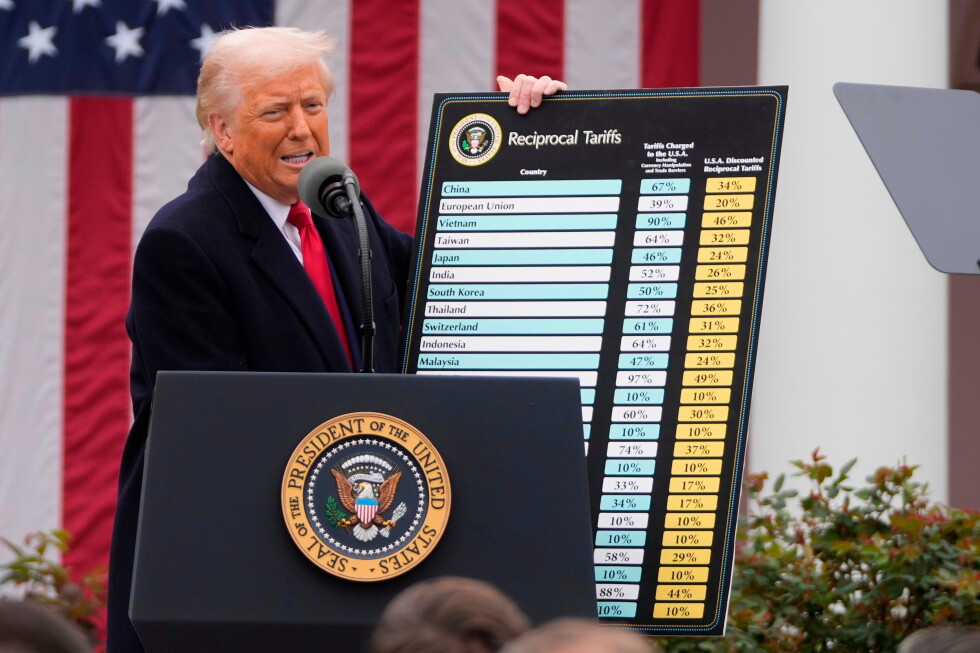
WASHINGTON — Just hours before a set of temporary trade tariffs imposed by the Trump administration expired at midnight Thursday, U.S. President Donald Trump moved forward with a new slate of permanent double-digit tariffs targeting imports from 60 global trading partners, advancing his protectionist trade agenda after a major Supreme Court defeat erased his earlier sweeping tariff policy earlier this year.
The new measures set import taxes ranging from 10% to 12.5% on goods covering 99% of U.S. inbound imports, with the administration justifying the move by accusing the affected nations of failing to sufficiently enforce their own bans on imports produced through forced labor. “The United States has had a forced labor import ban for nearly a century, and rigorously enforces it; it’s well past time for our trading partners to do the same,” U.S. Trade Representative Jamieson Greer said in a statement announcing the new tariffs.
The timing of the rollout is no coincidence: the temporary 10% global tariffs Trump put in place after the Supreme Court’s February ruling striking down his earlier broad tariffs are set to expire at 12:01 a.m. ET Friday. That February decision blocked the tariffs Trump had imposed under the 1977 International Emergency Economic Powers Act (IEEPA), which the president had invoked to declare the U.S.’s longstanding trade deficit a national emergency, breaking with decades of bipartisan U.S. policy that prioritized lower tariffs and expanded global trade. After the Supreme Court ruled IEEPA did not grant the president authority to impose broad tariffs in this context, the administration was forced to issue refunds to U.S. importers that had paid the levies.
In response, Trump enacted temporary tariffs under Section 122 of the 1974 Trade Act, but that legal authority only allows for 150 days of temporary measures — a deadline that expires this week. To replace the expiring levies, the Trump administration is turning to a more legally durable authority: Section 301 of the 1974 Trade Act, which allows the president to impose import tariffs and other trade sanctions against nations found to engage in “unjustifiable,” “unreasonable,” or “discriminatory” trade practices. Trump previously used this same section to impose large-scale tariffs on Chinese imports during his first term, and those levies survived multiple legal challenges in U.S. courts.
The new forced labor tariffs were first proposed last month. A senior anonymous administration official confirmed Thursday that some nations have already strengthened their forced labor enforcement rules in response to the proposal, qualifying them for lower tariff rates. For example, India’s originally proposed 12.5% tariff was adjusted down to 10% after policy changes. The new tariffs also include key carveouts: oil and gas, fertilizer, and all goods eligible for duty-free status under the U.S.-Mexico-Canada Agreement (USMCA), the North American trade deal Trump negotiated during his first term, are fully exempt.
The policy has drawn immediate pushback from both domestic political opponents and affected trading nations. U.S. Rep. Richard Neal of Massachusetts, the top Democrat on the House Ways and Means Committee, called the forced labor justification a cynical pretext for a protectionist agenda. “Forced labor is a real and pervasive problem in our supply chains and demands serious enforcement. It should never be cheapened into a pretext for a tariff policy built on dubious legal theories and personal grievances,” Neal said.
Brazil, which faces the full 12.5% tariff under the new policy, called the U.S. move “arbitrary and unjustified” in an official statement. The Brazilian government announced it will activate its reciprocity law to impose retaliatory tariffs on U.S. goods and file a formal complaint against the U.S. with the World Trade Organization, accusing Washington of “manipulate an issue of great importance to human rights and the struggles of workers worldwide in order to accuse 59 countries and the European Union of unfair practices.” Chile, also facing a 12.5% rate, pushed back against the designation, noting the country has “solid labor institutions, a robust regulatory framework and a firm commitment to the prevention and eradication of forced labor,” adding the tariff application is “inconsistent with these standards, as well as with the technical, political, and legal background presented throughout the investigation process.”
Economically, the new tariffs carry political risk for the Trump administration ahead of November’s midterm elections. Tariffs are ultimately paid by U.S. importing companies, which typically pass the added costs onto consumers in the form of higher prices — a major concern at a time when American households are already grappling with persistently high cost of living.
While many human rights and labor experts share skepticism about the Trump administration’s underlying motivation for the tariffs, most acknowledge the measures have already spurred meaningful global policy changes to address forced labor, a widespread global human rights crisis that affects an estimated 27.6 million people worldwide as of 2021, per data from the U.N.’s International Labour Organization (ILO).
Martina Vandenberg, founder and president of The Human Trafficking Legal Center, said her organization has long supported forced labor import bans as a useful tool to curb global exploitation, even if they are not a standalone solution. “It’s possible to be extremely critical of tariffs, as we are, and to be very concerned about blanket tariffs used as bludgeons against countries. And yet I think it’s undeniable that there is a significant response in terms of the adoption of import bans,” Vandenberg said. She and her organization have called for a phased implementation of tariffs, however, to give nations time to build robust, enforceable enforcement mechanisms rather than just symbolic policy changes.
Kenya Davis, a partner at law firm Boies Schiller Flexner, noted that prior to these tariffs, the 2021 Uyghur Forced Labor Prevention Act — which bans imports of any goods linked to forced labor in China’s Xinjiang region — was the most significant U.S. legislation targeting forced labor. While the effectiveness of that law remains debated, Davis said it successfully drew global attention to the crisis, and the new tariffs could serve a similar awareness-building purpose. Still, Davis cautioned that without a transparent comprehensive approach that includes technical assistance for nations building enforcement systems, enthusiasm for the new tariffs should be muted.
Isabelle Glimcher, a senior research scientist focused on global labor at the NYU Stern Center for Human Rights, pointed to one key structural flaw in the policy: the tariffs penalize countries for failing to ban forced-labor imports, rather than addressing forced labor in domestic production that ends up exported to the U.S. Even so, Glimcher confirmed that the threat of tariffs has already pushed nations including India to adopt new forced labor import bans, with the European Union also moving forward with its own forced labor regulations set to take effect in 2026. “Not all of these things are necessarily or wholly attributable to the Section 301 investigations, but does seem like countries are responding and starting to take all of this seriously,” Glimcher said.
Looking ahead, additional Section 301 tariffs could be on the horizon. The Office of the U.S. Trade Representative has already launched an investigation into whether 16 countries accounting for 70% of U.S. imports have engaged in overproduction that suppresses global prices and disadvantages U.S. companies, though that probe is not yet complete.