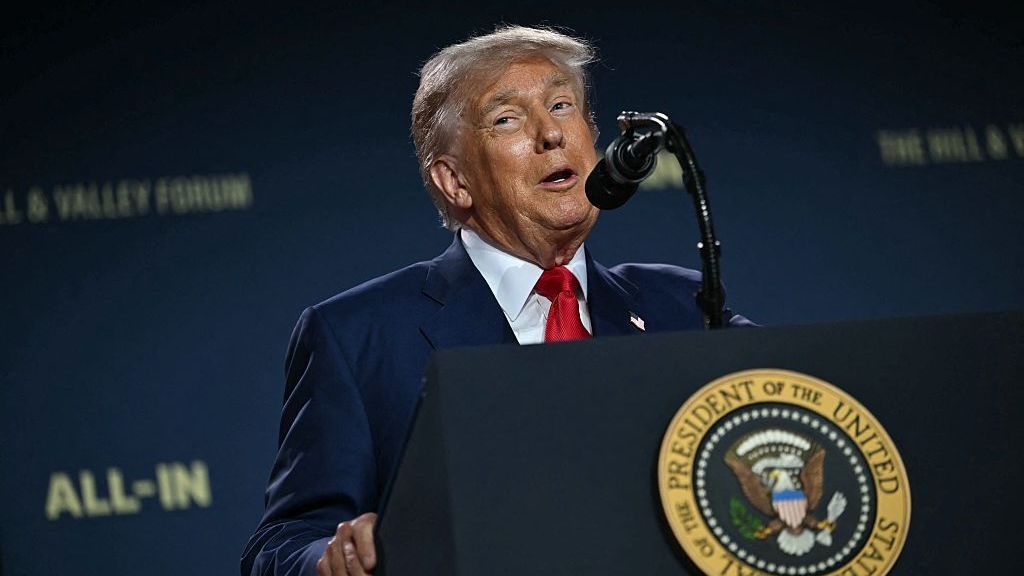
As global alarm over artificial intelligence’s potential existential and societal risks reaches a fever pitch, former U.S. President Donald Trump has shaken up the policy conversation with a new announcement: he plans to establish a dedicated national ‘AI Force’ and appoint a senior White House-level ‘AI tsar’ to lead the country’s AI strategy.
In a social media statement published Saturday, Trump pushed back against the growing chorus of experts and industry leaders calling for a temporary slowdown in cutting-edge AI development until robust safety guardrails can be put in place. He emphasized that under his leadership, the federal government would not place unnecessary barriers that would curb the rapid expansion of the U.S. AI sector. Going further, Trump dismissed widespread public and expert concern over AI’s potential harms as a deliberate ‘hoax’, a stance he has repeated in recent public comments.
Trump framed AI as a transformative technological shift on par with — and far more impactful than — the first Industrial Revolution or the rise of the internet. He projected that AI could eventually account for as much as 25% of U.S. gross domestic product, and stressed that his top priority is maintaining U.S. technological leadership over China in this critical emerging field. AI innovation has already emerged as a core point of competition between the world’s two largest economies, and the issue is expected to be on the agenda when Trump meets Chinese President Xi Jinping next week, according to pre-summit briefing expectations. The former president added that for bad actors who misuse AI for harmful purposes, his administration would leverage existing criminal and civil legal frameworks to hold wrongdoers accountable. Notably, Trump offered no specific structural details, policy outlines, or implementation timeline for his proposed ‘AI Force’ in his initial announcement.
Trump’s proposal comes amid a wave of urgent warnings from AI researchers, top industry leaders, and policymakers across the Western world about the risks posed by unregulated development of increasingly powerful AI systems. In recent weeks, multiple current and former AI researchers have sounded the alarm about existential risk, with one prominent figure estimating a greater than 10% probability that unconstrained AI advancement could lead to human extinction. Major AI companies are currently locked in a global race to roll out increasingly powerful models, with many working toward the development of so-called ‘superintelligence’ — a theoretical AI system that would outperform humans across virtually all cognitive and strategic tasks.
In recent months, three of the world’s largest AI developers — Anthropic, OpenAI, and Google, creators of leading chatbots Claude, ChatGPT, and Gemini respectively — have publicly reported security gaps and incidents where their platforms were exploited for malicious activity. Earlier this year, Anthropic CEO Dario Amodei became the latest top AI leader to call for an industry-wide slowdown in advanced AI development, paired with binding government regulation and independent third-party monitoring of high-risk model training. Amodei’s call has been backed by other prominent industry figures, including OpenAI CEO Sam Altman and xAI founder Elon Musk. Anthropic co-founder Jack Clark told the BBC in a recent interview that mandatory ‘kill switches’ — remote shutdown systems that can be activated by independent third parties to disable misbehaving models — should be required for all high-capacity AI systems.
While U.S. lawmakers have already begun drafting new AI-focused legislation in response to growing safety concerns, Altman acknowledged this week that federal regulators and policymakers have struggled to keep up with the breakneck pace of AI innovation, leaving a gap in effective oversight. Altman pushed back against heavy-handed government intervention, however, arguing that the public and policymakers should place greater trust in AI companies to self-regulate and develop safety systems. ‘The world should trust that we are going to do the right thing because it’s the right thing and we feel the magnitude of this,’ Altman told a tech industry conference in San Francisco.
Across the Atlantic, the debate over AI regulation is also accelerating. In the United Kingdom, cross-party MPs and members of the House of Lords have warned that existing national laws are not equipped to mitigate human rights risks posed by rapidly advancing AI systems. The parliamentary Joint Committee on Human Rights has released a new report calling for a dedicated new AI bill to address what it describes as the ‘scale and seriousness’ of these emerging threats to public rights and safety.