Escalating tensions in the long-running Yemeni conflict spilled over into Saudi Arabian territory over the weekend, as Houthi forces launched a coordinated wave of missile and drone strikes targeting key sites in the Saudi capital Riyadh and energy infrastructure in the Red Sea coastal city of Yanbu. The assault, which marked a sharp escalation of hostilities between the Iran-aligned Houthi movement and the Saudi-led coalition, came as the Houthis have made rapid territorial gains across northern Yemen in recent weeks, pushing the Saudi-backed Yemeni government into a defensive position.
The Houthi movement formally claimed responsibility for the attacks Saturday, with group spokesperson Yahya Saree confirming that the operation used a mixed arsenal of long-range missiles and unmanned aerial drones. Saree framed the strikes as a reciprocal response to what he called “criminal Saudi attempts” to target the Houthi-held Yemeni capital Sanaa, a recurring point of friction that has driven repeated cross-border attacks since a fragile 2022 truce collapsed last July.
Shortly after the attacks were announced, coalition spokesperson Major General Turki al-Maliki released an official statement confirming that Saudi air defense systems had successfully intercepted and destroyed a ballistic missile aimed at Riyadh. Maliki added that defense forces also foiled additional attack attempts targeting four other locations across the kingdom — Taif, Baish, Farasan, and Yanbu — before any of the incoming projectiles could reach their intended targets. The coalition accused the Houthis of deliberately targeting civilian populations and critical civilian infrastructure, noting that the alliance retains full rights under international humanitarian law to deploy all appropriate defensive and retaliatory measures against the group in response to the escalation.
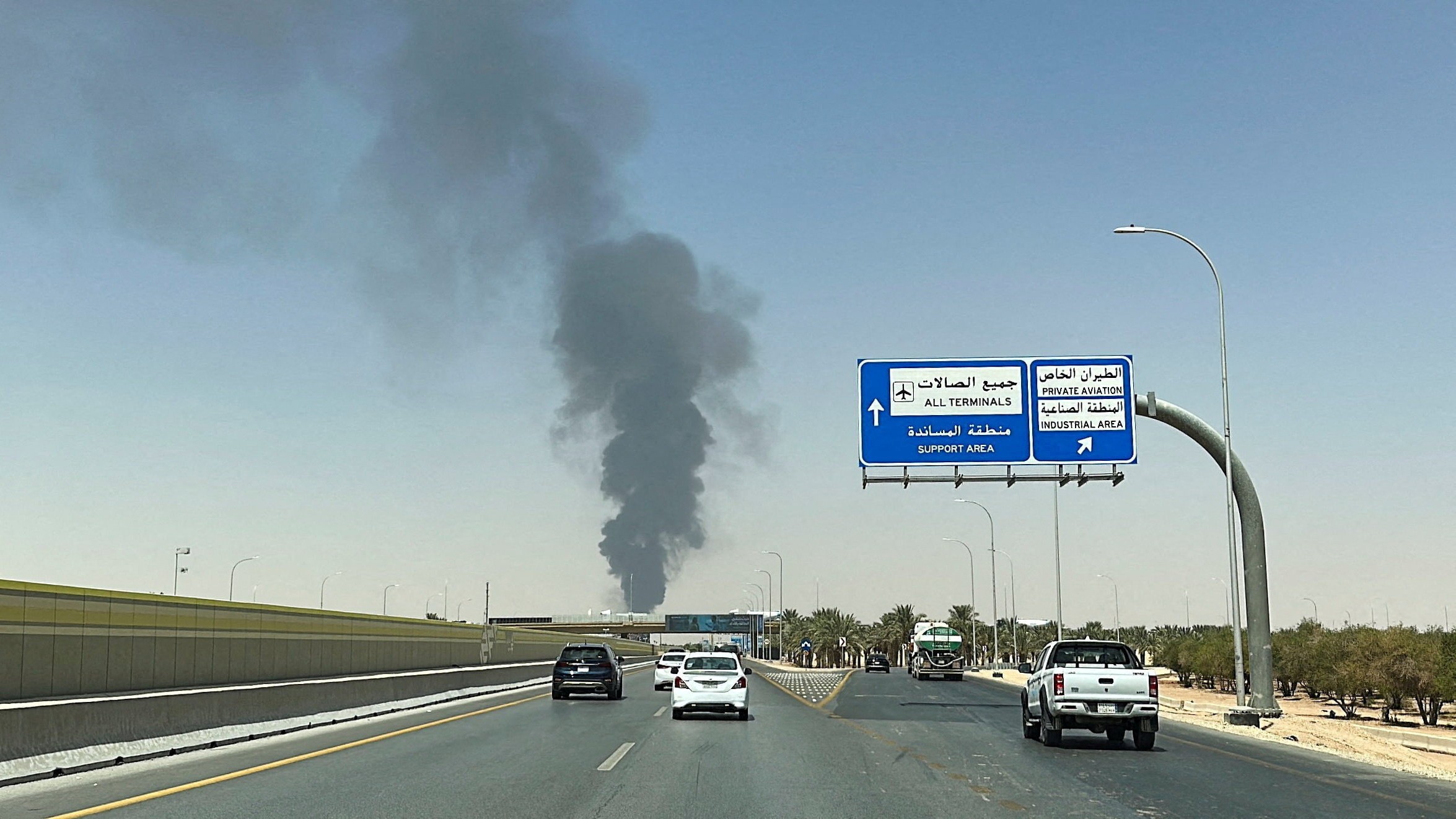
In a marked shift from recent rounds of hostilities, Saudi authorities issued an immediate early-morning public alert ordering Riyadh residents to shelter indoors — the first official shelter order issued during this latest phase of conflict with the Houthis. Hours after the alert, multiple local residents speaking to AFP confirmed they heard multiple loud explosions reverberate across wide areas of the capital. Around the same time, emergency response teams extinguished an outbreaking fire at a fuel storage depot adjacent to Riyadh’s main international airport, where an Aramco-branded oil tanker had caught fire. Social media footage circulating widely online showed thick plumes of black smoke rising from the area, though officials have not yet confirmed a definitive link between the fire and the reported Houthi strikes.
The weekend attack follows just days after Saudi officials accused the Houthis of launching an attempted strike on the holy city of Mecca, a site that draws millions of Muslim pilgrims annually. Riyadh labeled that alleged attempt a “cowardly terrorist attack,” a claim that Houthi representatives immediately rejected as entirely false. The Houthi movement has been waging a sustained ground campaign to seize full control of Yemen’s entire Red Sea coastline, a push that would put the strategic Bab al-Mandeb strait — one of the world’s busiest global shipping chokepoints — entirely under Houthi control. The group has faced near-constant Saudi air bombardment throughout this territorial campaign.
Despite Riyadh’s recent negotiation of new defense cooperation agreements with Turkey and Pakistan, these pacts have so far failed to blunt the growing cross-border threat posed by advancing Houthi forces. In comments released Saturday, Turkish Foreign Minister Hakan Fidan issued a formal condemnation of the attacks on Saudi territory and energy infrastructure, arguing that the kingdom should not be dragged into the broader regional standoff between Iran and the United States. Fidan added that Turkey stands ready to fulfill its obligations under the recent trilateral defense pact, including providing any military support Saudi Arabia may require in response to ongoing Houthi aggression. For its part, Pakistan confirmed that it has not yet held discussions about launching a coordinated military response under its existing defense agreement with Riyadh, but noted that the country will take action when “the time comes.”
The United States, a long-time Saudi security partner, has offered only limited backing to Riyadh amid the escalating conflict. As recently as last week, American news outlet Axios reported that the White House rejected a direct Saudi request for U.S. military forces to carry out targeted strikes against Houthi positions in Yemen. Just days before the latest attacks, however, the U.S. State Department announced its formal approval of a $24.3 billion arms deal to supply the Saudi military with F-35 fifth-generation fighter jets. State Department officials said the deal will strengthen Saudi Arabia’s capacity to deter both current and future security threats.
The current phase of the Yemeni civil war traces back to 2014, when Houthi forces seized Sanaa and large swathes of northern Yemeni territory, prompting the Saudi-led military intervention to restore the internationally recognized Yemeni government in March 2015. The 2022 truce that brought months of reduced violence collapsed last July after the Houthis allowed an Iranian commercial aircraft to land in Sanaa in defiance of Saudi-enforced airspace restrictions.
The Houthi movement’s recent rapid advances along Yemen’s Red Sea coast have triggered growing global concern over the security of international maritime trade. The territorial gains add new disruptions to global shipping already strained by Iranian restrictions on traffic through the Strait of Hormuz, another critical global energy chokepoint. Houthi leaders have insisted that commercial shipping transiting the Bab al-Mandeb faces no threats from the group, with the exception of vessels with confirmed links to Saudi Arabia. With major outside powers offering only limited backing to Riyadh, Saudi officials have moved to expand the kingdom’s independent military operations inside Yemen to counter the growing Houthi advance.