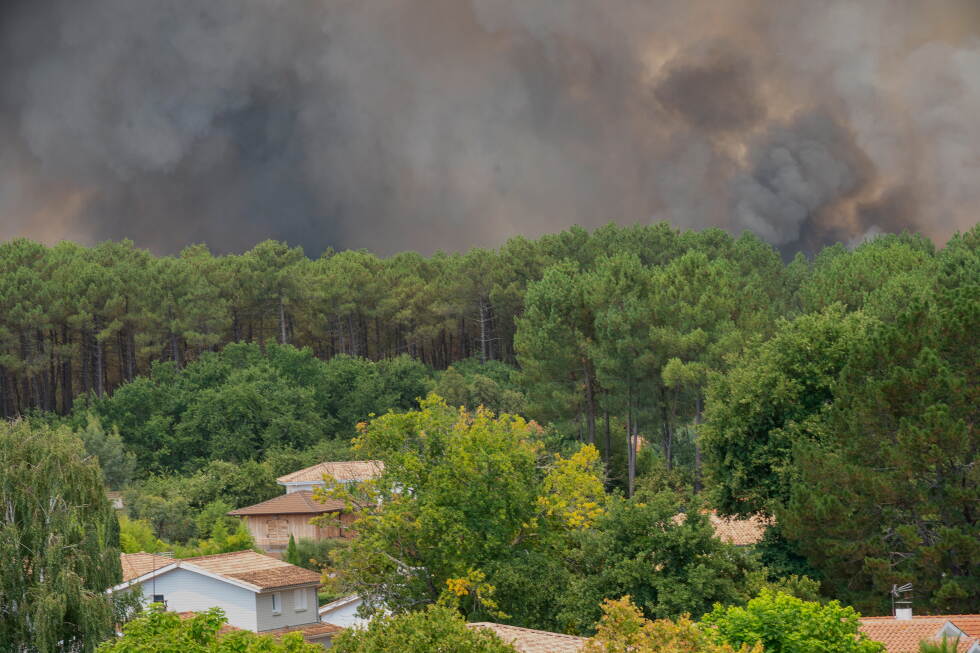
A fast-spreading wildfire burning through Gironde region forestland along France’s Atlantic coast has forced roughly 20,000 residents and vacationers to flee their homes and resorts, in what marks the latest major wildfire event to hit Southern Europe amid a season of record heat and prolonged drought.
The blaze, which ignited near the coastal town of Lège-Cap Ferret, roughly 60 kilometers southwest of Bordeaux, has already scorched more than 31 square kilometers of vegetation, regional authorities confirmed Thursday. As of the latest update, no injuries have been documented, but the fire has advanced to within 300 meters of residential neighborhoods in the town of Lège, prompting urgent emergency action.
More than 700 firefighters, including reinforcement teams deployed from the Paris region, have been assigned to contain the blaze, with water bombers called in to drop massive amounts of water on the fire line from the air. By Thursday evening, regional prefect Sophie Brocas’ office reported that while the fire has not yet been fully extinguished, it has been successfully contained to the northern area of Lège, limiting further spread for the time being.
Evacuation efforts unfolded in two phases overnight and through Thursday: first, roughly 11,000 people, including tourists staying at coastal holiday camps and campgrounds, plus more than 1,000 permanent residents living along the forest edge, were moved to safe zones. As a precautionary measure, authorities later ordered a full evacuation of the nearby village of Claouey, which hosts multiple additional campsites, adding another 8,800 people to the total evacuation count. Local municipalities have set up dedicated reception centers to provide shelter, food, and basic support for displaced evacuees.
This Gironde blaze is just one part of a far wider wildfire crisis that has engulfed Southern Europe this summer, a disaster climate scientists link directly to human-caused climate change, which is amplifying the frequency and severity of extreme heat and prolonged dry conditions across the Mediterranean region. France has already faced a cascade of heat waves starting earlier than usual this year, bringing record-breaking high temperatures and leaving vegetation so parched that wildfire risk has jumped dramatically. French Interior Minister Laurent Nunez reported that as of this week, more than 12,500 wildfires have burned across France since the start of 2024, consuming nearly 44,000 hectares of land.
The crisis extends far beyond France’s borders. In Italy, wildfires continued to spread across Sicily on Thursday, just one day after a veteran fire department chief, Alessandro Marchì, died while battling a blaze in the province of Caltanissetta. Italian President Sergio Mattarella released a formal statement of condolences to Marchì’s family and fellow first responders following his death.
In Spain, firefighters are working around the clock to contain dozens of active blazes amid an ongoing severe heat wave that is projected to push temperatures as high as 44 degrees Celsius (111 degrees Fahrenheit) in the country’s southeast. A blaze near Alcalá de Henares, just outside of Madrid, forced a temporary suspension of high-speed rail service between the capital and Barcelona on Thursday, disrupting travel for thousands of passengers. In the province of Guadalajara, crews continue to battle a week-old blaze that is already the second-largest wildfire recorded in modern Spanish history, having burned 320 square kilometers of land. Other active fires in central Spain, including one near the city of Toledo, have destroyed roughly 20 residential structures and forced additional evacuations of local communities.