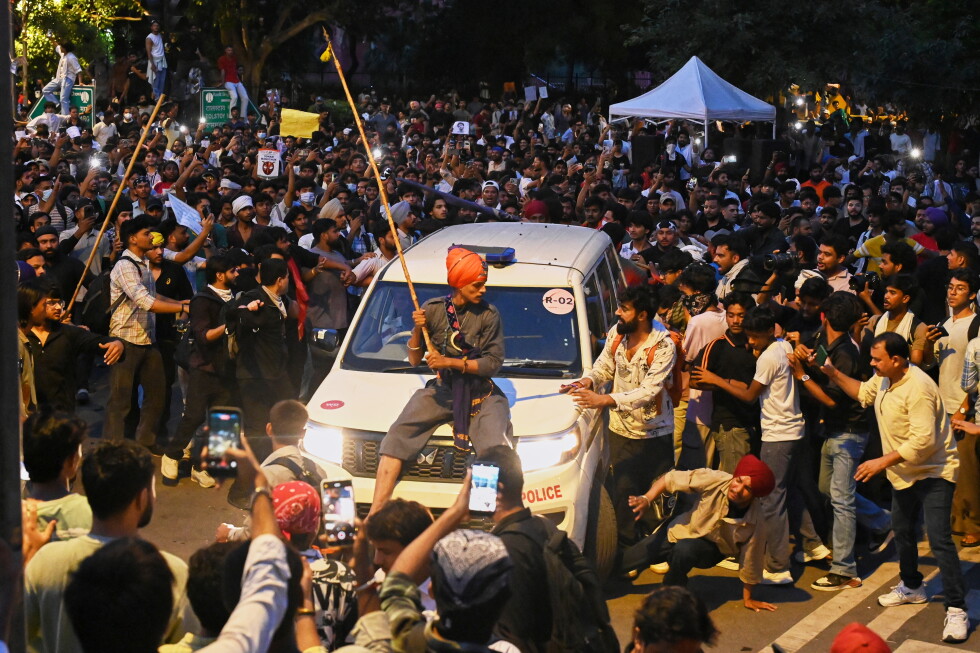
NEW DELHI – Thousands of young Indian demonstrators maintained a street sit-in in the heart of New Delhi on Thursday, ignoring newly imposed movement restrictions in a major show of force that has emerged as one of the most significant threats to Prime Minister Narendra Modi’s sitting administration. What is now known as the ‘Cockroach’ protest movement launched more than a month ago, sparked by widespread allegations of question paper leaks in two of India’s most competitive high-stakes entrance examinations: one for admissions to elite medical colleges, and another for entry into coveted government job roles. In the weeks since its inception, the movement has outgrown its original focus on exam-related grievances, drawing in working professionals, ordinary families, and a broad cross-section of the public united by simmering discontent with the ruling government.
Thursday’s gathering at Jantar Mantar, New Delhi’s long-recognized official protest zone, came on the heels of overnight street clashes that saw police deploy tear gas canisters and baton charges to break up crowds. This marked the second violent confrontation between authorities and demonstrators in a single week. Just four days prior, on Monday, thousands of protestors had broken through security restrictions to march toward India’s Parliament building before security forces dispersed the crowd with the same crowd-control tactics.
Despite police roadblocks aimed at blocking access to the protest site, demonstrators managed to regroup by early Thursday morning and return to continue their demonstration. In a bid to cut off crowd flow to the area, local authorities suspended passenger services on the Delhi Metro at 16 stations across the city’s central district.
The issue of repeated exam paper leaks has emerged as a flashpoint for millions of young Indians, who see it as a visible symbol of systemic failure. Protesters have put forward three core demands: the immediate resignation of India’s Education Minister Dharmendra Pradhan, sweeping structural reforms to India’s broken national examination system, and financial compensation for the families of students who died by suicide in the wake of recent paper leak scandals.
Facing rapidly mounting political pressure, Prime Minister Modi broke his weeks-long public silence on the unrest on Thursday, announcing the creation of fast-track special courts to speed up the prosecution of those involved in organizing exam paper leaks. The new fast-track courts are designed to cut through the backlog that plagues India’s famously slow national judicial system. In a public post on the social media platform X, Modi emphasized, “Nothing is more important than the welfare and future of our youth!”
Leaders of the Cockroach Janta Party, the informal organizational body behind the movement, have rejected any compromise, insisting demonstrations will continue until the education minister steps down. Staying true to the movement’s satirical, tongue-in-cheek identity, movement founder Abhijeet Dipke responded to Modi’s statement with a meme of Pradhan captioned “Hi, my name is Nothing,” a direct jab at the prime minister’s comment.
The movement traces its origins to an online satirical campaign launched in May, before shifting to in-person, small-scale street protests across major Indian cities in June. It gained explosive traction after prominent Indian activist Sonam Wangchuk joined the demonstration and launched a hunger strike that has now extended past three weeks. Over the weekend, police forcibly removed Wangchuk from the protest site and transferred him to a government hospital, a move that further galvanized public anger.
For many young Indians, these demonstrations represent one of the last remaining high-profile outlets for dissent in a country where the Modi administration has overseen a widespread crackdown on activist groups, opposition political figures, and public anti-government protests.
The movement’s rapid expansion beyond student circles reflects deep-seated, widespread frustration among India’s large youth population, mirroring a broader regional trend across South Asia, where youth-led anti-government movements have shaken established political establishments in recent years. It has also drawn support from Indians across all age groups, who share concerns over lack of government accountability, cripplingly high unemployment, and the scarcity of quality economic opportunity for young people.
India is home to one of the world’s youngest national populations, with millions of new working-age people entering the labor market each year, a market that has consistently failed to generate enough secure, well-paying positions to meet demand. Even after decades of strong headline economic growth under successive Modi governments, many young Indians report that their personal employment and income prospects have not improved meaningfully. As one of the largest voting blocs in the country, India’s youth are poised to become an increasingly influential political force in upcoming national and state elections.