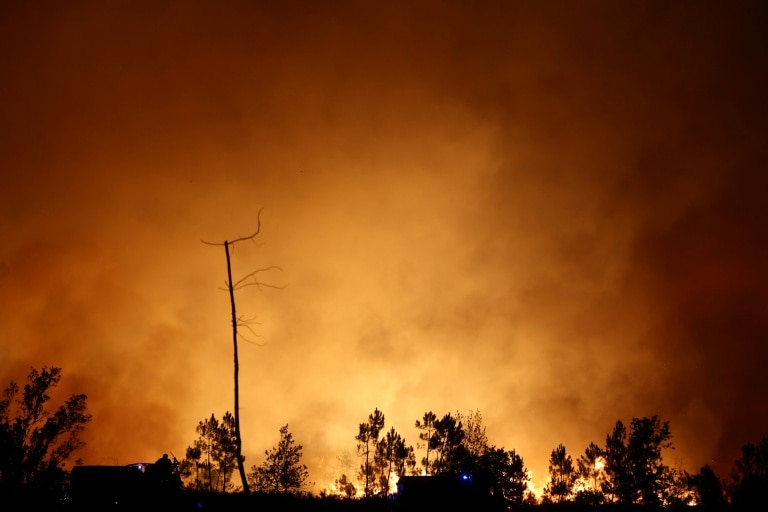
A wave of intense, fast-spreading wildfires is tearing through Mediterranean regions of Southern Europe this week, leaving one first responder dead, forcing mass evacuations across France, Italy, and Spain, and destroying thousands of hectares of forested land as record-high temperatures and dry conditions amplify fire risk.
In Italy, the island of Sicily has been burning for several consecutive days, with temperatures soaring past 40°C and gusty hot winds pushing flames deeper into populated and wooded areas. On Wednesday, regional president Renato Schifani confirmed that roughly 6,000 first responders, forestry workers, and civil protection personnel had been deployed to contain the blazes, supported by water-bombing aircraft. Even with the massive response, 50 active fires were still burning across the island as of Wednesday. The situation has been labeled “serious” by Italian Civil Protection Agency spokespeople, who note that extremely high temperatures and parched, dry soil are creating ideal conditions for fire spread. Tragically, Interior Minister Matteo Piantedosi confirmed one firefighter died after falling ill while working to contain the blazes.
Just north of Sicily, the neighboring Calabria region has recorded more than 160 active fires, and local civil protection leaders say most are the result of deliberate arson by malicious actors. In a shocking detail, officials report some arsonists have tied flammable liquid-soaked rags to the tails of stray cats, turning the animals into unwitting fire starters to spread blazes across large areas.
Across the Mediterranean in France, two major blazes near the popular Arcachon Basin, just outside Bordeaux, have forced thousands of residents and visitors to evacuate. One fire alone has already scorched more than 1,000 hectares (nearly 2,500 acres) of dense pine forest. Captain Wilfried Schneider, a French firefighter, described the blaze as having “rare” intensity, fueled by the tightly packed, extremely dry pine stands that cover much of the region. Bernard Roche, a 75-year-old resident who has lived in the affected Le Porge area for 35 years, told reporters he fled his cabin despite decades of living in the region, saying the heat and intensity of the fire was too dangerous to stay. Le Porge mayor Martial Zaninetti said early investigations suggest the fire may have been sparked by heavy machinery used to clear forest tracks, though no official confirmation has been released.
Further east along France’s Mediterranean coast, a separate blaze that broke out Tuesday in the Var region between Marseille and Nice spread at an unexpectedly rapid rate, burning 2,550 hectares — an area twice the size of London’s Heathrow Airport — and forcing 400 people to evacuate. Nearly 1,000 firefighters and water-carrying aircraft managed to partially contain the blaze by Wednesday morning.
In central Spain, a new wildfire burning outside the historic city of Toledo, roughly 75 kilometers south of Madrid, prompted authorities to order the evacuation of three villages on Wednesday, while residents of a fourth were told to shelter in place with doors and windows sealed. The Civil Guard issued emergency mobile alerts to at-risk residents and closed several major arterial roads cut off by the advancing blaze. This new fire comes as hundreds of firefighters continue to battle a far larger blaze 100 kilometers north of Madrid that has already destroyed 32,000 hectares of land. Data from the European Forest Fire Information System shows that Spain has already seen more than 393,000 hectares of land consumed by wildfires in 2025, making it the worst wildfire season for the country in recorded modern history.
Climate scientists have long confirmed that human-caused fossil fuel emissions are driving rising global temperatures, which in turn make extreme weather events including heatwaves and wildfires far more frequent and more severe than historical norms.