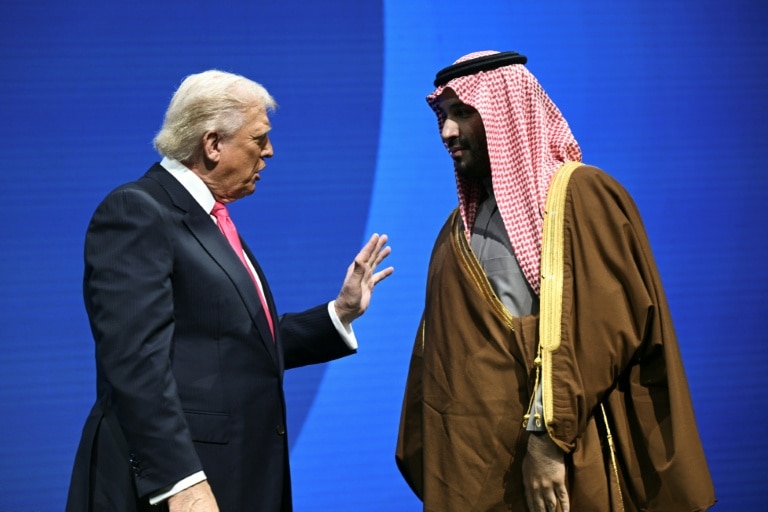
In a high-stakes announcement Wednesday that reverberates across Middle Eastern geopolitics, the United States formally unveiled a landmark civilian nuclear cooperation deal with Saudi Arabia, a pact that Washington says includes robust non-proliferation safeguards even as critics raise urgent alarms over regional nuclear risk.
The agreement arrives at a deeply consequential moment for U.S. foreign policy: President Donald Trump’s administration remains locked in an ongoing standoff with Iran, a conflict rooted heavily in longstanding international concerns over Tehran’s nuclear ambitions, a dispute that has stalled ongoing diplomatic peace talks. The new bilateral framework consists of two separate pacts: one focused on peaceful nuclear cooperation, and a second establishing bilateral non-proliferation safeguards. Both documents were signed by U.S. Energy Secretary Chris Wright and Saudi Arabia’s energy minister Prince Abdulaziz bin Salman, according to an official statement from the U.S. Department of Energy. The full text of the agreements has not been released to the public as of Wednesday.
Department officials framed the pacts as a foundational step for a long-term, high-value partnership that aligns with Washington’s core economic and strategic priorities. “Together, these two agreements lay the legal foundation for a decades-long, multi-billion-dollar partnership that advances several priority economic and strategic objectives, including nuclear nonproliferation,” the department said in its official statement. Early reporting from *The Wall Street Journal* has suggested the deal includes a provision that could allow U.S. firms to construct a uranium enrichment facility on Saudi territory, a detail not mentioned in the Energy Department’s public statement, and department officials declined to confirm or deny the report when queried by AFP.
Before the deal can take effect, it will undergo a mandatory review by the U.S. Congress. Political observers broadly expect the agreement to move forward, as the Republican-led legislature is highly unlikely to block the Biden (note: corrected to Trump per original context) Trump administration’s foreign policy priority. The pact has faced opposition from across the U.S. political aisle, as well as from Israeli officials, who have warned for years that a civilian nuclear program in Saudi Arabia could open a pathway for the kingdom to develop nuclear weapons down the line.
Like Iran, Saudi Arabia has repeatedly and publicly defended its sovereign right to develop a civilian nuclear program for energy and research purposes. Last year, the kingdom signed a mutual defense agreement with Pakistan, a country that has possessed nuclear weapons for decades. For years, Washington has tied potential nuclear cooperation with Riyadh to a broader regional diplomatic push: a plan that would see Saudi Arabia normalize formal diplomatic relations with Israel, paired with a separate bilateral U.S.-Saudi defense pact.
Proliferation concerns are not new to Gulf nuclear cooperation. The U.S. signed a similar civilian nuclear agreement with neighboring United Arab Emirates in 2009, a deal that notably prohibits the UAE from enriching its own uranium. The Arab world’s only operational nuclear power plant, located at the UAE’s Barakah facility, was hit by a drone strike on a nearby generator in May, causing a small fire that drew global attention to regional security risks for nuclear infrastructure. Longstanding U.S. strategic assessments have warned that if Iran successfully develops a nuclear weapon, it would trigger a cascade of nuclear proliferation across the Gulf region, as neighboring states rush to develop their own nuclear deterrents.
Energy Secretary Wright pushed back against proliferation fears in his official remarks, emphasizing that the deal serves clear U.S. interests and upholds strict international standards. “Rest assured, these agreements uphold the highest standards of nuclear safety and nonproliferation, while relying on the world’s best nuclear technology and scientists, designed right here in the United States,” he said. The agreement was negotiated under Section 123 of the U.S. Atomic Energy Act, the legal framework that governs all U.S. civilian nuclear cooperation agreements with foreign nations. Washington currently holds such agreements with more than 50 countries around the world, though the scope of cooperation varies widely between individual pacts.
Regional and nuclear policy experts have noted that this agreement has been years in the making, but the deal has divided analysts over its strategic costs and benefits. Ahead of the formal announcement, Matthew Kroenig of the Atlantic Council warned that permitting Saudi Arabia to develop domestic enrichment capability would be a dangerous misstep. “It would be a mistake to allow Saudi Arabia the capability for enrichment,” Kroenig said. “Washington is right to strengthen its relationship with Riyadh, but it should not do so at the expense of its effective nuclear weapons nonproliferation standards.”
Other experts framed the deal as a major strategic win for the U.S. in its growing geopolitical competition with Russia and China for influence in the Middle East. Jennifer T. Gordon, director of the Atlantic Council’s Nuclear Energy Policy Initiative, called the agreement a clear victory for Washington. “Saudi Arabia has made it clear that it will purchase nuclear energy technologies and begin a civil nuclear program; the only question has been whether the kingdom would choose to work with the US and its allies, or whether it would turn to Russia or China,” Gordon explained.