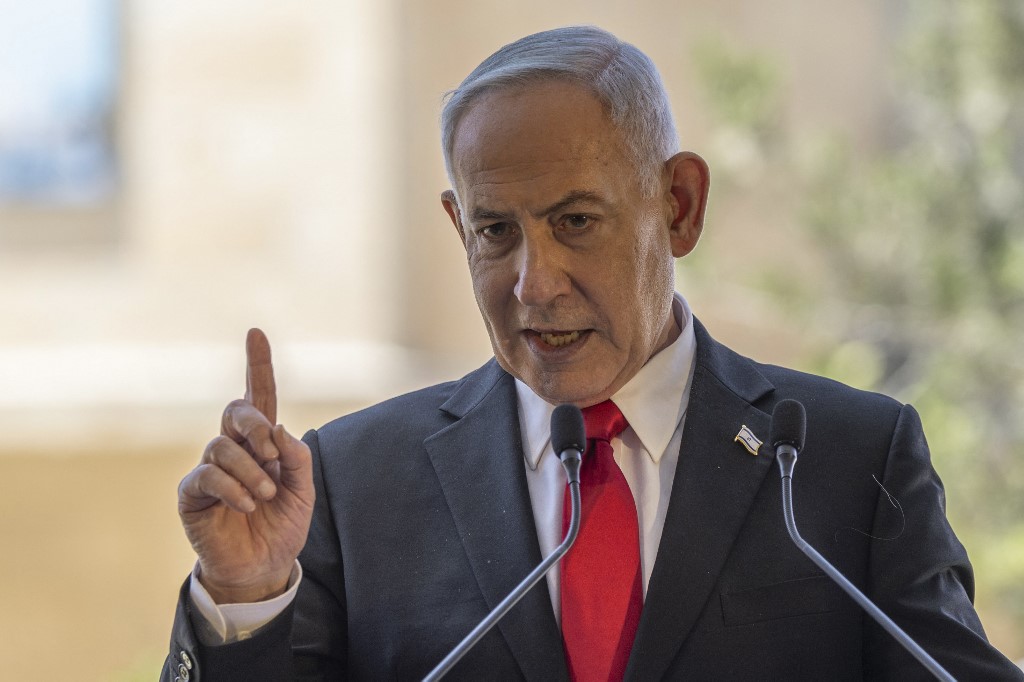
A wave of public anger and security anxiety swept across Israel on Wednesday, triggered by early reports that the U.S. administration under former President Donald Trump had approved a landmark 30-year civilian nuclear cooperation agreement with Saudi Arabia that would permit uranium enrichment on Saudi soil. The revelation immediately united political opponents across Israel’s ideological spectrum in criticism, with many targeting long-serving Prime Minister Benjamin Netanyahu over what they frame as a catastrophic failure of Israeli foreign and security policy.
Avigdor Liberman, leader of the right-wing opposition party Yisrael Beytenu, warned that the civilian nuclear framework would inevitably pave the way for Riyadh to develop nuclear weapons, sparking a devastating nuclear arms race across the entire Middle East. He called on Israeli leaders to take an uncompromising public stance against the deal and urged immediate lobbying efforts in the U.S. Congress to block its finalization.
Yair Golan, head of the left-wing opposition party The Democrats, issued a direct rebuke of Netanyahu, arguing that the prime minister had simultaneously failed to achieve the long-sought goal of diplomatic normalization with Saudi Arabia and cleared a path for the kingdom to build an unsupervised nuclear program. For decades, normalizing ties with Saudi Arabia has ranked among Israel’s top foreign policy priorities, a strategic push intended to reduce regional isolation and sideline negotiations with the Palestinians. Saudi Arabia has repeatedly rejected normalization progress, however, insisting it will not move forward without a lasting Israeli-Palestinian peace agreement. Golan added that Netanyahu has weakened Israel both militarily and politically, leaving the country sidelined as global powers make decisions that will shape Israeli security for generations.
Even Benny Gantz, leader of the centrist-right Blue and White party, joined the chorus of criticism, echoing that the emerging U.S.-Saudi deal poses a direct threat to Israeli national security. He blamed Netanyahu’s far-right governing coalition for repeatedly squandering opportunities to reshape the Middle East in Israel’s favor.
Against the backdrop of this growing nuclear security debate, Israeli President Isaac Herzog issued a rare urgent warning on Tuesday evening about threats to the integrity of the country’s upcoming 27 October national elections. Though Herzog’s role is largely ceremonial, he told the public that Israel’s internal security service Shin Bet and the Central Elections Committee had alerted him to multiple serious threats to the electoral process from both domestic and foreign actors.
Herzog also called for an end to the vitriolic infighting that has dominated the pre-election campaign, framing the vote as a critical test of both Israeli democracy and social cohesion. Speaking ahead of Tisha B’Av, the Jewish fast day that commemorates the destruction of the First and Second Ancient Temples, Herzog drew a direct parallel between modern internal division and the historical cycles of infighting that led to the collapse of earlier Jewish self-rule. “Twice in the history of our people, we merited to establish independent rule in our land. Twice we failed,” Herzog said, urging all parties and candidates to avoid crossing rhetorical red lines and treat political rivals as opponents, not enemies. “Elections are not a civil war,” he repeated twice in his address, emphasizing the historic responsibility of all Israelis to protect the integrity of the democratic process.
In a third development Wednesday, Israeli newspaper Haaretz reported that the country’s State Attorney’s Office will pursue criminal charges against a former senior National Security Ministry official over the illegal approval of thousands of gun licenses, following an exposé published by the outlet last year. The official, Dror Israel Avishar, who previously led the ministry’s Firearms Department, is suspected of fraud and breach of public trust. All charges are pending a pre-trial hearing.
Avishar stepped down from his post in December 2023, shortly after Haaretz revealed that the ministry, led by far-right National Security Minister Itamar Ben Gvir, had distributed thousands of gun licenses in violation of existing national regulations. According to the State Attorney’s Office, after the 7 October 2023 attacks, unapproved personnel issued roughly 23,000 conditional gun permits and 15,000 final licenses as part of Ben Gvir’s push to expedite the application process. The minister appointed 82 “temporary licensing officials” drawn almost exclusively from his own political circle, and these appointees routinely ignored mandatory regulations requiring proof of completed firearms safety and shooting training before approving licenses.
Attorneys for Avishar have stated that their client resigned not over misconduct, but because of a bitter public dispute with Ben Gvir over the minister’s push to massively expand gun access across Israel. Since the 7 October attacks, expanding gun ownership for Israeli citizens has been one of Ben Gvir’s signature policy priorities. Between October 2023 and September 2025, Haaretz reports the ministry issued roughly 200,000 new gun licenses. Before the 2023 attacks, roughly 170,000 Israelis held active gun licenses; per Ben Gvir’s own public comments, his so-called “gun reform” has pushed the total number of licensed gun owners in the country to more than 410,000. “My policy is clear: a weapon in the right hand saves lives,” Ben Gvir said in March during an announcement expanding gun license eligibility to Jewish neighborhoods in Jerusalem.