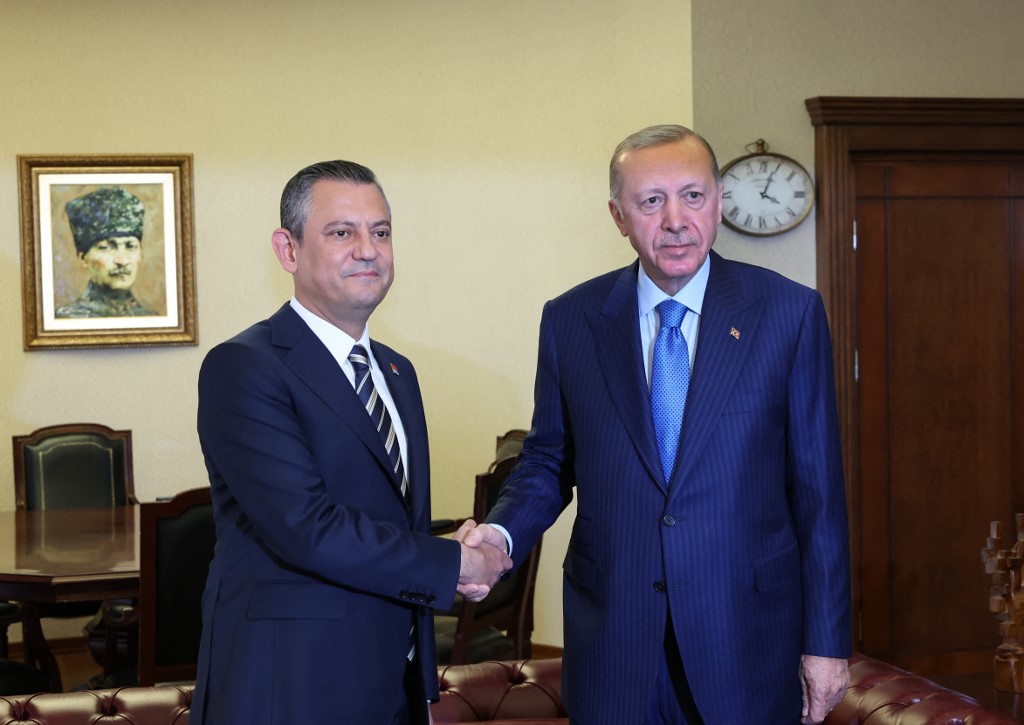
Turkey’s fractured main opposition bloc entered a new phase of upheaval this week, when former Republican People’s Party (CHP) chairman Ozgur Ozel announced plans to formally launch a new political force — named Yeni Parti, or New Party — on Monday, capping months of escalating internal and judicial conflict that has gutted the decades-old CHP.
The schism traces back to the CHP’s historic victory in the 2024 Turkish local elections, where the party swept most of the country’s major urban centers and claimed the largest share of the national vote, positioning it as the most credible threat to President Recep Tayyip Erdogan’s long-running rule ahead of the 2028 presidential and parliamentary polls. Within months, a wave of judicial investigations targeted CHP leadership and elected officials, leading to the arrest of 26 CHP mayors on corruption charges — including Ekrem Imamoglu, the widely popular mayor of Istanbul.
A separate legal case accused Ozel of securing the CHP chairmanship through bribery and improper lobbying. In May, a Turkish court annulled the party congress that elected Ozel, removed him from office, and reinstated former CHP leader Kemal Kilicdaroglu as interim pending the outcome of Ozel’s appeal. Since his return, Kilicdaroglu has rejected repeated calls from party members to hold an extraordinary congress to resolve the leadership dispute, instead purging senior party officials aligned with Ozel and Imamoglu. Many Ankara-based political analysts suspect Kilicdaroglu’s reinstatement was quietly supported by Erdogan’s ruling Justice and Development Party (AKP) as part of a deliberate strategy to split the opposition. To date, the judicial pressure and internal chaos have already pushed several sitting CHP mayors to defect to the AKP.
As the party’s power struggle intensified, Ozel opted to break away entirely, building a new movement that is expected to draw the vast majority of the CHP’s sitting lawmakers and provincial leadership. Reports indicate that 94 of the CHP’s 135 members of parliament and 74 of its 81 provincial chairs will join Ozel’s new party. A small group of Ozel-aligned officials will remain in the original CHP, however, to block Kilicdaroglu from consolidating full control over the remaining rump party.
The split has created a complex new political calculus for Erdogan, carrying both clear short-term advantages and long-term risks for his bid to retain power in 2028. In the immediate term, the divided opposition plays directly into the AKP’s strategic goals. The opposition already lost significant momentum after months of legal pressure on the CHP, and a split into rival factions leaves no unified challenger to Erdogan. If the fractured opposition fields multiple presidential candidates, political strategists widely expect that split to enable Erdogan to win outright in the first round of voting.
This advantage has been compounded by Erdogan’s ongoing 2024 peace process with the Kurdistan Workers’ Party (PKK), which has pulled the pro-Kurdish Dem Party away from the broader opposition alliance, giving the government unobstructed political space to advance its corruption cases against CHP leaders. Polling also suggests that Kilicdaroglu retains very little support among the CHP’s original voter base: only 5 to 10 percent of CHP voters say they will remain with the party under his leadership. Multiple surveys indicate Ozel’s new party could capture more than 30 percent of the national vote, surpassing the AKP’s current support share — the CHP won 37 percent of the vote in the 2024 local elections.
Still, even with this strong initial showing, the split could benefit Erdogan in parliamentary elections, where tightly contested constituencies often swing to the candidate or party with even a narrow lead. A pollster affiliated with the AKP told Middle East Eye that the new party’s initial momentum is likely to fade over time, and the AKP’s internal leadership sees Ozel as a preferable opponent to other potential challengers. Despite Ozel’s growing popularity, AKP strategists believe he would struggle to win a nationwide head-to-head contest against Erdogan. With Kilicdaroglu also expected to field his own presidential candidate, the opposition vote will be further fragmented, easing Erdogan’s path to victory.
One major wild card in the current political equation is Mansur Yavas, the popular incumbent mayor of Ankara. Multiple independent polls consistently show Yavas leading Erdogan by 15 to 20 percentage points, making him the opposition’s strongest potential presidential candidate. Yavas has thus far signaled he intends to remain in the CHP, but Ozel-aligned officials privately warn that Yavas could face his own corruption investigations if he solidifies his position as the leading opposition challenger. Erdogan’s current approval rating sits between 35 and 40 percent, but polling analysts note he could push that figure close to 50 percent through a well-executed populist campaign ahead of 2028.
Despite these short-term gains for the ruling party, the emergence of Ozel’s new party carries significant long-term risks for Erdogan and the AKP. For decades, Erdogan built successful election campaigns by framing the CHP as an elitist, bureaucratic, statist movement disconnected from ordinary Turkish voters, tying it to unpopular historical policies such as the university headscarf ban. That messaging has resonated deeply with conservative and Islamist constituencies for decades. Ozel’s new party carries none of the CHP’s historical baggage, leaving it free to build a cross-spectrum coalition.
If Ozel succeeds in building a broad center-left movement that unites voters across Turkey’s political divide, while rolling out a credible policy platform focused on restoring independent institutions and repairing Turkey’s struggling economy, the new party could emerge as a formidable long-term challenger to AKP rule. A recent joint poll conducted by the IstanPol think tank and Rawest Research, which surveyed 1,985 respondents across 20 Turkish cities between July 3 and 10, found that 55.9 percent of all respondents believe the new party can succeed. Support for the project is particularly high among opposition voters: 81 percent of CHP supporters, 72 percent of Dem Party voters, and 61 percent of nationalist IYI Party voters expressed confidence in the new party. Notably, even 67 percent of voters from the AKP’s coalition partner, the Nationalist Movement Party (MHP), and 45 percent of AKP voters said they believe the new party can achieve full or partial success.
Political analysts argue the new movement has an opportunity to avoid the organizational weaknesses that have long hampered the CHP, including an overcentralized structure that relies on tightly controlled local branches with little engagement with broader civil society. Kemal Buyukyuksel, an analyst at George Mason University, wrote for independent outlet Progresif that the new party should not model itself on traditional, centralized political organizations. Instead, he argued, it can function as a broad political space that incorporates elements of civil society and grassroots social movements. “Instead of being a machine that plans everything from the central office, the party can become a platform that opens up space for social initiatives emerging in different places, connects them, and gives them a common political direction,” Buyukyuksel explained.