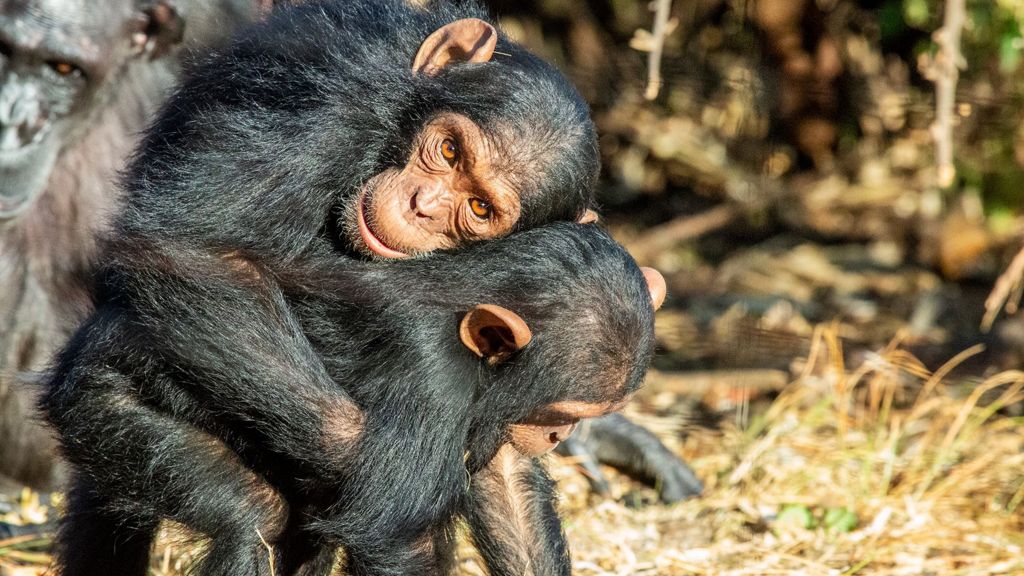
When teams of athletes huddle close before a high-stakes match, or friends squeeze each other in a hug ahead of a stressful challenge, this instinct to reach for physical connection may be far older than humanity itself. New research published in *Proceedings of the Royal Society B: Biological Sciences* reveals that the use of affectionate, reassuring touch to build social cohesion before tense competitive events is a shared behavior between chimpanzees and bonobos — humanity’s closest living ape relatives — pointing to an evolutionary origin that stretches back at least seven million years. The work, led by researchers from Durham University, offers groundbreaking new insight into the deep ancestral roots of human social cooperation.
The research team conducted their observational study at two accredited great ape sanctuaries, one located in the Democratic Republic of Congo and the other in Zambia. To replicate the naturally competitive context of wild feeding scenarios, the team designed a controlled experiment: after the apes learned that a shipment of desirable peanuts was imminent, researchers documented all social interactions in the five-minute window before the food arrived. This setup created the controlled stressful competition needed to observe how apes prepare for potential conflict.
One of the study’s most surprising findings upends long-held popular assumptions about chimpanzee behavior. While chimpanzees are widely stereotyped as an inherently aggressive great ape species, the research documented frequent instances of pre-conflict reassuring physical contact between individuals. This contact ranged from gentle touching and embracing to more intimate gestures, such as mutual finger-to-mouth contact, that function to lower tension and build mutual trust. Bonobos, already known for more tolerant social dynamics, displayed even higher rates of this reassuring touch, matching their more collaborative species norms.
“Before stressful events, they come together, they reassure each other, they touch each other, they hug each other,” explained Professor Zanna Clay, one of the lead researchers on the project. Clay draws a parallel between this ape behavior and the pre-game huddles common in human team sports, framing the pre-competition contact as a collective “rallying cry.” “It’s like a ‘we’ rather than a ‘me,’” she added. The research also documented a unique collective behavior the team dubbed “reassurance trains,” where multiple apes take turns embracing one another in sequence to unify the whole group ahead of competition.
The team found that apes that engaged in this pre-stress touching and embracing saw tangible social benefits: these individuals were far more likely to access the contested food resource and eat alongside other group members without aggressive conflict. More socially tolerant groups of apes consistently showed higher levels of this reassuring pre-competition contact, confirming the link between the behavior and peaceful cooperation.
Dr. Jake Brooker, another co-author of the study, emphasized that comparing behavior in the two closely related great ape species opens a rare window into the evolutionary origins of human sociality. “Comparing bonobos and chimpanzees – our two closest relatives – offers fascinating insight into the evolutionary roots of social behaviour and how they, and we, manage tension, competition and cooperation,” Brooker said. The research team concludes that social touch, as a tool for building trust and cooperation, is one of the oldest forms of social communication, far predating the emergence of complex human language.
Based on the shared behavior of both chimpanzees and bonobos, researchers estimate that this social touch strategy dates back at least seven million years, to before the evolutionary split that separated the common ancestor of humans, chimpanzees, and bonobos into distinct lineages. That means when humans hug a nervous teammate, share a comforting handshake, or huddle close before a big challenge, we are drawing on an ancient social toolkit inherited from our shared ape ancestry — a biological instinct that has helped social primates navigate competition and build cooperation for millions of years.